Showing posts with label The History Lesson. Show all posts

August 31, 2018

Misia - Another Red-headed Muse - Part Three


Photo of Misia by Vuillard, 1897Misia by Renoir 1904

In 1907 Misia’s marriage to Alfred Edwards was in tatters. Misia was extremely jealous of her husband's mistress Genevieve Lantelme, and said in her memoirs "I had contrived to get a photograph of Lantelme; it adorned my dressing-table, and I made desperate efforts to look like her, dress my hair in the same way, wear the same clothes."

Genevieve Lantelme
Genevieve Lantelme and Edwards married but in 1911 Lantelme drowned after falling off Edwards’ yactht.

Around 1909 Misia began an affair with the lusty Spanish Painter José Maria Sert; she married him in 1920. Sert’s murals achieved international recognition. His work adorns the assembly hall of the League of Nations, the Waldorf-Astoria in New York and his mural at the Rockefeller Center replaced the one painted by Diego Rivera which was dismantled after Rockefeller objected to its subject matter.


José Maria Sert
Sert had been working at the Ballets Russes painting sets and creating the dancer's costumes. He was a colourful, fiery man with enough money to keep Misia in the style to which she had been accustomed. They decorated their apartment on the Rue de Rivoli in an unorthodox but staggeringly grand way. Massive pieces of rock crystal were placed in front of the fire to refract light. Tables were made of tortoiseshell or the semi-precious malachite.
Mural by Sert, Rockefeller Center
In the meantime thanks to Serge Diaghilev and his Ballets Russes, Misia’s drawing-room on the Rue de Rivoli became home away from home for the Russians. She opened her door to him while he broadened her horizons. When Igor Stravinsky first played the score of Le Sacre du Printemps to Diaghilev, the event inevitably took place in Misia’s apartment.
Serge Diaghilev
Misia loved José Sert, saying she was the only man who truly “satisfied” her. But Misia had a way of attracting younger, prettier women into her circle who threatened to steal her man. This time Roussy Mdivani was the thief.

Roussy managed to crawl into the Sert’s bedroom the last time José made love to Misia. Misia didn't hold a grudge, "The poor girl was not responsible for the feeling she had for you." she wrote Sert. "I found it very natural that she should adore you."

Misia was weirdly fond and protective of Roussy Mdivani, inviting her everywhere and tending to her health. All three were taking drugs; Sert had always used cocaine, Misia was finding release in morphine, Roussy was willing to try anything. The triangle lasted for as long as Misia’s pride allowed. They divorced in 1927.

In Misia’s circle between the wars, fashion steadily got the edge on art. In 1916 Misia met Coco Chanel who was to become her closest female friend. Apparently Misia, although morphine-addicted, created bonsai-like table-top trees out of rock-crystal and semi-precious stones. It’s uncertain if she made the trees herself but she certainly designed them. She designed dresses for a New York City fashion house around the same time.

When Sert finally cut ties with Misia, she consoled herself with the company of Coco Chanel, who was to now assume the dominant role in Misia’s life. Jean Cocteau dramatized their friendship in Les Monstres Sacrés but apparently he really never understood their relationship.

After Roussy’s early death, José Sert moved back in with Misia. During World War II Misia did her best to save artist Max Jacob’s life, She tried to pull every string to save him from the Nazis.
At her post-war soirées she invited collaborators and résistants on different days, but if they happened to bump into each other by chance she left them to sort it out. Her close friend Coco was arrested for a short time, suspected of being a Nazi collaborator.

Misia lived until 1950. She survives only in the works of others.

photo of Lantelme found at http://elgrillo.web-log.nl/el_grillo/paris/index.html
top photo of Misia by Vuillard found at the great website http://www.aloj.us.es/galba/monograficos/LOFOTOGRAFICO/POSTIMPRESIONISTAS/Fotos_Vuillard1.htm

Misia - Another Red-headed Muse - Part One

Portrait of Misia - Henri-Toulouse Lautrec

I had never heard of Misia until G-Pup bought me the book Misia, The Life of Misia Sert, by Arthur Gold and Robert Fizdale, second hand.

It turns out that Misia is one of the most inspirational muses and patrons of the Parisian avant-garde. Artists, musicians, writers and dancers at the turn of the (last) century were beguiled by her. A beauty in her time, Misia was painted by Toulouse-Lautrec, by Bonnard and Vuillard, and according to her memoirs, 7 or 8 times by Renoir.

She’s another in my series of red-headed muses and this gingersnap of a woman seemed to have her finger in all pies.

Misia Godebska, was born in 1872 in Russia. Her mother died in childbirth. Her father, the sculptor Cyprien Godebska, was engaged in the reconstruction of the Tsar’s palace. Remarried, he sent her off to live with family. She had a few idyllic years living with her grandmother in Belgium where she was found be a gifted pianist, only to be reunited with her distant father and step-mother in Paris. There Misia grew up in amongst the upper crust of French society, but she was shunted off to a succession of boarding schools and family members.

Henri Toulouse-Lautrec

She married early, at the age of 16, to Thadée Natanson, a Polish ex-pat politician and journalist. Later he became the editor of the Paris arts magazine la Revue Blanche, focusing on the circle of the Paris avant-garde.

La Revue Blanche was published from 1891 to 1902. One had to know Misia before being published in the magazine and in turn, Misia only wanted to know those who were gifted. She knew almost everyone who mattered in Paris’s artistic circles. Her taste was original and discerning. Probably a true bohemian, she was unwilling to desert her money and her class.

The painters (Vuillard, Bonnard, Lautrec and Renoir) painted her and the composers debuted their masterpieces at her piano. Ravel and Debussy were frequent guests. Vuillard adored her. Stéphane Mallarmé wrote poetry for her.

Photo by Édouard Vuillard

Although I don’t find her particularly striking, the painters thought her looks miraculous, with a legendary pair of legs and a dreamy bosom. Colette revolved around this group too, sporting a waistline almost as small as Misia’s.


At a party of 300, thrown by Misia’s brother-in-law to celebrate the completion of nine large panels painted by Vuillard, Toulouse-Lautrec was the barman.

Misia ate up her husband Thadée’s money; as a patron she required plenty of material items. With the help of Thadée and his money she was able to entertain at their homes in the country as well. At one of these country parties, Misia caught the eye of the vulgar newspaper baron Alfred Edwards, editor of Le Matin.

Thadée Natanson was facing bankruptcy. Edwards bailed him out, on condition that he surrender his wife. Thadée and la Revue Blanche were saved and Misia was the price...

More to follow.

Misia - Another Red-headed Muse - Part Two

Pierre Bonnard
Pierre Bonnard
Edouard Vuillard

In 1900 Misia was a voluptous 28 years old. The Paris Exposition was on. Misia was about to lose her good friend Toulouse-Lautrec. Her husband, Thadée Natanson, began taking more of an interest in politics. He found le Revue Blanche boring and entered into new and not-so-lucrative ventures. And the newspaper magnate Alfred Edwards fanatically pursued Misia like Pépé le Pew pursued the little black and white cat.

Photo of Misia and Thadée by Edouard Vuillard

Misia was offended and a little afraid of the extremely boorish, powerful Edwards. Misia’s husband found her attitude childish and urged her to use her charm to secure financial backing from him.

His plan backfired. Alfred Edwards did in fact help ease Thadée Natanson's financial woes, but Edwards was so obsessed with Misia that having her as a mistress was not enough. He wanted her as his wife. The fact that he already had a wife didn’t seem to matter.

Alfred Edwards

Once again Thadée had bungled his affairs. He resigned himself to the situation between Edwards and his wife and cabled Misia to “arrange everything.” Misia now saw Thadée as a tarnished knight - Edwards as the dragon. Perhaps by marrying the dragon she would no longer need protection. Misia began to feel “the agitation which strongly resembles love”. She began living with Alfred Edwards in 1903 and married him a few years later.

Misia acquired new friends in the Parisian musical and artistic circles. She was a confidante of Pablo Picasso and Jean Cocteau and an early and devoted patron of Sergei Diaghilev's Ballets Russes. She was an inspiration to Proust and Apollinaire.

Maurice Ravel dedicated "Le Cygne" to her. When Ravel failed for the third time to win the Prix de Rome, Misia used her new husband’s clout to make the director of the Conservatoire resign. Gabriel Fauré, Misia’s childhood piano teacher took over the postion.

Misia played the piano for Caruso while he sang Neapolitan songs, and told him to pipe down when she’s had enough.

Misia was a close friend of designer Coco Chanel. Coco said "Misia never read a book"; however, she was always surrounded by people who were pure culture.”

Many of her friends from the old days stayed close and at least one grew even closer. Renoir didn’t pick sides. He was a deeply moral man and approved of Misia’s gift for bringing life alive.

Renoir longed to paint Misia’s famous breasts naked, but she would never bare them, probably because Edwards was lurking jealously despite the fact that Renoir was badly crippled with arthritis. Misia once rewarded Renoir for a portrait by giving him a blank cheque. He filled it out with the going rate. Apparently Renoir wrote love letters to her, but on the advice of her literary agent, deeming them as “too silly”, Misia destroyed them before her death.

Misia by Renoir

Misia lost Edwards to the gorgeous actress Genevieve Lantelme. As the break-up took a long time Misia was able to continue enjoying a large income. In the early stages of the breakup she headed for the coast to get away from it all. Marcel Proust was on hand to observe that Misia had ended up sharing a stretch of beach with her husband and his new mistress and her ex-husband Thadée.

More to come. (including a third husband)

May 30, 2016

Georges Melies - The Inspiration for Hugo

Scene from Hugo, Paramount Pictures
 I first posted this story 2 years ago. I've just returned from seeing Martin Scorsese's Hugo and I hadn't realized that the film was so closely tied with the story of the real Georges Méliès. Here's a synopsis of Méliès life. Please enjoy the accompanying films. 
Many of us have seen a clip of the ancient film where the poor Man in the Moon gets smacked in the face by a rocket. Georges Méliès, born in Paris in 1861 is responsible for that early film and as a film maker Méliès was the first to utilize cinema's potential to tell magical stories.


Méliès was an illusionist by trade. Before making films he was a stage magician at the Theatre Robert-Houdin (how wonderful).

In 1895, after seeing a demonstration of the Lumière brothers' camera, he became interested in film. Two years later he established his own studio.

From his rooftop property in Montreuil, Méliès directed 531 films ranging from 1 minute in length to 40 minutes. These early films are similar to the magic tricks that Méliès had been performing on stage featuring disappearing objects or people. Despite this, Georges Méliès revolutionized early cinema. Although many of Méliès’s early films were devoid of plot, his special effects and storyboards became fundamental aspects of filmmaking. His films were even pirated!

He wrote, directed and acted in nearly all of his films. His most widely-known film is 1902’s A Trip to the Moon (Le voyage dans la Lune) includes the celebrated scene mentioned above in which the rocket-ship hits the Man in the Moon.

However, Méliès, the poor guy, could not compete with the larger studios like Pathé (who eventually bought him out) and he spent his last years selling toys in a boutique in Paris’s Montparnasse train station.

Méliès did not grasp the value of his films, and he allowed most of his film stock to be melted down into boot heels during World War I. Many of his films were recycled into new film and as a result much of his legacy does not exist today. Luckily, a copy of Méliès's 1899 short film Cleopatra, believed to be lost, was discovered in Paris in 2005.

The importance of his work was recognized in the years prior to his death. In 1932 the Cinema Society gave Méliès a home in Château d'Orly where he died in 1938.
Please enjoy these Méliès videos found on Youtube.
(vozdh)

(thedisko)

Georges Méliès - The Inspiration for HUGO

Scene from Hugo, Paramount Pictures
 I first posted this story 2 years ago. I've just returned from seeing Martin Scorsese's Hugo and I hadn't realized that the film was so closely tied with the story of the real Georges Méliès. Here's a synopsis of Méliès life. Please enjoy the accompanying films. 
Many of us have seen a clip of the ancient film where the poor Man in the Moon gets smacked in the face by a rocket. Georges Méliès, born in Paris in 1861 is responsible for that early film and as a film maker Méliès was the first to utilize cinema's potential to tell magical stories.


Méliès was an illusionist by trade. Before making films he was a stage magician at the Theatre Robert-Houdin (how wonderful).

In 1895, after seeing a demonstration of the Lumière brothers' camera, he became interested in film. Two years later he established his own studio.

From his rooftop property in Montreuil, Méliès directed 531 films ranging from 1 minute in length to 40 minutes. These early films are similar to the magic tricks that Méliès had been performing on stage featuring disappearing objects or people. Despite this, Georges Méliès revolutionized early cinema. Although many of Méliès’s early films were devoid of plot, his special effects and storyboards became fundamental aspects of filmmaking. His films were even pirated!

He wrote, directed and acted in nearly all of his films. His most widely-known film is 1902’s A Trip to the Moon (Le voyage dans la Lune) includes the celebrated scene mentioned above in which the rocket-ship hits the Man in the Moon.

However, Méliès, the poor guy, could not compete with the larger studios like Pathé (who eventually bought him out) and he spent his last years selling toys in a boutique in Paris’s Montparnasse train station.

Méliès did not grasp the value of his films, and he allowed most of his film stock to be melted down into boot heels during World War I. Many of his films were recycled into new film and as a result much of his legacy does not exist today. Luckily, a copy of Méliès's 1899 short film Cleopatra, believed to be lost, was discovered in Paris in 2005.

The importance of his work was recognized in the years prior to his death. In 1932 the Cinema Society gave Méliès a home in Château d'Orly where he died in 1938.
Please enjoy these Méliès videos found on Youtube.
(vozdh)

(thedisko)

January 14, 2014

The Monuments Men

I originally posted this on Sept 3, 2009. I see that the book is about to hit the big screen with some big talent. Can't wait. It really IS time I read the book. I've had it on my bedside table for 3 years!


Now here’s a book I have to read.

Here's the true story of the Monuments Men (and women).

The Monuments Men: Allied Heroes, Nazi Thieves, and the Greatest Treasure Hunt in History by Robert M Edsel.

The “Monuments Men” were a group of approximately 345 men and women from thirteen Allied nations who comprised the Monuments, Fine Arts, and Archives section during World War II. Founded in 1943 this group of Allies was established to assist in the protection and restitution of cultural property in war areas during and following World War II. As the war came to a close, they worked to locate and return works of art and other items of cultural importance which had been stolen by the Nazis.

Countless monuments, churches, and works of art were saved or protected by the dedicated personnel of the MFAA section. Frequently entering liberated towns ahead of ground troops, Monuments Men worked quickly to assess damage and make temporary repairs to paintings, frescoes, sculpture and statuary, before moving on through conquered Nazi territory with the Allied Armies.

In the last year of the war, they tracked, located, and returned more than 5 million artistic and cultural items stolen by Hitler and the Nazis.

Many of the groups personnel were museum directors, curators, art historians, and educators and went on to have prolific careers in institutions such as the National Gallery of Art and the Metropolitan Museum of Art, as well as in museums and other institutions in Europe.

Beginning in late March 1945, Allied forces began discovering hidden repositories in what would become the “greatest treasure hunt in history.” In Germany alone, U.S forces found approximately 1,500 repositories of art and cultural objects. While many of these caches of priceless treasures had been looted by Adolf Hitler and the Nazis, others had been legitimately evacuated from German museums for safekeeping. Monuments Men oversaw the safeguarding, cataloguing and removal of all works from these repositories, regardless of their origin. The Monuments Men remained in Europe for up to six years following the conclusion of the War to oversee the complicated restitution of stolen works of art.

Here are some examples of what they found (courtesy of Wikipedia)

Berchtesgaden, Germany: The 101st Airborne Division, known as the “Screaming Eagles,” found more than 1,000 paintings and sculptures stolen by German Reichsmarshall Hermann Göring. The cache had been evacuated from his country estate, Carinhall, and moved to Berchtesgaden in April 1945 to protect it from the invading Russians.

Bernterode, Germany: Americans found four coffins containing the remains of Germany’s greatest leaders, including those of Frederick the Great (Frederick II of Prussia) and Field Marshal Paul Von Hindenburg. Also found in the mine were 271 paintings, including court portraits from the Palace of Sanssouci in Potsdam, which had been hidden behind a locked door and a brick wall nearly five feet thick. The site was originally used as an ammunition and military supply complex manned by hundreds of slave laborers.

Merkers, Germany: The Kaiserode mine at Merkers was discovered by the U.S. 3rd Army under General George S. Patton in April 1945. Reichsbank gold, along with 400 paintings from the Berlin museums and numerous other crates of treasures were also discovered. More dismal discoveries included gold and personal belongings from Nazi concentration camp victims.

Neuschwanstein Castle: Over 6,000 items including ERR (Einsatzstab Reichsleiter Rosenberg, Alfred Rosenberg’s task force organized for the “legalized” looting of Jews) documents, furniture, jewelry, paintings and other belongings stolen by the ERR from private collectors in France were found here. Monuments Man Capt. James Rorimer oversaw the repository’s evacuation.

Altaussee, Austria: This extensive complex of salt mines served as a huge repository for art stolen by the Nazis, but it also contained holdings from Austrian collections. More than 6,500 paintings alone were discovered at Alt Aussee. The contents included: Belgian-owned treasures such as Michelangelo’s Madonna of Bruges stolen from the Church of Our Lady in Bruges, and Jan van Eyck’s Ghent Altarpiece stolen from Saint Bavo Cathedral in Ghent; Vermeer’s The Astronomer and The Artist’s Studio which were to be focal points of Hitler’s Führer Museum in Linz, Austria; and paintings from the Capodimonte Museum in Naples that had been stolen by the Hermann Göring Tank Division (Fallschirm-Panzer Division 1 Hermann Göring) at Monte Cassino.

San Leonardo, Italy: In the jail cell of this very northern town, Allied officials discovered paintings from the Uffizi that had been hurriedly unloaded by retreating German troops. Among the masterpieces were paintings by Sandro Botticelli, Filippo Lippi and Giovanni Bellini.

There’s a John Frankenheimer movie starring Burt Lancaster movie called The Train in which a German colonel loads a train with French art treasures to send to Germany. The Resistance (mainly Lancaster) must stop it without damaging the cargo. It’s pretty thrilling and different from the usual war movies made in the 60s.

Speaking of 60s war movies, the clip above promoting Robert M. Edsel’s book The Monuments Men: Allied Heroes, Nazi Thieves, and the Greatest Treasure Hunt in History, features the rousing theme music from the film Where Eagles Dare. A real eye-opener, I must say, first thing in the morning.

Here's more information about the Monuments Men
http://www.monumentsmenfoundation.org/about/

Where I sit and write right now, a few blocks north of Lake Ontario, I am enduring Toronto’s annual air show. It sounds as if we are under attack. Mon Dieu!

January 7, 2014

NO NO NO This is not Van Gogh.


"I myself still find photographs frightful and don’t like to have any, especially not of people whom I know and love." 
Vincent Van Gogh, to his sister Willemien, September 19, 1889.*

 Hold everything. There's something WRONG on the internet! Since I first posted this deflating article 4 years ago, this erroneous photo has shown up everywhere on the web as being a genuine photograph of Vincent Van Gogh, even Wikipedia. What is the world coming to?! In a nutshell, the photographer and the studio indicated on the bottom of this carte-de-visite is located  in SAINT-HYACINTHE, QUEBEC, CANADA. A quick Google tells me there is only one SAINT-HYACINTHE in the world, and it's not in Belgium. The 1901 Canadian Census also indicates that Victor Morin lived in Saint-Hyacinthe and worked as a photographer.


Researchers shouldn't bend the facts to fit their stories. Please pass this on. 
Here's the rest of my post from July 2009. 

While I was trying to find a photo of Van Gogh to accompany another post I happened upon this photo, supposedly of Vincent Van Gogh. It came to light about 5 years ago and was on display at the Seton Gallery at the University of New Haven in an exhibition titled Discovering Vincent van Gogh: A Forensic Study in Identification.

The man in the photograph does bear a striking resemblance to Van Gogh. The information found on the 4 1/2" X 5 1/2", photograph circa 1886, identifies the photographer as Victor Morin, 42 RUE ST. FRANCOIS, ST HYACINTHE.

The photograph was discovered in the early 1990s by a customer flipping through an album of photographs, mostly of clergymen, dating back to the late 19th century at an antique dealer's in Massachusetts. The man who found the picture saw the resemblance to Vincent Van Gogh and took the photograph to a photo historian who had previously worked on identifying images of Abraham Lincoln and Ulysses Grant. The expert was convinced it was Vincent, contesting the veracity of earlier known photos of Vincent, believing them to be his brother instead.

Tests were performed on the photograph by a forensic institute also in New Haven. Investigators matched the size of the forehead, the shape of the eyes and even individual hairs.They too believed this to be Van Gogh stating, "Even the most minute detail matched up, even the smallest hairs on the beards matched up,"

The Van Gogh Museum in Amsterdam has contested that the picture is the artist. And rightly so.  I’d really like this to be a photo of Vincent Van Gogh – my stomach flipped when I saw it. I love Van Gogh, his letters and his myth. But alas, it’s just wishful thinking. Despite Van Gogh’s hard life, the subject of the photo looks older than the 33 years Vincent would be in the photo. But the quickest Google verifies the photographer Morin as being located in St. Hyacinthe, Quebec, Canada. There is no other St. Hyacinthe. Not Belgium like the expert says. You just can't bend the facts. (Ancestry.com backs this up as in 1901 Victor Morin is listed as a photographer on the 1901 Canadian Census)

Considering Vincent van Gogh was hungry enough to eat paint and borrowed money constantly from his brother, I don’t think Vincent came to La Belle Province and had his photo taken.

Thanks to an article at Guardian.co.uk, The Guardian, Tuesday 24 February 2004, David Teather
*http://vangoghletters.org/vg/letters/let804/letter.html

September 29, 2012

Reading Between the Lines


A few years back I bought this cookbook at an open-air antique show about 45 minutes west of Toronto. “A Years Dinners: 365 Seasonable Dinners with Instructions for Cooking", by May Little, was published by Harrods. There’s no publication date but I’m guessing this book might have been published around 1925-1930. It comes with the quaint sub-title. “With Instructions for Cooking. A Handy Guide-book for Worried Housekeepers.”

It’s a fabulous old book with planned menus for every day of the year and gives instructions on how to prepare meals for invalids, how to get the most from one’s trips to the market. It also has a digestion table, something I’ve never seen before, so you know that the boiled mutton suet you just ate will remain in your stomach for 4.5 hours. There is a lot of suet in this book, but that’s they way things were back then.

The first half of this book is comprised of daily menus, most of them consisting of 6 or 7 courses. I like to think of a below-stairs cook like Mrs. Bridges buying this book to help with the daily menu. The remainder of the book, besides the guides mentioned above, are the recipes. The most thumbed and splotched part of this book is the dessert chapter. Sweet Dishes contains 180 different desserts, the majority of them “puddings”.

But this book had another tale to tell me. A cook or a wife had used the corner of a Sainsbury’s bill for a bookmark. On it was a printed date: 1930-something. The bill was from Sainsbury’s 56-58 Kings Road, Chelsea, SW3, and written out to M. Cap Michell Innes, 5 Cad Street.

I’m very curious by nature so I had to look this up. First I found out in my London A-Z that there isn’t a Cad Street in London; it's Cadogan Street. And after some sleuthing with Ancestry.com and the internet, I was able to find out who Cap. Michell Innes was.

Captain Cecil Mitchell-Innes was the Chief Constable of the Lincolnshire Constabulary. He retired in 1931 and somehow ended up with a fairly swanky address in London's Chelsea. He received the title Commander of the Order of the British Empire (CBE) in 1920. His name shows up in Ancestry.com entry in a book called The Royal Blood of Britain. In fact the name Mitchell-Innes is quite a storied one.

Ancestry.com puts Cecil Mitchell-Innes at 5 Cadogan Street, beginning in 1933 and to his death in the 1940s. The Lincolnshire Police website rounded out the rest of the information for me.
“Cecil Mitchell-Innes was born Born on the 6th July, 1866, at Edinburgh, he was educated at Cheam School, Surrey, and Fettes College, Edinburgh. His military career began In 1885 when he was gazetted to the Leinster Regiment and sailed for India where he served for 11 years. He was appointed Captain in 1893,when he became adjutant of the Simla Volunteer Rifles. On leaving India he went to Bermuda, Canada and Jamaica, and was transferred to the Queens Own Cameron Highlanders in 1898. He left the Army in 1903, and early that year was selected to organise and superintend physical education in Scotland, and to inspect and report upon all the training colleges throughout Scotland. He studied police duties under the Chief Constables of the North Riding of Yorkshire and Hertfordshire. He commenced his duties as Chief Constable (of Lincolnshire) on the 29th October. 1903, at a time when conditions were beginning to change owing to the development of motor vehicles and telephone services. In 1904, the telephone was installed at Headquarters and in a number of divisional headquarters stations, and by 1924 there were telephones at 40 police stations in the County. In the first year of his appointment, Captain Mitchell-Innes introduced the first typewriter used in the Force, at Headquarters, but it was not until 1920 that they were provided at superintendents' stations, and a further five years before sub-divisional stations had them.”

I only wish all my books and antiques has such interesting tales to tell.

http://www.lincs.police.uk/getFile.asp?FC_ID=110&docID=177.

April 21, 2012

Undone


An intimate warmth predominates James Tissot’s The Shop Girl (1883-1885). The shaded interior makes the viewer feel like an elite insider. The black-clad girl opening the shop’s door onto a lively Paris street is the focus of the work. Inside, a hushed serenity is achieved through the muted light and the gentle shadows on the girl’s face. The world outside the shop is hustling and bustling and is depicted as such through Tissot’s slapdash brush strokes, whereas his work on the young lady is barely decipherable.

The viewer’s eye first alights to the central shop girl and the pink package she holds and is then drawn to the recurring black figure on the left. This repetitive design element bounces us back from the edge of the frame to the busyness in the window and the pile of ribbon on the counter. The open door seems less important than what has just transpired in the shop.

This nineteenth century slice of life is as accurately detailed as a photograph. However, Tissot used a palette of oil paints to subtly blend colours necessary for warm skin and ribbons. Slow-drying oil paint was a necessity for Tissot, who took two years to complete this work. Unlike a photo, the painting is large, about 1x1.5 metres. From the perspective of a gallery goer standing about a metre away,  Tissot’s  shop girl seems almost life-sized.

Tissot places the viewer into the shoes of a male who has just purchased something for a woman.  Men are gazing at the shop girls through the window, as if they too were commodities or confections. A woman from a higher place in society passes with her eyes demurely averted. There is a lot of masculine attention going on. The central girl has met the male gaze of the viewer and is intensely maintaining it. She’s about to hand the gentleman shopper his package as he joins his chauffeur and horses outside. 

The somberly-clad shop girl contrasts with the tumble of pink ribbons on the countertop revealing, perhaps, that the high-buttoned girl could just as easily become “undone” as the pink mess left on the counter. Tissot’s painting contains other elements that could allude to hidden pleasures: the cupped “V” of the rosy package pointing to the girl’s lap where there lays a barely decipherable pocket; the wooden gargoyle lasciviously pointing his tongue; and the ribbon artfully fallen into a heart shape on the floor. 

To me, The Shop Girl is reminiscent of Manet’s A Bar at the Folies Bergere (1882). In both, a black clad server with something to offer locks eyes with the viewer. Each contains a disconcerting back view of another in black: in Tissot’s, an identically-dressed assistant; in Manet’s, a skewed reflection. These strange dopplegangers may be alluding to the fact that even though these working girls give the illusion that they are of the same class as the men they are serving, in reality, they are removed from it. Here the similarity with Manet’s Impressionistic style ends as Tissot’s small, mannered brush strokes realistically portray the shop girl’s face and the shop’s interior. Although completed at the height of Impressionism, Tissot’s work does not reflect the style of the day.

Copyright Hazel Smith, 2011
Proviso -FAH 245 should probably not copy this.

April 15, 2012

Buy - Amnesty International's Chimes of Freedom - The Songs of Bob Dylan


Bob Dylan's first studio album came out 50 years ago this year. Amnesty International is also commemorating fifty years since its inception. My Dylan-mad husband bought Chimes of Freedom, the Songs of Bob Dylan - Honouring 50 years of Amnesty International . It's great. You'll feel good when you buy it. It's wonderful if you know the "Canon" and if you don't you will surely learn more Bob tunes than you knew before. Eighty artists participated. There's Miley Cyrus, Johnny Cash, Neil Finn ex Crowded House, Pete Townshend, Cage the Elephant, Marianne Faithfull, Patti Smith, and  bunch of bands I'm too out of the loop to know. There's 92-year-old Pete Seeger singing Forever Young, old flame Joan Baez, plus Sting singing in his new "deep voice".

Bob Dylan shuns the mantle of "Civil Rights Activist", ( I think he shuns just about everything) but this project is such a great melding of music and human rights activism that the connection can't be avoided.Check it out.

Dylan's career and Amnesty International aren't the only things turning 50  this year. Just sayin....

March 26, 2012

Hidden Van Gogh

Photo: Associated Press
Thursday, July 28, 1886. To Theo Van Gogh from Antwerp

"My dear Theo...
This week I painted a large thing with two nude torsos - two wrestlers, a pose set by Verlat. And I really enjoyed doing that...

Yours truly,
Vincent"

This work with the nude torsos was unknown until it was discovered under another uncharacteristic and disputed Van Gogh still life.

Here's the story from BBC News: Entertainment & Arts.

Vincent van Gogh still life is deemed genuine

A work once thought to be by Vincent van Gogh but later dismissed has now been confirmed as an authentic painting by the Dutch master.

Still Life With Meadow Flowers and Roses, originally considered a Van Gogh, has belonged to a Dutch museum since 1974.

But doubts crept in due to the painting style and the unusual canvas size and it was discredited in 2003.

However, experts have now authenticated the painting using an X-ray technique.

The painting has now been hung in the Van Gogh section of the Kroeller-Mueller museum in Otterlo for the first time.

The work is thought to have come from the period when Van Gogh lived with his brother Theo in Paris from 1886.

Van Gogh originally painted a canvas of two wrestlers and then painted Still Life With Meadows and Roses over it.

Using a new X-ray technique, researchers examined the two wrestlers in more detail.

The brush strokes and pigments pointed to Van Gogh.

Researchers also discovered the large canvas was a standard format for figure paintings at the Antwerp academy where Van Gogh studied at the time.
A senior researcher at Amsterdam's Van Gogh Museum, Louis van Tilborgh, took part in the study.

He said the wrestlers posing half-naked in the original painting was characteristic of the Antwerp academy at the time.

Van Gogh also wrote to his brother saying that he was pleased with how the wrestler painting had turned out.

But he later painted directly over it which experts say accounts for the "uncharacteristic exuberance" of the floral still life.

Photo: Associated Press

January 12, 2012

The Elephant and the Dove - Diego Rivera and Frida Kahlo at the AGO

In the autumn of 2012  the Art Gallery of Ontario will exhibit works by Mexican artist Frida Kahlo and her on again, off again husband Diego Rivera. Frida & Diego: Passion, Politics and Painting will feature works by the two artists, primarily drawn from the Museo Dolores Olmedo in Mexico city. The works to be exhibited will highlight Rivera and Kahlo’s lives, both together and apart, their politics and how their passionate views and activism influenced their work. The exhibition will be at the AGO from Oct. 20, 2012 through Jan. 20, 2013. Frida & Diego: Passion, Politics and Painting is presented in collaboration with the High Museum of Art in Atlanta, Georgia, which will display the exhibition in February 2013. 
Photo by Carl van Vechten via Wikipedia
 Frida Kahlo is a fascinating woman who should never be dismissed as the lady with the eyebrows who painted only portraits of herself. Her paintings were described by the Surrealist André Breton as “a ribbon around a bomb,” She was called a Surrealist by some, but she resisted the label and claimed she painted her reality, not her dreams. Rivera's and Kahlo's work show their support for the Communist movement, as well as the concept of Mexicanidad, an identification with Mexico’s indigenous roots.

Frida's relationship with the muralist Diego Rivera was a tempestuous one. They married in 1929. They divorced in November 1939 only to remarry in November of 1940. It seemed to be a case of "can't live with him, can't live without him". Early in their relationship they had a double studio/house built in San Angel; separate living quarters joined by a bridge. Rivera, despite his 300 pounds, was catnip for the ladies. Frida had many affairs with both men and women including Leon Trotsky, sculptor Isamu Noguchi and Jaqueline Lamba, the wife of André Breton. Many photos of Diego and Frida can be viewed on the PBS site.
riveraexperts.com


Hayden Herrera's biography of Frida Kahlo is an excellent read. Adapted from Herrera's book was the equally-excellent 2002 biographical film Frida. The movie was directed by Julie Taymor, currently avoiding brickbats for the Spiderman play. The movie is up there on my list of top 20 films and it's worth seeing.

Can't wait for October.

November 11, 2011

French Soldiers of the Great War

I bought these compelling photos at an auction about ten years ago as part of the "contents of a drawer". I return to them again and again. I've found very little information about them as the names are so hard to read. The rotund fellow from the 54th Artillerie is the focus of the photos. I've tried to get in touch with descendents who may have an interest but to no avail.

 Still beautiful after 140 days on the campaign. December 12, 1914.

Just look at these guys! The stories they could tell. This one's titled After lunch at Bayonvillers, January 1915. Lignon Senior, far left is the father of Lignon Junior, far right. Joseph Marius Lignon died April 18th 1918, and was buried at the Locre Cemetery in Belgium.He is 23 at the time of this photo. The other man with the fine ears is called Moreau. Our fellow is called T.(or F.) Duroy or Duvoy. Bayonvillers is village east of Amiens, about 20km south of where the Battle of the Somme took place.

Taken Monday night the 18th of December, 1916 by the fellow on the far left in the picture below. Members of the 54th Artillerie and PAD 28 pay a visit to Madame and Mademoiselle de Labeniere and Mademoiselle de Finfe. Lignon Senior is seated at the left. Moreau is at the bureau behind him. Our soldier is at the vitrine behind Mlle. Finfe's head.

An interesting picture of a canal barge named Old Arras. Barthelmy, on the left,  took the photo above this one.

A very gloomy shot of soldiers transporting guns. My cavalier is sitting high in the saddle on the left. There are explosions visible on the horizon.

A mysterious photo captioned Breakfast in l'acayuna. I've tried to find that word but I can't. If that rings a bell with anyone please let me know. I'm pretty sure they are in officers quarters in a trench or near the Front. Dr. Sasportas is the doctor of the group. ( Nov. 17th I just solved this mystery. dans la cayuna, is really dans la cagna, which in this case means "dugout")

Here's the reverse of this photo with my scribbling. 


This one's captioned He sprawled a Bergere.  Bergere, I think in this connotation refers to the chaise lounges the soldiers are recuperating on. I don't know if this is my soldier or not. The patients are being treated to a musical interlude.

I'd be greatly interested if anyone out there could add anything to these scenarios. I've been unwilling to share them until now because they are precious to me.


All photos are property of Hazel Smith. Please seek my permission before using.

John McCrae: In Flanders Fields


John McCrae, a Canadian soldier, doctor and a poet is best remembered for his poem, "In Flanders Fields". Born in Guelph, Ontario in 1872, he was educated at Guelph Collegiate and the University of Toronto medical school.

As a youngster John joined the Highland Cadet Corps at the age of 14, and at 17 he joined the Militia Field Battery commanded by his father. By 1896 he achieved the rank of Lieutenant. In the meantime he was training to be a doctor at the University of Toronto. During this period he wrote poetry. Sixteen of his poems were published in various magazines.

In 1898, along with his degree in medicine, John received a gold medal from the University of Toronto for his high marks. When the South African War (Boer War) started in October 1899 John felt it was important to fight. He was commissioned to lead an army from Guelph. Though suffering from chronic asthma, he served in South Africa for a year. While stationed there, seeing the poor medical treatment of sick and wounded soldiers disturbed him.

After returning to Canada and resigning from the military, John picked up his life where he had left off. He resumed his studies and went on to become assistant pathologist at Montreal General Hospital. In 1905 he set up his own practice as well as continuing work at several hospitals.

When the Great War broke out in August 1914, John was among the first to enlist. He was appointed brigade surgeon to the First Brigade Canadian Forces Artillery. Just before he left, he wrote to a friend:

"It is a terrible state of affairs, and I am going because I think every bachelor, especially if he has experience of war, ought to go. I am really rather afraid, but more afraid to stay at home with my conscience."

John sailed for England with the First Contingent on Oct. 3, 1914. After spending four months on the Salisbury Plain, the First Contingent moved to France in early February 1915 and by the 10th of March, John would first experience the fighting of the Great War at Neuve Chapell. He had taken his favorite horse, Bonfire, with him to France, but had few riding opportunities for some time.

McCrae helped the wounded from the trenches near Ypres, Belgium. This area, which is traditionally called Flanders, was the sight of some of the heaviest fighting of the Great War. In April, the Germans launched their initial chlorine gas attack against French troops who were fighting next to the Canadians. The French collapsed as the gas overcame them and it was left to the Canadians to fill the gap and stop the advancing Germans.

On May 2nd Lieutenant Alex Helmer, a friend of John's, was killed in the fighting and buried beneath a simple wooden cross. John wrote his most famous poem the next day and it was Alex's death some say inspired John to write the poem that has become symbolic for the suffering and loss of the Great War. In Flanders' Fields was first published in the British magazine Punch in Dec 1915 and became the most popular poem of the War.

Soon after the poem was written John was transferred to No.3 Canadian Field Hospital in France as Chief of Medical Services. This move away from the front would spare John from some of the dangers of war but not the horror, for here John would treat thousands of the wounded evacuated from the trenches after battles such as the Somme, Vimy Ridge, Arras and Passchendaele.

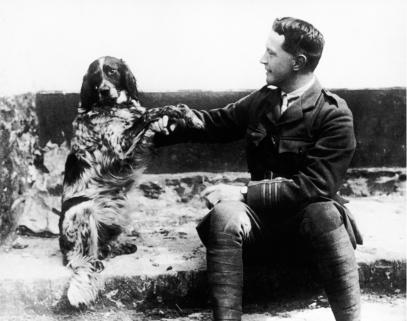
During the summer of 1917 John was troubled by attacks of asthma and bronchitis possibly aggravated by the gas he inhaled at Ypres. His health deteriorated noticeably. He lost much of his enthusiasm, and took frequent solitary rides on Bonfire, accompanied by his spaniel , Bonneau, a stray rescued from the battlefield.

Just after receiving word he was appointed consulting surgeon to the British Army, the first Canadian to be so honoured, McCrae fell seriously ill with pneumonia. On January 28, 1918, six days after being admitted to hospital, McCrae died. He was 46 years old. He was buried with full military honours in Wimereaux Cemetery, near Boulogne, France. The large funeral was attended by hundreds of mourners, from generals to nurses and medical orderlies. His horse, Bonfire, led the burial procession, its master's boots reversed in the stirrups.

McCrae's burial site is commemorated by a large plaque at the main cemetery entrance and by a memorial seat built into a wall nearby. His family home at Guelph, Ontario, has been preserved as a museum, with a memorial cenotaph and garden of remembrance. It is "In Flanders Fields" that remains his most meaningful memorial, It was translated into many languages, and led to the poppy being adopted as the Flower of Remembrance for the war dead of Britain and the Commonwealth. To this day, John McCrae's poem is read aloud at Remembrance Day ceremonies held every November 11th throughout each nation of the British Commonwealth.


I originally wrote this post in 2003 for my son who was nine at the time.

November 10, 2011

Remembrance Day

.

Remembering Toronto's Fallen from World War II

Patrick Cain painstakingly mapped the homes listed as the next of kin addresses for 3,224 Toronto residents killed in World War II and marked each with a poppy. Please check out this poignant interactive tribute to Toronto's fallen by clicking here.

One at a time, the poppies are meaningful enough, a death on every corner - en masse they create a terrible bloody blot. 

http://www.openfile.ca/remembrance_day

A repost from a year ago today.