Showing posts with label Verse. Show all posts

December 24, 2012

The Clever Pup's Guide to Making Christmas Work - Be Jolly - Sing.

The Twelve Days of Christmas

On the first day of Christmas,
my true love sent to me
A partridge in a pear tree.

On the second day of Christmas,
my true love sent to me
Two turtle doves,
And a partridge in a pear tree.

On the third day of Christmas,
my true love sent to me
Three French hens,
Two turtle doves,
And a partridge in a pear tree.

On the fourth day of Christmas,
my true love sent to me
Four calling birds,
Three French hens,
Two turtle doves,
And a partridge in a pear tree.

On the fifth day of Christmas,
my true love sent to me
Five golden rings,
Four calling birds,
Three French hens,
Two turtle doves,
And a partridge in a pear tree.

On the sixth day of Christmas,
my true love sent to me
Six geese a-laying,
Five golden rings,
Four calling birds,
Three French hens,
Two turtle doves,
And a partridge in a pear tree.

On the seventh day of Christmas,
my true love sent to me
Seven swans a-swimming,
Six geese a-laying,
Five golden rings,
Four calling birds,
Three French hens,
Two turtle doves,
And a partridge in a pear tree.

On the eighth day of Christmas,
my true love sent to me
Eight maids a-milking,
Seven swans a-swimming,
Six geese a-laying,
Five golden rings,
Four calling birds,
Three French hens,
Two turtle doves,
And a partridge in a pear tree.

On the ninth day of Christmas,
my true love sent to me
Nine ladies dancing,
Eight maids a-milking,
Seven swans a-swimming,
Six geese a-laying,
Five golden rings,
Four calling birds,
Three French hens,
Two turtle doves,
And a partridge in a pear tree.

On the tenth day of Christmas,
my true love sent to me
Ten lords a-leaping,
Nine ladies dancing,
Eight maids a-milking,
Seven swans a-swimming,
Six geese a-laying,
Five golden rings,
Four calling birds,
Three French hens,
Two turtle doves,
And a partridge in a pear tree.

On the eleventh day of Christmas,
my true love sent to me
Eleven pipers piping,
Ten lords a-leaping,
Nine ladies dancing,
Eight maids a-milking,
Seven swans a-swimming,
Six geese a-laying,
Five golden rings,
Four calling birds,
Three French hens,
Two turtle doves,
And a partridge in a pear tree.

On the twelfth day of Christmas,
my true love sent to me
Twelve drummers drumming,
Eleven pipers piping,
Ten lords a-leaping,
Nine ladies dancing,
Eight maids a-milking,
Seven swans a-swimming,
Six geese a-laying,
Five golden rings,
Four calling birds,
Three French hens,
Two turtle doves,
And a partridge in a pear tree! 

December 22, 2012

The Clever Pup's Guide to Making Christmas Work - Be Jolly - Sing


Good King Wenceslas

Good King Wenceslas looked out on the Feast of Stephen,
When the snow lay round about, deep and crisp and even.
Brightly shone the moon that night, though the frost was cruel,
When a poor man came in sight, gathering winter fuel.

“Hither, page, and stand by me, if you know it, telling,
Yonder peasant, who is he? Where and what his dwelling?”
“Sire, he lives a good league hence, underneath the mountain,
Right against the forest fence, by Saint Agnes’ fountain.”

“Bring me food and bring me wine, bring me pine logs hither,
You and I will see him dine, when we bear them thither.”
Page and monarch, forth they went, forth they went together,
Through the cold wind’s wild lament and the bitter weather.

“Sire, the night is darker now, and the wind blows stronger,
Fails my heart, I know not how; I can go no longer.”
“Mark my footsteps, my good page, tread now in them boldly,
You shall find the winter’s rage freeze your blood less coldly.”

In his master’s steps he trod, where the snow lay dinted;
Heat was in the very sod which the saint had printed.
Therefore, Christian men, be sure, wealth or rank possessing,
You who now will bless the poor shall yourselves find blessing.

December 16, 2012

The Clever Pup's Guide to Making Christmas Work - Be Jolly - Sing


God Rest Ye Merry Gentlemen

God rest ye merry gentlemen
Let nothing you dismay
Remember, Christ, our Saviour
Was born on Christmas day
To save us all from Satan's power
When we were gone astray
O tidings of comfort and joy,
Comfort and joy
O tidings of comfort and joy

From God our Heavenly Father
A blessed Angel came;
And unto certain Shepherds
Brought tidings of the same:
How that in Bethlehem was born
The Son of God by Name.
O tidings of comfort and joy,
Comfort and joy
O tidings of comfort and joy

And when they came to Bethlehem
Where our dear Saviour lay,
They found Him in a manger,
Where oxen feed on hay;
His Mother Mary kneeling down,
Unto the Lord did pray.
O tidings of comfort and joy,
Comfort and joy
O tidings of comfort and joy

Now to the Lord sing praises,
All you within this place,
And with true love and brotherhood
Each other now embrace;
This holy tide of Christmas
All other doth deface.
O tidings of comfort and joy,
Comfort and joy
O tidings of comfort and joy

December 1, 2012

The Clever Pup's Guide to Making Christmas Work - Listen - Loreena McKennitt


No, this isn't Helen Mirren in a red wig. It's the fabulous Canadian singer and harpist, Loreena McKennitt. We have a long tradition of listening to her in our house at Christmastime and it's a tradition I plan to continue.

A Midwinter's Dream is a seasonal collection featuring Loreena on vocals and harp. Her musical influences range from Celtic to classical to Middle Eastern. Her exotic arrangements of  “The Holly and the Ivy,” and “God Rest Ye Merry, Gentlemen,” are as much a part of Christmas in our house as a Charlie Brown Christmas.

Loreena's first foray into Christmas music was the exquisite and far-too-short A Winter Garden: Five Songs for the Season. Of the recording Loreena said " I hope some of the scent of frankincense and myrrh comes through." And it does. There is some duplication with A Midwinter's Dream above, but it's shorter and sweeter. 

More winter tunes are found on To Drive the Cold Winter Away. Ethereal, it really is the kind of music to listen to in a half-darkened room with your feet tucked under a blanket. You have to have glass of good red wine with you too. 

I tear up listening to these samples. I guess Loreena McKennitt makes Christmas work for me.

December 16, 2011

"Get Back to the Presents"


 "Get back to the Presents."

"There were the Useful Presents: engulfing mufflers of the old coach days, and mittens made for giant sloths; zebra scarfs of a substance like silky gum that could be tug-o'-warred down to the galoshes; blinding tam-o'-shanters like patchwork tea cozies and bunny-suited busbies and balaclavas for victims of head-shrinking tribes; from aunts who always wore wool next to the skin there were mustached and rasping vests that made you wonder why the aunts had any skin left at all; and once I had a little crocheted nose bag from an aunt now, alas, no longer whinnying with us. And pictureless books in which small boys, though warned with quotations not to, would skate on Farmer Giles' pond and did and drowned; and books that told me everything about the wasp, except why."

Go on - the Useless Presents."
"Bags of moist and many-colored jelly babies and a folded flag and a false nose and a tram-conductor's cap and a machine that punched tickets and rang a bell; never a catapult; once, by mistake that no one could explain, a little hatchet; and a celluloid duck that made, when you pressed it, a most unducklike sound, a mewing moo that an ambitious cat might make who wished to be a cow; and a painting book in which I could make the grass, the trees, the sea and the animals any colour I pleased, and still the dazzling sky-blue sheep are grazing in the red field under the rainbow-billed and pea-green birds. Hardboileds, toffee, fudge and allsorts, crunches, cracknels, humbugs, glaciers, marzipan, and butterwelsh for the Welsh. And troops of bright tin soldiers who, if they could not fight, could always run. And Snakes-and-Families and Happy Ladders. And Easy Hobbi-Games for Little Engineers, complete with instructions. Oh, easy for Leonardo! And a whistle to make the dogs bark to wake up the old man next door to make him beat on the wall with his stick to shake our picture off the wall. And a packet of cigarettes: you put one in your mouth and you stood at the corner of the street and you waited for hours, in vain, for an old lady to scold you for smoking a cigarette, and then with a smirk you ate it. And then it was breakfast under the balloons."

That's what Christmas is all about,  Dylan Thomas. Thanks

November 11, 2011

John McCrae: In Flanders Fields


John McCrae, a Canadian soldier, doctor and a poet is best remembered for his poem, "In Flanders Fields". Born in Guelph, Ontario in 1872, he was educated at Guelph Collegiate and the University of Toronto medical school.

As a youngster John joined the Highland Cadet Corps at the age of 14, and at 17 he joined the Militia Field Battery commanded by his father. By 1896 he achieved the rank of Lieutenant. In the meantime he was training to be a doctor at the University of Toronto. During this period he wrote poetry. Sixteen of his poems were published in various magazines.

In 1898, along with his degree in medicine, John received a gold medal from the University of Toronto for his high marks. When the South African War (Boer War) started in October 1899 John felt it was important to fight. He was commissioned to lead an army from Guelph. Though suffering from chronic asthma, he served in South Africa for a year. While stationed there, seeing the poor medical treatment of sick and wounded soldiers disturbed him.

After returning to Canada and resigning from the military, John picked up his life where he had left off. He resumed his studies and went on to become assistant pathologist at Montreal General Hospital. In 1905 he set up his own practice as well as continuing work at several hospitals.

When the Great War broke out in August 1914, John was among the first to enlist. He was appointed brigade surgeon to the First Brigade Canadian Forces Artillery. Just before he left, he wrote to a friend:

"It is a terrible state of affairs, and I am going because I think every bachelor, especially if he has experience of war, ought to go. I am really rather afraid, but more afraid to stay at home with my conscience."

John sailed for England with the First Contingent on Oct. 3, 1914. After spending four months on the Salisbury Plain, the First Contingent moved to France in early February 1915 and by the 10th of March, John would first experience the fighting of the Great War at Neuve Chapell. He had taken his favorite horse, Bonfire, with him to France, but had few riding opportunities for some time.

McCrae helped the wounded from the trenches near Ypres, Belgium. This area, which is traditionally called Flanders, was the sight of some of the heaviest fighting of the Great War. In April, the Germans launched their initial chlorine gas attack against French troops who were fighting next to the Canadians. The French collapsed as the gas overcame them and it was left to the Canadians to fill the gap and stop the advancing Germans.

On May 2nd Lieutenant Alex Helmer, a friend of John's, was killed in the fighting and buried beneath a simple wooden cross. John wrote his most famous poem the next day and it was Alex's death some say inspired John to write the poem that has become symbolic for the suffering and loss of the Great War. In Flanders' Fields was first published in the British magazine Punch in Dec 1915 and became the most popular poem of the War.

Soon after the poem was written John was transferred to No.3 Canadian Field Hospital in France as Chief of Medical Services. This move away from the front would spare John from some of the dangers of war but not the horror, for here John would treat thousands of the wounded evacuated from the trenches after battles such as the Somme, Vimy Ridge, Arras and Passchendaele.

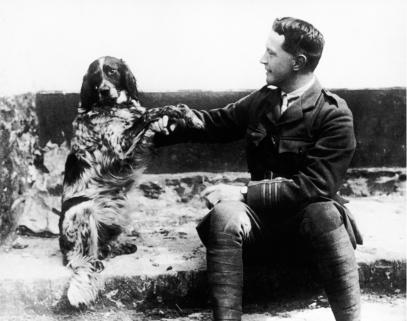
During the summer of 1917 John was troubled by attacks of asthma and bronchitis possibly aggravated by the gas he inhaled at Ypres. His health deteriorated noticeably. He lost much of his enthusiasm, and took frequent solitary rides on Bonfire, accompanied by his spaniel , Bonneau, a stray rescued from the battlefield.

Just after receiving word he was appointed consulting surgeon to the British Army, the first Canadian to be so honoured, McCrae fell seriously ill with pneumonia. On January 28, 1918, six days after being admitted to hospital, McCrae died. He was 46 years old. He was buried with full military honours in Wimereaux Cemetery, near Boulogne, France. The large funeral was attended by hundreds of mourners, from generals to nurses and medical orderlies. His horse, Bonfire, led the burial procession, its master's boots reversed in the stirrups.

McCrae's burial site is commemorated by a large plaque at the main cemetery entrance and by a memorial seat built into a wall nearby. His family home at Guelph, Ontario, has been preserved as a museum, with a memorial cenotaph and garden of remembrance. It is "In Flanders Fields" that remains his most meaningful memorial, It was translated into many languages, and led to the poppy being adopted as the Flower of Remembrance for the war dead of Britain and the Commonwealth. To this day, John McCrae's poem is read aloud at Remembrance Day ceremonies held every November 11th throughout each nation of the British Commonwealth.


I originally wrote this post in 2003 for my son who was nine at the time.

October 27, 2011

On Rue Descartes

photo: copyright Hazel Smith 2010

Photo copyright Hazel Smith 2010

Photo: copyright Hazel Smith 2010


The gist of this poem by Yves Bonnefoy is that although we pass a dirty city tree and look right through it, this is might be enough to remind us that it's still a part of nature, along with the sky, the birds and the wind. The poet asks the philosopher if he has looked at this tree on his street, if he did his thoughts will be freer.

June 19, 2010

There is a town in north Ontario...

There is a town in north Ontario,
With dream comfort memory to spare,
And in my mind
I still need a place to go,
All my changes were there.

The sentimentality doesn't suit me but I'm off to Parry Sound this weekend to move a few more boxes and to close my parent's house for good. I moved in there the day after my 3rd birthday and I'll be dropping off the keys 2 days before my 48th. I haven't lived there exclusively since I was 18, but there have been Christmases, Thanksgivings, and summers too that my son has started to enjoy.

My brother has taken a place near the beach and that should ease the adjustment.


Should be an interesting few days as the G8 is happening 45 miles away in Huntsville. There should be the occasional fighter jet and helicopter overhead. And goodness knows what the highway will be like.

The house has been sold to a couple with two boys and a Great Dane. I'm certain they'll love it and I wish them all the luck in the world.

I guess I should say Lyrics - Neil Young

May 23, 2010

Busy Old Fool, Unruly Sun - Rave on John Donne

This is what my husband said to me upon waking.

This bed thy center is, these walls, thy sphere.
We could do with a small fridge up here.


Not my bed. Image found at www.maisonapart.com

March 30, 2010

I often think that the night is more alive and more richly colored than the day - Vincent Van Gogh, March 30, 1853 - July 29, 1890

Starry, starry night.
Paint your palette blue and grey,
Look out on a summer's day,
With eyes that know the darkness in my soul.
Shadows on the hills,
Sketch the trees and the daffodils,
Catch the breeze and the winter chills,
In colors on the snowy linen land.

Now I understand what you tried to say to me,
How you suffered for your sanity,
How you tried to set them free.
They would not listen, they did not know how.
Perhaps they'll listen now.

Starry, starry night.
Flaming flowers that brightly blaze,
Swirling clouds in violet haze,
Reflect in Vincent's eyes of china blue.
Colors changing hue, morning field of amber grain,
Weathered faces lined in pain,
Are soothed beneath the artist's loving hand.

Now I understand what you tried to say to me,
How you suffered for your sanity,
How you tried to set them free.
They would not listen, they did not know how.
Perhaps they'll listen now.

For they could not love you,
But still your love was true.
And when no hope was left in sight
On that starry, starry night,
You took your life, as lovers often do.
But I could have told you, Vincent,
This world was never meant for one
As beautiful as you.

Starry, starry night.
Portraits hung in empty halls,
Frameless head on nameless walls,
With eyes that watch the world and can't forget.
Like the strangers that you've met,
The ragged men in the ragged clothes,
The silver thorn of bloody rose,
Lie crushed and broken on the virgin snow.

Now I think I know what you tried to say to me,
How you suffered for your sanity,
How you tried to set them free.
They would not listen, they're not listening still.
Perhaps they never will..

Don McLean, 1970

February 22, 2010

Edna St. Vincent Millay - (February 22, 1892 – October 19, 1950)

What lips my lips have kissed, and where, and why,
I have forgotten, and what arms have lain
Under my head till morning, but the rain
Is full of ghosts tonight, that tap and sigh
Upon the glass and listen for reply,
And my heart there stirs a quiet pain
For unremembered lads that not again
Will turn to me at midnight with a cry.
Thus in the winter stands the lonely tree,
Nor knows what birds have vanished one by one,
Yet knows its boughs more silent than before:
I cannot say what loves have come and gone,
I only know that summer sang in me
A little while, that in me sings no more.

January 9, 2010

January, month of empty pockets!


"The shortest day has passed, and whatever nastiness of weather we may look forward to in January and February,
at least we notice that the days are getting longer. Minute by minute they lengthen out. It takes some weeks before
we become aware of the change. It is imperceptible even as the growth of a child, as you watch it day by day,
until the moment comes when with a start of delighted surprise we realize that we can stay out of doors in a
twilight lasting for another quarter of a precious hour."
- Vita Sackville-West

The above is Painting #2 for 2010. It's a complete rip-off of Canadian artist William Goodridge Roberts (more about him later). I needed some practice.

Does anyone know who I'm quoting in my title (without Googling)? She's one of my favourite writers and I was recently disappointed by a movie adaptation of one of her classic stories.

January 5, 2010

Meeting at Night

Here are two more of the BBC Essential Poems (to Fall in Love With). Unfortunately I can't obtain this DVD as it's only available in Europe, so thanks (FilmographySam).

Meeting at Night by Robert Browning and Proposal by Tom Vaughan are read by Samuel West, known in our household as the unfortunate Leonard Bast.

Meeting at Night by Robert Browning

The grey sea and the long black land;
And the yellow half-moon large and low;
And the startled little waves that leap
In fiery ringlets from their sleep,
As I gain the cove with pushing prow,
And quench its speed i' the slushy sand.


Then a mile of warm sea-scented beach;
Three fields to cross till a farm appears;
A tap at the pane, the quick sharp scratch
And blue spurt of a lighted match,
And a voice less loud, through its joys and fears,
Than the two hearts beating each to each!

The Proposal by Tom Vaughan

Let's fall in love-
In our mid-thirties
It's not only
Where the hurt is.

I won't get smashed up
Should you go
Away for weekends-
We both know

No two people
Can be completely
All-sufficient.
But twice weekly

We'll dine together
Split the bill,
Admire each other's
Wit. We will

Be splendid lovers,
Slow, well-trained,
Tactful, gracefully
Unrestrained.

You'll keep your flat
And I'll keep mine-
Our bank accounts
Shall not entwine.

We'll make the whole thing
Hard and bright.
We'll call it love-
We may be right.

January 3, 2010

Sonnet 29


BBC2 ran a series called Essential Poems (To Fall in Love With).Thanks to(frklinee)on Youtube for sharing this clip of Matthew Macfadyen reading Shakespeare's Sonnet 29.

When in disgrace with Fortune and men's eyes,
I all alone beweep my outcast state,
And trouble deaf heaven with my bootless cries,
And look upon myself and curse my fate,
Wishing me like to one more rich in hope,
Featured like him, like him with friends possess'd,
Desiring this man's art, and that man's scope,
With what I most enjoy contented least.
Yet in these thoughts myself almost despising,
Haply I think on thee, and then my state,
Like to the lark at break of day arising
From sullen earth, sings hymns at heaven's gate;
For thy sweet love remembered such wealth brings
That then I scorn to change my state with kings.
–William Shakespeare

December 31, 2009

Happy New Year


MACDUFF
Was it so late, friend, ere you went to bed,
That you do lie so late?

Porter
'Faith sir, we were carousing till the
second cock: and drink, sir, is a great
provoker of three things.

MACDUFF
What three things does drink especially provoke?

Porter
Marry, sir, nose-painting, sleep, and
urine. Lechery, sir, it provokes, and unprovokes;
it provokes the desire, but it takes
away the performance: therefore, much drink
may be said to be an equivocator with lechery:
it makes him, and it mars him; it sets
him on, and it takes him off; it persuades him,
and disheartens him; makes him stand to, and
not stand to; in conclusion, equivocates him
in a sleep, and, giving him the lie, leaves him.

MACDUFF
I believe drink gave thee the lie last night.

December 20, 2009

A Child's Christmas in Wales - by Dylan Thomas


I'm repeating myself, yet again, but it's worth it. Here's Dylan Thomas', A Child's Christmas in Wales. It makes me nostalgic for something I've never experienced. Reading it is a delight but we have an old snap, crackle and pop vinyl recording that we listen to with friends every Christmas. Please check out the links if you need definitions. Enjoy!


One Christmas was so much like another, in those years around the sea-town corner now and out of all sound except the distant speaking of the voices I sometimes hear a moment before sleep, that I can never remember whether it snowed for six days and six nights when I was twelve or whether it snowed for twelve days and twelve nights when I was six.

All the Christmases roll down toward the two-tongued sea, like a cold and headlong moon bundling down the sky that was our street; and they stop at the rim of the ice-edged fish-freezing waves, and I plunge my hands in the snow and bring out whatever I can find. In goes my hand into that wool-white bell-tongued ball of holidays resting at the rim of the carol-singing sea, and out come Mrs. Prothero and the firemen.

It was on the afternoon of the Christmas Eve, and I was in Mrs. Prothero's garden, waiting for cats, with her son Jim. It was snowing. It was always snowing at Christmas. December, in my memory, is white as Lapland, though there were no reindeers. But there were cats. Patient, cold and callous, our hands wrapped in socks, we waited to snowball the cats. Sleek and long as jaguars and horrible-whiskered, spitting and snarling, they would slink and sidle over the white back-garden walls, and the lynx-eyed hunters, Jim and I, fur-capped and moccasined trappers from Hudson Bay, off Mumbles Road, would hurl our deadly snowballs at the green of their eyes. The wise cats never appeared.

We were so still, Eskimo-footed arctic marksmen in the muffling silence of the eternal snows - eternal, ever since Wednesday - that we never heard Mrs. Prothero's first cry from her igloo at the bottom of the garden. Or, if we heard it at all, it was, to us, like the far-off challenge of our enemy and prey, the neighbor's polar cat. But soon the voice grew louder.
"Fire!" cried Mrs. Prothero, and she beat the dinner-gong.

And we ran down the garden, with the snowballs in our arms, toward the house; and smoke, indeed, was pouring out of the dining-room, and the gong was bombilating, and Mrs. Prothero was announcing ruin like a town crier in Pompeii. This was better than all the cats in Wales standing on the wall in a row. We bounded into the house, laden with snowballs, and stopped at the open door of the smoke-filled room.

Something was burning all right; perhaps it was Mr. Prothero, who always slept there after midday dinner with a newspaper over his face. But he was standing in the middle of the room, saying, "A fine Christmas!" and smacking at the smoke with a slipper.

"Call the fire brigade," cried Mrs. Prothero as she beat the gong.
"There won't be there," said Mr. Prothero, "it's Christmas."
There was no fire to be seen, only clouds of smoke and Mr. Prothero standing in the middle of them, waving his slipper as though he were conducting.
"Do something," he said. And we threw all our snowballs into the smoke - I think we missed Mr. Prothero - and ran out of the house to the telephone box.
"Let's call the police as well," Jim said. "And the ambulance." "And Ernie Jenkins, he likes fires."

But we only called the fire brigade, and soon the fire engine came and three tall men in helmets brought a hose into the house and Mr. Prothero got out just in time before they turned it on. Nobody could have had a noisier Christmas Eve. And when the firemen turned off the hose and were standing in the wet, smoky room, Jim's Aunt, Miss. Prothero, came downstairs and peered in at them. Jim and I waited, very quietly, to hear what she would say to them. She said the right thing, always. She looked at the three tall firemen in their shining helmets, standing among the smoke and cinders and dissolving snowballs, and she said, "Would you like anything to read?"

Years and years ago, when I was a boy, when there were wolves in Wales, and birds the color of red-flannel petticoats whisked past the harp-shaped hills, when we sang and wallowed all night and day in caves that smelt like Sunday afternoons in damp front farmhouse parlors, and we chased, with the jawbones of deacons, the English and the bears, before the motor car, before the wheel, before the duchess-faced horse, when we rode the daft and happy hills bareback, it snowed and it snowed. But here a small boy says: "It snowed last year, too. I made a snowman and my brother knocked it down and I knocked my brother down and then we had tea."

"But that was not the same snow," I say. "Our snow was not only shaken from white wash buckets down the sky, it came shawling out of the ground and swam and drifted out of the arms and hands and bodies of the trees; snow grew overnight on the roofs of the houses like a pure and grandfather moss, minutely -ivied the walls and settled on the postman, opening the gate, like a dumb, numb thunder-storm of white, torn Christmas cards."

"Were there postmen then, too?"
"With sprinkling eyes and wind-cherried noses, on spread, frozen feet they crunched up to the doors and mittened on them manfully. But all that the children could hear was a ringing of bells."
"You mean that the postman went rat-a-tat-tat and the doors rang?"
"I mean that the bells the children could hear were inside them."
"I only hear thunder sometimes, never bells."
"There were church bells, too."
"Inside them?"
"No, no, no, in the bat-black, snow-white belfries, tugged by bishops and storks. And they rang their tidings over the bandaged town, over the frozen foam of the powder and ice-cream hills, over the crackling sea. It seemed that all the churches boomed for joy under my window; and the weathercocks crew for Christmas, on our fence."

"Get back to the postmen"
"They were just ordinary postmen, found of walking and dogs and Christmas and the snow. They knocked on the doors with blue knuckles ...."
"Ours has got a black knocker...."
"And then they stood on the white Welcome mat in the little, drifted porches and huffed and puffed, making ghosts with their breath, and jogged from foot to foot like small boys wanting to go out."
"And then the presents?"
"And then the Presents, after the Christmas box. And the cold postman, with a rose on his button-nose, tingled down the tea-tray-slithered run of the chilly glinting hill. He went in his ice-bound boots like a man on fishmonger's slabs.
"He wagged his bag like a frozen camel's hump, dizzily turned the corner on one foot, and, by God, he was gone."

"Get back to the Presents."
"There were the Useful Presents: engulfing mufflers of the old coach days, and mittens made for giant sloths; zebra scarfs of a substance like silky gum that could be tug-o'-warred down to the galoshes; blinding tam-o'-shanters like patchwork tea cozies and bunny-suited busbies and balaclavas for victims of head-shrinking tribes; from aunts who always wore wool next to the skin there were mustached and rasping vests that made you wonder why the aunts had any skin left at all; and once I had a little crocheted nose bag from an aunt now, alas, no longer whinnying with us. And pictureless books in which small boys, though warned with quotations not to, would skate on Farmer Giles' pond and did and drowned; and books that told me everything about the wasp, except why."

Go on - the Useless Presents."
"Bags of moist and many-colored jelly babies and a folded flag and a false nose and a tram-conductor's cap and a machine that punched tickets and rang a bell; never a catapult; once, by mistake that no one could explain, a little hatchet; and a celluloid duck that made, when you pressed it, a most unducklike sound, a mewing moo that an ambitious cat might make who wished to be a cow; and a painting book in which I could make the grass, the trees, the sea and the animals any colour I pleased, and still the dazzling sky-blue sheep are grazing in the red field under the rainbow-billed and pea-green birds. Hardboileds, toffee, fudge and allsorts, crunches, cracknels, humbugs, glaciers, marzipan, and butterwelsh for the Welsh. And troops of bright tin soldiers who, if they could not fight, could always run. And Snakes-and-Families and Happy Ladders. And Easy Hobbi-Games for Little Engineers, complete with instructions. Oh, easy for Leonardo! And a whistle to make the dogs bark to wake up the old man next door to make him beat on the wall with his stick to shake our picture off the wall. And a packet of cigarettes: you put one in your mouth and you stood at the corner of the street and you waited for hours, in vain, for an old lady to scold you for smoking a cigarette, and then with a smirk you ate it. And then it was breakfast under the balloons."

"Were there Uncles like in our house?"
"There are always Uncles at Christmas. The same Uncles. And on Christmas morning, with dog-disturbing whistle and sugar fags, I would scour the swatched town for the news of the little world, and find always a dead bird by the Post Office or by the white deserted swings; perhaps a robin, all but one of his fires out. Men and women wading or scooping back from chapel, with taproom noses and wind-bussed cheeks, all albinos, huddles their stiff black jarring feathers against the irreligious snow. Mistletoe hung from the gas brackets in all the front parlors; there was sherry and walnuts and bottled beer and crackers by the dessertspoons; and cats in their fur-abouts watched the fires; and the high-heaped fire spat, all ready for the chestnuts and the mulling pokers. Some few large men sat in the front parlors, without their collars, Uncles almost certainly, trying their new cigars, holding them out judiciously at arms' length, returning them to their mouths, coughing, then holding them out again as though waiting for the explosion; and some few small aunts, not wanted in the kitchen, nor anywhere else for that matter, sat on the very edge of their chairs, poised and brittle, afraid to break, like faded cups and saucers."

Not many those mornings trod the piling streets: an old man always, fawn-bowlered, yellow-gloved and, at this time of year, with spats of snow, would take his constitutional to the white bowling green and back, as he would take it wet or fire on Christmas Day or Doomsday; sometimes two hale young men, with big pipes blazing, no overcoats and wind blown scarfs, would trudge, unspeaking, down to the forlorn sea, to work up an appetite, to blow away the fumes, who knows, to walk into the waves until nothing of them was left but the two furling smoke clouds of their inextinguishable briars. Then I would be slap-dashing home, the gravy smell of the dinners of others, the bird smell, the brandy, the pudding and mince, coiling up to my nostrils, when out of a snow-clogged side lane would come a boy the spit of myself, with a pink-tipped cigarette and the violet past of a black eye, cocky as a bullfinch, leering all to himself.


I hated him on sight and sound, and would be about to put my dog whistle to my lips and blow him off the face of Christmas when suddenly he, with a violet wink, put his whistle to his lips and blew so stridently, so high, so exquisitely loud, that gobbling faces, their cheeks bulged with goose, would press against their tinsled windows, the whole length of the white echoing street. For dinner we had turkey and blazing pudding, and after dinner the Uncles sat in front of the fire, loosened all buttons, put their large moist hands over their watch chains, groaned a little and slept. Mothers, aunts and sisters scuttled to and fro, bearing tureens. Auntie Bessie, who had already been frightened, twice, by a clock-work mouse, whimpered at the sideboard and had some elderberry wine. The dog was sick. Auntie Dosie had to have three aspirins, but Auntie Hannah, who liked port, stood in the middle of the snowbound back yard, singing like a big-bosomed thrush. I would blow up balloons to see how big they would blow up to; and, when they burst, which they all did, the Uncles jumped and rumbled. In the rich and heavy afternoon, the Uncles breathing like dolphins and the snow descending, I would sit among festoons and Chinese lanterns and nibble dates and try to make a model man-o'-war, following the Instructions for Little Engineers, and produce what might be mistaken for a sea-going tramcar.

Or I would go out, my bright new boots squeaking, into the white world, on to the seaward hill, to call on Jim and Dan and Jack and to pad through the still streets, leaving huge footprints on the hidden pavements.
"I bet people will think there's been hippos."
"What would you do if you saw a hippo coming down our street?"
"I'd go like this, bang! I'd throw him over the railings and roll him down the hill and then I'd tickle him under the ear and he'd wag his tail."
"What would you do if you saw two hippos?"

Iron-flanked and bellowing he-hippos clanked and battered through the scudding snow toward us as we passed Mr. Daniel's house.
"Let's post Mr. Daniel a snow-ball through his letter box."
"Let's write things in the snow."
"Let's write, 'Mr. Daniel looks like a spaniel' all over his lawn."
Or we walked on the white shore. "Can the fishes see it's snowing?"

The silent one-clouded heavens drifted on to the sea. Now we were snow-blind travelers lost on the north hills, and vast dewlapped dogs, with flasks round their necks, ambled and shambled up to us, baying "Excelsior." We returned home through the poor streets where only a few children fumbled with bare red fingers in the wheel-rutted snow and cat-called after us, their voices fading away, as we trudged uphill, into the cries of the dock birds and the hooting of ships out in the whirling bay. And then, at tea the recovered Uncles would be jolly; and the ice cake loomed in the center of the table like a marble grave. Auntie Hannah laced her tea with rum, because it was only once a year.

Bring out the tall tales now that we told by the fire as the gaslight bubbled like a diver. Ghosts whooed like owls in the long nights when I dared not look over my shoulder; animals lurked in the cubbyhole under the stairs and the gas meter ticked. And I remember that we went singing carols once, when there wasn't the shaving of a moon to light the flying streets. At the end of a long road was a drive that led to a large house, and we stumbled up the darkness of the drive that night, each one of us afraid, each one holding a stone in his hand in case, and all of us too brave to say a word. The wind through the trees made noises as of old and unpleasant and maybe webfooted men wheezing in caves. We reached the black bulk of the house. "What shall we give them? Hark the Herald?"
"No," Jack said, "Good King Wencelas. I'll count three." One, two three, and we began to sing, our voices high and seemingly distant in the snow-felted darkness round the house that was occupied by nobody we knew. We stood close together, near the dark door. Good King Wencelas looked out On the Feast of Stephen ... And then a small, dry voice, like the voice of someone who has not spoken for a long time, joined our singing: a small, dry, eggshell voice from the other side of the door: a small dry voice through the keyhole. And when we stopped running we were outside our house; the front room was lovely; balloons floated under the hot-water-bottle-gulping gas; everything was good again and shone over the town.
"Perhaps it was a ghost," Jim said. "
Perhaps it was trolls," Dan said, who was always reading.
"Let's go in and see if there's any jelly left," Jack said. And we did that.

Always on Christmas night there was music. An uncle played the fiddle, a cousin sang "Cherry Ripe," and another uncle sang "Drake's Drum." It was very warm in the little house. Auntie Hannah, who had got on to the parsnip wine, sang a song about Bleeding Hearts and Death, and then another in which she said her heart was like a Bird's Nest; and then everybody laughed again; and then I went to bed. Looking through my bedroom window, out into the moonlight and the unending smoke-colored snow, I could see the lights in the windows of all the other houses on our hill and hear the music rising from them up the long, steady falling night. I turned the gas down, I got into bed. I said some words to the close and holy darkness, and then I slept

December 13, 2009

Song for Snowy Weather


The more it
Snows-tiddley-pom
The more it
Goes-tiddley-pom
The more it
Goes-tiddley-pom
on
Snowing.

And Nobody
Knows-tiddley-pom,
How cold my
Toes-tiddley-pom
Are Growing.

Thanks Alan Alexander Milne!

Image: When this personal Christmas card drawn by Ernest Shepard sold for $101,500 at Christie’s New York in December 1997, its provenance was cited as “Purchased from the estate of the artist…1978….” http://www.maineantiquedigest.com/stories

December 7, 2009

For the Benefit of Mr. Kite


For the benefit of Mr. Kite
There will be a show tonight on trampoline
The Hendersons will all be there
Late of Pablo Fanques Fair-what a scene
Over men and horses hoops and garters
Lastly through a hogshead of real fire!
In this way Mr. K. will challenge the world!
The celebrated Mr. K.
Performs his feat on Saturday at Bishopsgate
The Hendersons will dance and sing
As Mr. Kite flys through the ring don't be late
Messrs. K and H. assure the public
Their production will be second to none
And of course Henry The Horse dances the waltz!
The band begins at ten to six
When Mr. K. performs his tricks without a sound
And Mr. H. will demonstrate
Ten summersets he'll undertake on solid ground
Having been some days in preparation
A splendid time is guaranteed for all
And tonight Mr. Kite is topping the bill.

August 20, 2009

Theme Thursday - Shadow


Jessie Wilcox-Smith

Although this poem is not my own, it has special meaning to me. As a child I had a book called Gateway to Storyland (edited by Watty Piper). It contained stories like The Gingerbread Boy, Peter Rabbit and the Three Little Kittens. My Shadow was also included. I learned to read from that book. I remember the day clearly when it all came together for me.

Here's Robert Louis Stevenson's My Shadow originally from The Child's Garden of Verses.

I have a little shadow that goes in and out with me,
And what can be the use of him is more than I can see.
He is very, very like me from the heels up to the head;
And I see him jump before me, when I jump into my bed.

The funniest thing about him is the way he likes to grow--
Not at all like proper children, which is always very slow;
For he sometimes shoots up taller like an india-rubber ball,
And he sometimes goes so little that there's none of him at all.

He hasn't got a notion of how children ought to play,
And can only make a fool of me in every sort of way.
He stays so close behind me, he's a coward you can see;
I'd think shame to stick to nursie as that shadow sticks to me!

One morning, very early, before the sun was up,
I rose and found the shining dew on every buttercup;
But my lazy little shadow, like an arrant sleepy-head,
Had stayed at home
behind me and was fast asleep in bed.

--Robert Louis Stevenson