Showing posts with label The Francophile. Show all posts

August 31, 2018

Misia - Another Red-headed Muse - Part Three


Photo of Misia by Vuillard, 1897Misia by Renoir 1904

In 1907 Misia’s marriage to Alfred Edwards was in tatters. Misia was extremely jealous of her husband's mistress Genevieve Lantelme, and said in her memoirs "I had contrived to get a photograph of Lantelme; it adorned my dressing-table, and I made desperate efforts to look like her, dress my hair in the same way, wear the same clothes."

Genevieve Lantelme
Genevieve Lantelme and Edwards married but in 1911 Lantelme drowned after falling off Edwards’ yactht.

Around 1909 Misia began an affair with the lusty Spanish Painter José Maria Sert; she married him in 1920. Sert’s murals achieved international recognition. His work adorns the assembly hall of the League of Nations, the Waldorf-Astoria in New York and his mural at the Rockefeller Center replaced the one painted by Diego Rivera which was dismantled after Rockefeller objected to its subject matter.


José Maria Sert
Sert had been working at the Ballets Russes painting sets and creating the dancer's costumes. He was a colourful, fiery man with enough money to keep Misia in the style to which she had been accustomed. They decorated their apartment on the Rue de Rivoli in an unorthodox but staggeringly grand way. Massive pieces of rock crystal were placed in front of the fire to refract light. Tables were made of tortoiseshell or the semi-precious malachite.
Mural by Sert, Rockefeller Center
In the meantime thanks to Serge Diaghilev and his Ballets Russes, Misia’s drawing-room on the Rue de Rivoli became home away from home for the Russians. She opened her door to him while he broadened her horizons. When Igor Stravinsky first played the score of Le Sacre du Printemps to Diaghilev, the event inevitably took place in Misia’s apartment.
Serge Diaghilev
Misia loved José Sert, saying she was the only man who truly “satisfied” her. But Misia had a way of attracting younger, prettier women into her circle who threatened to steal her man. This time Roussy Mdivani was the thief.

Roussy managed to crawl into the Sert’s bedroom the last time José made love to Misia. Misia didn't hold a grudge, "The poor girl was not responsible for the feeling she had for you." she wrote Sert. "I found it very natural that she should adore you."

Misia was weirdly fond and protective of Roussy Mdivani, inviting her everywhere and tending to her health. All three were taking drugs; Sert had always used cocaine, Misia was finding release in morphine, Roussy was willing to try anything. The triangle lasted for as long as Misia’s pride allowed. They divorced in 1927.

In Misia’s circle between the wars, fashion steadily got the edge on art. In 1916 Misia met Coco Chanel who was to become her closest female friend. Apparently Misia, although morphine-addicted, created bonsai-like table-top trees out of rock-crystal and semi-precious stones. It’s uncertain if she made the trees herself but she certainly designed them. She designed dresses for a New York City fashion house around the same time.

When Sert finally cut ties with Misia, she consoled herself with the company of Coco Chanel, who was to now assume the dominant role in Misia’s life. Jean Cocteau dramatized their friendship in Les Monstres Sacrés but apparently he really never understood their relationship.

After Roussy’s early death, José Sert moved back in with Misia. During World War II Misia did her best to save artist Max Jacob’s life, She tried to pull every string to save him from the Nazis.
At her post-war soirées she invited collaborators and résistants on different days, but if they happened to bump into each other by chance she left them to sort it out. Her close friend Coco was arrested for a short time, suspected of being a Nazi collaborator.

Misia lived until 1950. She survives only in the works of others.

photo of Lantelme found at http://elgrillo.web-log.nl/el_grillo/paris/index.html
top photo of Misia by Vuillard found at the great website http://www.aloj.us.es/galba/monograficos/LOFOTOGRAFICO/POSTIMPRESIONISTAS/Fotos_Vuillard1.htm

Misia - Another Red-headed Muse - Part One

Portrait of Misia - Henri-Toulouse Lautrec

I had never heard of Misia until G-Pup bought me the book Misia, The Life of Misia Sert, by Arthur Gold and Robert Fizdale, second hand.

It turns out that Misia is one of the most inspirational muses and patrons of the Parisian avant-garde. Artists, musicians, writers and dancers at the turn of the (last) century were beguiled by her. A beauty in her time, Misia was painted by Toulouse-Lautrec, by Bonnard and Vuillard, and according to her memoirs, 7 or 8 times by Renoir.

She’s another in my series of red-headed muses and this gingersnap of a woman seemed to have her finger in all pies.

Misia Godebska, was born in 1872 in Russia. Her mother died in childbirth. Her father, the sculptor Cyprien Godebska, was engaged in the reconstruction of the Tsar’s palace. Remarried, he sent her off to live with family. She had a few idyllic years living with her grandmother in Belgium where she was found be a gifted pianist, only to be reunited with her distant father and step-mother in Paris. There Misia grew up in amongst the upper crust of French society, but she was shunted off to a succession of boarding schools and family members.

Henri Toulouse-Lautrec

She married early, at the age of 16, to Thadée Natanson, a Polish ex-pat politician and journalist. Later he became the editor of the Paris arts magazine la Revue Blanche, focusing on the circle of the Paris avant-garde.

La Revue Blanche was published from 1891 to 1902. One had to know Misia before being published in the magazine and in turn, Misia only wanted to know those who were gifted. She knew almost everyone who mattered in Paris’s artistic circles. Her taste was original and discerning. Probably a true bohemian, she was unwilling to desert her money and her class.

The painters (Vuillard, Bonnard, Lautrec and Renoir) painted her and the composers debuted their masterpieces at her piano. Ravel and Debussy were frequent guests. Vuillard adored her. Stéphane Mallarmé wrote poetry for her.

Photo by Édouard Vuillard

Although I don’t find her particularly striking, the painters thought her looks miraculous, with a legendary pair of legs and a dreamy bosom. Colette revolved around this group too, sporting a waistline almost as small as Misia’s.


At a party of 300, thrown by Misia’s brother-in-law to celebrate the completion of nine large panels painted by Vuillard, Toulouse-Lautrec was the barman.

Misia ate up her husband Thadée’s money; as a patron she required plenty of material items. With the help of Thadée and his money she was able to entertain at their homes in the country as well. At one of these country parties, Misia caught the eye of the vulgar newspaper baron Alfred Edwards, editor of Le Matin.

Thadée Natanson was facing bankruptcy. Edwards bailed him out, on condition that he surrender his wife. Thadée and la Revue Blanche were saved and Misia was the price...

More to follow.

Misia - Another Red-headed Muse - Part Two

Pierre Bonnard
Pierre Bonnard
Edouard Vuillard

In 1900 Misia was a voluptous 28 years old. The Paris Exposition was on. Misia was about to lose her good friend Toulouse-Lautrec. Her husband, Thadée Natanson, began taking more of an interest in politics. He found le Revue Blanche boring and entered into new and not-so-lucrative ventures. And the newspaper magnate Alfred Edwards fanatically pursued Misia like Pépé le Pew pursued the little black and white cat.

Photo of Misia and Thadée by Edouard Vuillard

Misia was offended and a little afraid of the extremely boorish, powerful Edwards. Misia’s husband found her attitude childish and urged her to use her charm to secure financial backing from him.

His plan backfired. Alfred Edwards did in fact help ease Thadée Natanson's financial woes, but Edwards was so obsessed with Misia that having her as a mistress was not enough. He wanted her as his wife. The fact that he already had a wife didn’t seem to matter.

Alfred Edwards

Once again Thadée had bungled his affairs. He resigned himself to the situation between Edwards and his wife and cabled Misia to “arrange everything.” Misia now saw Thadée as a tarnished knight - Edwards as the dragon. Perhaps by marrying the dragon she would no longer need protection. Misia began to feel “the agitation which strongly resembles love”. She began living with Alfred Edwards in 1903 and married him a few years later.

Misia acquired new friends in the Parisian musical and artistic circles. She was a confidante of Pablo Picasso and Jean Cocteau and an early and devoted patron of Sergei Diaghilev's Ballets Russes. She was an inspiration to Proust and Apollinaire.

Maurice Ravel dedicated "Le Cygne" to her. When Ravel failed for the third time to win the Prix de Rome, Misia used her new husband’s clout to make the director of the Conservatoire resign. Gabriel Fauré, Misia’s childhood piano teacher took over the postion.

Misia played the piano for Caruso while he sang Neapolitan songs, and told him to pipe down when she’s had enough.

Misia was a close friend of designer Coco Chanel. Coco said "Misia never read a book"; however, she was always surrounded by people who were pure culture.”

Many of her friends from the old days stayed close and at least one grew even closer. Renoir didn’t pick sides. He was a deeply moral man and approved of Misia’s gift for bringing life alive.

Renoir longed to paint Misia’s famous breasts naked, but she would never bare them, probably because Edwards was lurking jealously despite the fact that Renoir was badly crippled with arthritis. Misia once rewarded Renoir for a portrait by giving him a blank cheque. He filled it out with the going rate. Apparently Renoir wrote love letters to her, but on the advice of her literary agent, deeming them as “too silly”, Misia destroyed them before her death.

Misia by Renoir

Misia lost Edwards to the gorgeous actress Genevieve Lantelme. As the break-up took a long time Misia was able to continue enjoying a large income. In the early stages of the breakup she headed for the coast to get away from it all. Marcel Proust was on hand to observe that Misia had ended up sharing a stretch of beach with her husband and his new mistress and her ex-husband Thadée.

More to come. (including a third husband)

May 30, 2016

Georges Melies - The Inspiration for Hugo

Scene from Hugo, Paramount Pictures
 I first posted this story 2 years ago. I've just returned from seeing Martin Scorsese's Hugo and I hadn't realized that the film was so closely tied with the story of the real Georges Méliès. Here's a synopsis of Méliès life. Please enjoy the accompanying films. 
Many of us have seen a clip of the ancient film where the poor Man in the Moon gets smacked in the face by a rocket. Georges Méliès, born in Paris in 1861 is responsible for that early film and as a film maker Méliès was the first to utilize cinema's potential to tell magical stories.


Méliès was an illusionist by trade. Before making films he was a stage magician at the Theatre Robert-Houdin (how wonderful).

In 1895, after seeing a demonstration of the Lumière brothers' camera, he became interested in film. Two years later he established his own studio.

From his rooftop property in Montreuil, Méliès directed 531 films ranging from 1 minute in length to 40 minutes. These early films are similar to the magic tricks that Méliès had been performing on stage featuring disappearing objects or people. Despite this, Georges Méliès revolutionized early cinema. Although many of Méliès’s early films were devoid of plot, his special effects and storyboards became fundamental aspects of filmmaking. His films were even pirated!

He wrote, directed and acted in nearly all of his films. His most widely-known film is 1902’s A Trip to the Moon (Le voyage dans la Lune) includes the celebrated scene mentioned above in which the rocket-ship hits the Man in the Moon.

However, Méliès, the poor guy, could not compete with the larger studios like Pathé (who eventually bought him out) and he spent his last years selling toys in a boutique in Paris’s Montparnasse train station.

Méliès did not grasp the value of his films, and he allowed most of his film stock to be melted down into boot heels during World War I. Many of his films were recycled into new film and as a result much of his legacy does not exist today. Luckily, a copy of Méliès's 1899 short film Cleopatra, believed to be lost, was discovered in Paris in 2005.

The importance of his work was recognized in the years prior to his death. In 1932 the Cinema Society gave Méliès a home in Château d'Orly where he died in 1938.
Please enjoy these Méliès videos found on Youtube.
(vozdh)

(thedisko)

Georges Méliès - The Inspiration for HUGO

Scene from Hugo, Paramount Pictures
 I first posted this story 2 years ago. I've just returned from seeing Martin Scorsese's Hugo and I hadn't realized that the film was so closely tied with the story of the real Georges Méliès. Here's a synopsis of Méliès life. Please enjoy the accompanying films. 
Many of us have seen a clip of the ancient film where the poor Man in the Moon gets smacked in the face by a rocket. Georges Méliès, born in Paris in 1861 is responsible for that early film and as a film maker Méliès was the first to utilize cinema's potential to tell magical stories.


Méliès was an illusionist by trade. Before making films he was a stage magician at the Theatre Robert-Houdin (how wonderful).

In 1895, after seeing a demonstration of the Lumière brothers' camera, he became interested in film. Two years later he established his own studio.

From his rooftop property in Montreuil, Méliès directed 531 films ranging from 1 minute in length to 40 minutes. These early films are similar to the magic tricks that Méliès had been performing on stage featuring disappearing objects or people. Despite this, Georges Méliès revolutionized early cinema. Although many of Méliès’s early films were devoid of plot, his special effects and storyboards became fundamental aspects of filmmaking. His films were even pirated!

He wrote, directed and acted in nearly all of his films. His most widely-known film is 1902’s A Trip to the Moon (Le voyage dans la Lune) includes the celebrated scene mentioned above in which the rocket-ship hits the Man in the Moon.

However, Méliès, the poor guy, could not compete with the larger studios like Pathé (who eventually bought him out) and he spent his last years selling toys in a boutique in Paris’s Montparnasse train station.

Méliès did not grasp the value of his films, and he allowed most of his film stock to be melted down into boot heels during World War I. Many of his films were recycled into new film and as a result much of his legacy does not exist today. Luckily, a copy of Méliès's 1899 short film Cleopatra, believed to be lost, was discovered in Paris in 2005.

The importance of his work was recognized in the years prior to his death. In 1932 the Cinema Society gave Méliès a home in Château d'Orly where he died in 1938.
Please enjoy these Méliès videos found on Youtube.
(vozdh)

(thedisko)

September 8, 2014

Light Luggage - Paris for a Week, Perhaps.

Mais Oui.

easy packing

 Hey everyone. I came across an article on Oh Happy Day - How to Pack for 2 Weeks to France in a Carry-On. It inspired me.

It's a pretty good, informative article. I'm a light packer too. Although my last Paris trip (2010, sigh) was only for a week, I think even Jordan has packed too much. Pack whatever floats your boat, but for my comfort a lighter suitcase is a better suitcase.

I would never pack 4 pairs of shoes. One extremely comfortable pair of boots or shoes on your feet should do. Two at a pinch. Shoes are heaviest, most clumbersome things to pack. Alegria shoes are the most comfortable thing I travel in. They are hell to pack though (and no backwoods hiking!) so I wear them on the plane. Security loves their huge soles!

If going in autumn  I would pack my most flattering, comfortable dress and a stand-out tunic or sweater dress for colour. Black tights and leggings, a black double-knit mini (or 2), a black turtleneck, a white shirt,  and a pair of black pants can be mixed and matched. Pick whatever colour,  but it's easier if its monochrome.  I would pack a heavy-knit wrap-around top and a light jersey cardi. A graphic t-shirt dress to sleep in. ( I will explain)  Everything can be dressed up with a colourful scarf or some chunky jewelry.

Things I would change from my last trip. I would add is a good pair of jeans and to switch the shoes for knee boots. I have to admit that no women I saw in Paris looked overly dynamic - Just jeans, leather boots, scarves galore and a good hair cut. I saw one really great coat on someone in the 4th Arrondisement, but all the craziness that one sees on the Sartorialist for example, must have been reserved for some other time and place because I saw none of it.

I would also tone down the stand-out tunic. I wore an orange sweater-dress from IVKO and I know that I was the only person in Paris wearing orange that day. It was obvious I was an out-of-towner,  Parisians still prefer dark colours. But if you want to stand out, go right ahead. I still might. I did wear a somewhat bright dress from Boden and was mistaken (from the back) for a French women's friend!

No PJs I just slept in a  long t-shirt dress. If you want to go to the disco. Wash it in the sink, dress it up with jewelry and accessories. I took a Roots Test Pattern T-shirt dress to sleep in (not the expensive Stella McCartney above). Needless to say (because I'm shy) I did not wear it out to a disco.

I've can come up with at least eight outfits from the above. Good luck if you are traveling this autumn. Bon Voyage.

 
I created the top collage on Polyvore. I haven't quite got the hang of it yet.

June 23, 2014

Café De Flore - Un Film Fantastique


The themes of music and love tie Paris in the 60s together with contemporary Montreal and wrap the whole story up in a completing knot in the last seconds of the movie. Café de Flore is an epic love story that covers two lifetimes. It recalls the destinies of Jacqueline, the Parisian mother of a Down Syndrome child, and Montreal DJ Antoine and the women orbiting around him.  It raises the question if soul-mates can last forever.


The character of Antoine is deftly portrayed by Quebec rocker Kevin Parent in his first acting role. The sharp-edged Jacqueline is played by the ex-Mrs. Depp, Vanessa Paradis. 

Café de Flore is stunning - expertly crafted - yet has only made about 20% of what the film cost. This mostly Canadian cine-gem would be a contender for Best Film if it were made in Hollywood. People would be laying prostrate at the feet of director Jean Marc Lavallee as the new great auteur.  Although the ending could only be called bittersweet, I fully recommend that you watch it.  

Midnight in Paris


"Talk about a fulfilling movie. That's the kind of movie I could sit through again immediately" That's the sort of remarkable thing my husband sometimes says and what he said to my son and me as we exited our local rep cinema after watching Woody Allen's latest foray, Midnight in Paris. Our west-end Toronto street-scape is more like the Wild West than the cobbled, curvy streets of Paris but we sauntered home, with romance in our eyes, expounding on the virtues of this great film.

We're on a bit of a Woody Allen bender at the moment; seeing Annie Hall on Friday and Manhattan on Saturday. My two men were expecting another witty, urbane rom-com and they got it. What they weren't expecting was a little time travel thrown in.

In Midnight in Paris, Owen Wilson plays a Hollywood screenwriter working on his first novel. He's totally besotted with Paris; its beauty and its foibles. Disenchanted with his life, he longs for the days of Hemingway and Fitzgerald. His fiance, exhibiting the worst xenophobic American traits, and his soon-to-be-in-laws are in tow, soaking up the best Paris has to offer but putting the city and the French down at the drop of a chapeau.

Wilson's character, Gil Pender, distances himself from his betrothed, her family and their new know-it-all friends. At the stroke of midnight he magically finds the portal that takes him to his favourite time period: Paris in the 20s.

He's startled  to be hobnobbing with Hemingway, F. Scott Fitzgerald, Zelda, and Cole Porter. No explanations are given for the time warp and Gil doesn't seem to want any. He just wants to go back again, and soon.

Actor Corey Stoll plays an excellent Hemingway; "Who wants to fight?". Marion Cotillard is Gil's 1920s lovely love interest. In another hiccup in time, Adriana (Cotillard) and Gil find themselves face to face with Toulouse-Lautrec, Degas and Gauguin.

Rachel McAdams plays Inez, Gil's fiance. Michael Sheen (whom I saw arm-in arm with McAdams on Toronto's Bloor Street, yay!)  plays their pendantic friend. France's First Lady Carla Bruni has a cameo as a guide at the Rodin Museum.

When I saw Kathy Bates' name in the opening credits, I thought who could she be but Gertrude Stein. Check mark! The Surrealists had no problem at all with Gil's time travel. Adrien Brody's turn as Dali (Rhinoceros!) was so perfect I had to see it again. I told my husband I wanted to rent the film as soon as it came out.  "Rent it," he said, "I want to buy it." Could there be a better endorsement?

December 2, 2012

The Clever Pup's Guide to Making Christmas Work - Dream

 Dream, and dream big. The Christmas tree (sapin de Noël) at Galeries Lafayette is 21 metres high, adorned with 600,000 lights and 5,000 Swarovski stars.

 I'm dreaming that one day, I'll get to Paris for Christmas.


Sapin de Noël 2012 - Galeries Lafayette by jasonfist
Photos Jason Whittaker for Hotels Paris Rive Gauche

April 21, 2012

Undone


An intimate warmth predominates James Tissot’s The Shop Girl (1883-1885). The shaded interior makes the viewer feel like an elite insider. The black-clad girl opening the shop’s door onto a lively Paris street is the focus of the work. Inside, a hushed serenity is achieved through the muted light and the gentle shadows on the girl’s face. The world outside the shop is hustling and bustling and is depicted as such through Tissot’s slapdash brush strokes, whereas his work on the young lady is barely decipherable.

The viewer’s eye first alights to the central shop girl and the pink package she holds and is then drawn to the recurring black figure on the left. This repetitive design element bounces us back from the edge of the frame to the busyness in the window and the pile of ribbon on the counter. The open door seems less important than what has just transpired in the shop.

This nineteenth century slice of life is as accurately detailed as a photograph. However, Tissot used a palette of oil paints to subtly blend colours necessary for warm skin and ribbons. Slow-drying oil paint was a necessity for Tissot, who took two years to complete this work. Unlike a photo, the painting is large, about 1x1.5 metres. From the perspective of a gallery goer standing about a metre away,  Tissot’s  shop girl seems almost life-sized.

Tissot places the viewer into the shoes of a male who has just purchased something for a woman.  Men are gazing at the shop girls through the window, as if they too were commodities or confections. A woman from a higher place in society passes with her eyes demurely averted. There is a lot of masculine attention going on. The central girl has met the male gaze of the viewer and is intensely maintaining it. She’s about to hand the gentleman shopper his package as he joins his chauffeur and horses outside. 

The somberly-clad shop girl contrasts with the tumble of pink ribbons on the countertop revealing, perhaps, that the high-buttoned girl could just as easily become “undone” as the pink mess left on the counter. Tissot’s painting contains other elements that could allude to hidden pleasures: the cupped “V” of the rosy package pointing to the girl’s lap where there lays a barely decipherable pocket; the wooden gargoyle lasciviously pointing his tongue; and the ribbon artfully fallen into a heart shape on the floor. 

To me, The Shop Girl is reminiscent of Manet’s A Bar at the Folies Bergere (1882). In both, a black clad server with something to offer locks eyes with the viewer. Each contains a disconcerting back view of another in black: in Tissot’s, an identically-dressed assistant; in Manet’s, a skewed reflection. These strange dopplegangers may be alluding to the fact that even though these working girls give the illusion that they are of the same class as the men they are serving, in reality, they are removed from it. Here the similarity with Manet’s Impressionistic style ends as Tissot’s small, mannered brush strokes realistically portray the shop girl’s face and the shop’s interior. Although completed at the height of Impressionism, Tissot’s work does not reflect the style of the day.

Copyright Hazel Smith, 2011
Proviso -FAH 245 should probably not copy this.

January 27, 2012

Sunday in the Olympic Park with Neville


Neville Gabie, artist in residence at London's Olympic Park has paid tribute to the construction workers at the 2012 Games site by interpreting French post-impressionist Georges Seurat's Bathers at Asnieres in his own way.

Landscapers, engineers, designers and security staff inhabit the photograph recreating the 1884 painting.

From what little I know of Seurat, he was enamoured with France's industrial age. He makes an effort to include the factories and their bellowing smoke stacks in the background when he could just as easily glossed over them. I'm guessing Georges would be tickled with this "post-industrial" take on his "Bathers".

(ODA via Getty Image)

November 13, 2011

Clotilde's Adventures in Canada


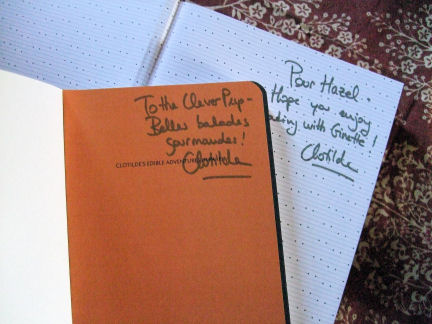
Yesterday, November 12, I had the pleasure of meeting Clotilde Dusoulier, creator of the Chocolate & Zucchini blog, while she was here in Toronto.

Usually Paris-based, Clotilde has just wrapped up two weeks here in Canada as the Gastronomic Writer in Residence at the Stratford Chef's School about 2 hours outside Toronto. Clotilde started Chocolate & Zucchini in 2003 and the lucky girl signed a book deal in '07. C&Z, along with the odious Sartorialist, were the first two blogs I followed when I finally entered the blogging universe.

The Cookbook Store at Yonge Street and Yorkville Avenue is where the book signing was held. Clotilde was there, promoting a book she has edited entitled  The Art of French Baking originally written in the 1930s by Ginette Mathiot. I also took my copy of Clotilde's Edible Adventures in Paris for her to sign. I poured over that book before I went to Paris in 2010. I actually didn't follow too much of her advice, but with cross-referencing I got to know the Arrondissements a little better.

When I got to The Cookbook Store at the appointed time there was just the staff plus about five fans. I thought I was in for a very intimate meeting. I wish it had been so. Clotilde was delayed because of highway issues. After a 20-minute wait there were about 30 gathered in the tiny shop.
Clotilde is lovely,  fresh and sounds just what I thought she would. At  just 30 years old she has an amazing life ahead. Living in Montmartre, writing a blog about food, having that content put into book form, traveling the world. - I'm deeply envious. Here are some pictures I took.


November 11, 2011

French Soldiers of the Great War

I bought these compelling photos at an auction about ten years ago as part of the "contents of a drawer". I return to them again and again. I've found very little information about them as the names are so hard to read. The rotund fellow from the 54th Artillerie is the focus of the photos. I've tried to get in touch with descendents who may have an interest but to no avail.

 Still beautiful after 140 days on the campaign. December 12, 1914.

Just look at these guys! The stories they could tell. This one's titled After lunch at Bayonvillers, January 1915. Lignon Senior, far left is the father of Lignon Junior, far right. Joseph Marius Lignon died April 18th 1918, and was buried at the Locre Cemetery in Belgium.He is 23 at the time of this photo. The other man with the fine ears is called Moreau. Our fellow is called T.(or F.) Duroy or Duvoy. Bayonvillers is village east of Amiens, about 20km south of where the Battle of the Somme took place.

Taken Monday night the 18th of December, 1916 by the fellow on the far left in the picture below. Members of the 54th Artillerie and PAD 28 pay a visit to Madame and Mademoiselle de Labeniere and Mademoiselle de Finfe. Lignon Senior is seated at the left. Moreau is at the bureau behind him. Our soldier is at the vitrine behind Mlle. Finfe's head.

An interesting picture of a canal barge named Old Arras. Barthelmy, on the left,  took the photo above this one.

A very gloomy shot of soldiers transporting guns. My cavalier is sitting high in the saddle on the left. There are explosions visible on the horizon.

A mysterious photo captioned Breakfast in l'acayuna. I've tried to find that word but I can't. If that rings a bell with anyone please let me know. I'm pretty sure they are in officers quarters in a trench or near the Front. Dr. Sasportas is the doctor of the group. ( Nov. 17th I just solved this mystery. dans la cayuna, is really dans la cagna, which in this case means "dugout")

Here's the reverse of this photo with my scribbling. 


This one's captioned He sprawled a Bergere.  Bergere, I think in this connotation refers to the chaise lounges the soldiers are recuperating on. I don't know if this is my soldier or not. The patients are being treated to a musical interlude.

I'd be greatly interested if anyone out there could add anything to these scenarios. I've been unwilling to share them until now because they are precious to me.


All photos are property of Hazel Smith. Please seek my permission before using.