I originally posted this on Sept 3, 2009. I see that the book is about to hit the big screen with some big talent. Can't wait. It really IS time I read the book. I've had it on my bedside table for 3 years!
Now here’s a book I have to read.
Here's the true story of the Monuments Men (and women).
The Monuments Men: Allied Heroes, Nazi Thieves, and the Greatest Treasure Hunt in History by Robert M Edsel.
The “Monuments Men” were a group of approximately 345 men and women from thirteen Allied nations who comprised the Monuments, Fine Arts, and Archives section during World War II. Founded in 1943 this group of Allies was established to assist in the protection and restitution of cultural property in war areas during and following World War II. As the war came to a close, they worked to locate and return works of art and other items of cultural importance which had been stolen by the Nazis.
Countless monuments, churches, and works of art were saved or protected by the dedicated personnel of the MFAA section. Frequently entering liberated towns ahead of ground troops, Monuments Men worked quickly to assess damage and make temporary repairs to paintings, frescoes, sculpture and statuary, before moving on through conquered Nazi territory with the Allied Armies.
In the last year of the war, they tracked, located, and returned more than 5 million artistic and cultural items stolen by Hitler and the Nazis.
Many of the groups personnel were museum directors, curators, art historians, and educators and went on to have prolific careers in institutions such as the National Gallery of Art and the Metropolitan Museum of Art, as well as in museums and other institutions in Europe.
Beginning in late March 1945, Allied forces began discovering hidden repositories in what would become the “greatest treasure hunt in history.” In Germany alone, U.S forces found approximately 1,500 repositories of art and cultural objects. While many of these caches of priceless treasures had been looted by Adolf Hitler and the Nazis, others had been legitimately evacuated from German museums for safekeeping. Monuments Men oversaw the safeguarding, cataloguing and removal of all works from these repositories, regardless of their origin. The Monuments Men remained in Europe for up to six years following the conclusion of the War to oversee the complicated restitution of stolen works of art.
Here are some examples of what they found (courtesy of Wikipedia)
Berchtesgaden, Germany: The 101st Airborne Division, known as the “Screaming Eagles,” found more than 1,000 paintings and sculptures stolen by German Reichsmarshall Hermann Göring. The cache had been evacuated from his country estate, Carinhall, and moved to Berchtesgaden in April 1945 to protect it from the invading Russians.
Bernterode, Germany: Americans found four coffins containing the remains of Germany’s greatest leaders, including those of Frederick the Great (Frederick II of Prussia) and Field Marshal Paul Von Hindenburg. Also found in the mine were 271 paintings, including court portraits from the Palace of Sanssouci in Potsdam, which had been hidden behind a locked door and a brick wall nearly five feet thick. The site was originally used as an ammunition and military supply complex manned by hundreds of slave laborers.
Merkers, Germany: The Kaiserode mine at Merkers was discovered by the U.S. 3rd Army under General George S. Patton in April 1945. Reichsbank gold, along with 400 paintings from the Berlin museums and numerous other crates of treasures were also discovered. More dismal discoveries included gold and personal belongings from Nazi concentration camp victims.
Neuschwanstein Castle: Over 6,000 items including ERR (Einsatzstab Reichsleiter Rosenberg, Alfred Rosenberg’s task force organized for the “legalized” looting of Jews) documents, furniture, jewelry, paintings and other belongings stolen by the ERR from private collectors in France were found here. Monuments Man Capt. James Rorimer oversaw the repository’s evacuation.
Altaussee, Austria: This extensive complex of salt mines served as a huge repository for art stolen by the Nazis, but it also contained holdings from Austrian collections. More than 6,500 paintings alone were discovered at Alt Aussee. The contents included: Belgian-owned treasures such as Michelangelo’s Madonna of Bruges stolen from the Church of Our Lady in Bruges, and Jan van Eyck’s Ghent Altarpiece stolen from Saint Bavo Cathedral in Ghent; Vermeer’s The Astronomer and The Artist’s Studio which were to be focal points of Hitler’s Führer Museum in Linz, Austria; and paintings from the Capodimonte Museum in Naples that had been stolen by the Hermann Göring Tank Division (Fallschirm-Panzer Division 1 Hermann Göring) at Monte Cassino.
San Leonardo, Italy: In the jail cell of this very northern town, Allied officials discovered paintings from the Uffizi that had been hurriedly unloaded by retreating German troops. Among the masterpieces were paintings by Sandro Botticelli, Filippo Lippi and Giovanni Bellini.
There’s a John Frankenheimer movie starring Burt Lancaster movie called The Train in which a German colonel loads a train with French art treasures to send to Germany. The Resistance (mainly Lancaster) must stop it without damaging the cargo. It’s pretty thrilling and different from the usual war movies made in the 60s.
Speaking of 60s war movies, the clip above promoting Robert M. Edsel’s book The Monuments Men: Allied Heroes, Nazi Thieves, and the Greatest Treasure Hunt in History, features the rousing theme music from the film Where Eagles Dare. A real eye-opener, I must say, first thing in the morning.
Here's more information about the Monuments Men
http://www.monumentsmenfoundation.org/about/
Where I sit and write right now, a few blocks north of Lake Ontario, I am enduring Toronto’s annual air show. It sounds as if we are under attack. Mon Dieu!
Showing posts with label The Library. Show all posts
Showing posts with label The Library. Show all posts
January 14, 2014


September 29, 2012
Reading Between the Lines


A few years back I bought this cookbook at an open-air antique show about 45 minutes west of Toronto. “A Years Dinners: 365 Seasonable Dinners with Instructions for Cooking", by May Little, was published by Harrods. There’s no publication date but I’m guessing this book might have been published around 1925-1930. It comes with the quaint sub-title. “With Instructions for Cooking. A Handy Guide-book for Worried Housekeepers.”
It’s a fabulous old book with planned menus for every day of the year and gives instructions on how to prepare meals for invalids, how to get the most from one’s trips to the market. It also has a digestion table, something I’ve never seen before, so you know that the boiled mutton suet you just ate will remain in your stomach for 4.5 hours. There is a lot of suet in this book, but that’s they way things were back then.
The first half of this book is comprised of daily menus, most of them consisting of 6 or 7 courses. I like to think of a below-stairs cook like Mrs. Bridges buying this book to help with the daily menu. The remainder of the book, besides the guides mentioned above, are the recipes. The most thumbed and splotched part of this book is the dessert chapter. Sweet Dishes contains 180 different desserts, the majority of them “puddings”.
But this book had another tale to tell me. A cook or a wife had used the corner of a Sainsbury’s bill for a bookmark. On it was a printed date: 1930-something. The bill was from Sainsbury’s 56-58 Kings Road, Chelsea, SW3, and written out to M. Cap Michell Innes, 5 Cad Street.
I’m very curious by nature so I had to look this up. First I found out in my London A-Z that there isn’t a Cad Street in London; it's Cadogan Street. And after some sleuthing with Ancestry.com and the internet, I was able to find out who Cap. Michell Innes was.
Captain Cecil Mitchell-Innes was the Chief Constable of the Lincolnshire Constabulary. He retired in 1931 and somehow ended up with a fairly swanky address in London's Chelsea. He received the title Commander of the Order of the British Empire (CBE) in 1920. His name shows up in Ancestry.com entry in a book called The Royal Blood of Britain. In fact the name Mitchell-Innes is quite a storied one.
Ancestry.com puts Cecil Mitchell-Innes at 5 Cadogan Street, beginning in 1933 and to his death in the 1940s. The Lincolnshire Police website rounded out the rest of the information for me.
“Cecil Mitchell-Innes was born Born on the 6th July, 1866, at Edinburgh, he was educated at Cheam School, Surrey, and Fettes College, Edinburgh. His military career began In 1885 when he was gazetted to the Leinster Regiment and sailed for India where he served for 11 years. He was appointed Captain in 1893,when he became adjutant of the Simla Volunteer Rifles. On leaving India he went to Bermuda, Canada and Jamaica, and was transferred to the Queens Own Cameron Highlanders in 1898. He left the Army in 1903, and early that year was selected to organise and superintend physical education in Scotland, and to inspect and report upon all the training colleges throughout Scotland. He studied police duties under the Chief Constables of the North Riding of Yorkshire and Hertfordshire. He commenced his duties as Chief Constable (of Lincolnshire) on the 29th October. 1903, at a time when conditions were beginning to change owing to the development of motor vehicles and telephone services. In 1904, the telephone was installed at Headquarters and in a number of divisional headquarters stations, and by 1924 there were telephones at 40 police stations in the County. In the first year of his appointment, Captain Mitchell-Innes introduced the first typewriter used in the Force, at Headquarters, but it was not until 1920 that they were provided at superintendents' stations, and a further five years before sub-divisional stations had them.”
I only wish all my books and antiques has such interesting tales to tell.
http://www.lincs.police.uk/getFile.asp?FC_ID=110&docID=177.
May 1, 2012

Tapioca Cream SoupLobster Cutlets
Roast Sirloin of Beef
Horseradish Sauce
Baked Potatoes
Asparagus
Yorkshire Pudding
Peach Mould
Cheese and Water Cress.
So what's keeping you? Get cracking.
If you're interested in the story of my book, please click here.
April 20, 2012
Rooney Mara vs Noomi Rapace

Which one do you think fits the bill better?
My husband, who is a completist, purchased the extended Swedish version. Originally called Millennium, it actually ran on Swedish TV before it had a theatrical release. It's nine hours long. Therefore I'm more partial to Noomi Rapace because I've been exposed to her more than Rooney Mara.
Noomi just seems a little tougher, a little more grownup. It's more believable that the men she meets, Armansky and Blomkvist, fall for her just a little. Rooney just seems a little young, a little frail, although Lisbeth is frequently mistaken for a rebellious teen.
My husband, the completist, has also purchased all three books, The Girl with the Dragon Tattoo, The Girl Who Played with Fire, and The Girl Who Kicked the Hornet's Nest in hardcover. That will have to round out his purchases because Stieg Larsson died of a heart attack in 2004 at the age of 50.
November 13, 2011
Clotilde's Adventures in Canada

Yesterday, November 12, I had the pleasure of meeting Clotilde Dusoulier, creator of the Chocolate & Zucchini blog, while she was here in Toronto.
Usually Paris-based, Clotilde has just wrapped up two weeks here in Canada as the Gastronomic Writer in Residence at the Stratford Chef's School about 2 hours outside Toronto. Clotilde started Chocolate & Zucchini in 2003 and the lucky girl signed a book deal in '07. C&Z, along with the odious Sartorialist, were the first two blogs I followed when I finally entered the blogging universe.

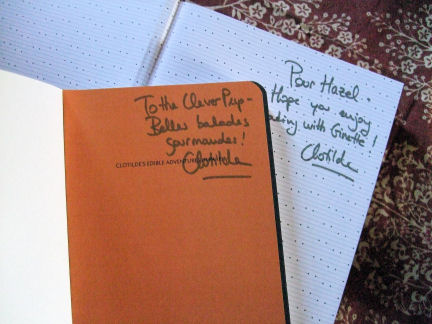
The Cookbook Store at Yonge Street and Yorkville Avenue is where the book signing was held. Clotilde was there, promoting a book she has edited entitled The Art of French Baking originally written in the 1930s by Ginette Mathiot. I also took my copy of Clotilde's Edible Adventures in Paris for her to sign. I poured over that book before I went to Paris in 2010. I actually didn't follow too much of her advice, but with cross-referencing I got to know the Arrondissements a little better.
When I got to The Cookbook Store at the appointed time there was just the staff plus about five fans. I thought I was in for a very intimate meeting. I wish it had been so. Clotilde was delayed because of highway issues. After a 20-minute wait there were about 30 gathered in the tiny shop.



November 11, 2011
John McCrae: In Flanders Fields

John McCrae, a Canadian soldier, doctor and a poet is best remembered for his poem, "In Flanders Fields". Born in Guelph, Ontario in 1872, he was educated at Guelph Collegiate and the University of Toronto medical school.
As a youngster John joined the Highland Cadet Corps at the age of 14, and at 17 he joined the Militia Field Battery commanded by his father. By 1896 he achieved the rank of Lieutenant. In the meantime he was training to be a doctor at the University of Toronto. During this period he wrote poetry. Sixteen of his poems were published in various magazines.
In 1898, along with his degree in medicine, John received a gold medal from the University of Toronto for his high marks. When the South African War (Boer War) started in October 1899 John felt it was important to fight. He was commissioned to lead an army from Guelph. Though suffering from chronic asthma, he served in South Africa for a year. While stationed there, seeing the poor medical treatment of sick and wounded soldiers disturbed him.
After returning to Canada and resigning from the military, John picked up his life where he had left off. He resumed his studies and went on to become assistant pathologist at Montreal General Hospital. In 1905 he set up his own practice as well as continuing work at several hospitals.
When the Great War broke out in August 1914, John was among the first to enlist. He was appointed brigade surgeon to the First Brigade Canadian Forces Artillery. Just before he left, he wrote to a friend:
"It is a terrible state of affairs, and I am going because I think every bachelor, especially if he has experience of war, ought to go. I am really rather afraid, but more afraid to stay at home with my conscience."
John sailed for England with the First Contingent on Oct. 3, 1914. After spending four months on the Salisbury Plain, the First Contingent moved to France in early February 1915 and by the 10th of March, John would first experience the fighting of the Great War at Neuve Chapell. He had taken his favorite horse, Bonfire, with him to France, but had few riding opportunities for some time.
McCrae helped the wounded from the trenches near Ypres, Belgium. This area, which is traditionally called Flanders, was the sight of some of the heaviest fighting of the Great War. In April, the Germans launched their initial chlorine gas attack against French troops who were fighting next to the Canadians. The French collapsed as the gas overcame them and it was left to the Canadians to fill the gap and stop the advancing Germans.
On May 2nd Lieutenant Alex Helmer, a friend of John's, was killed in the fighting and buried beneath a simple wooden cross. John wrote his most famous poem the next day and it was Alex's death some say inspired John to write the poem that has become symbolic for the suffering and loss of the Great War. In Flanders' Fields was first published in the British magazine Punch in Dec 1915 and became the most popular poem of the War.
Soon after the poem was written John was transferred to No.3 Canadian Field Hospital in France as Chief of Medical Services. This move away from the front would spare John from some of the dangers of war but not the horror, for here John would treat thousands of the wounded evacuated from the trenches after battles such as the Somme, Vimy Ridge, Arras and Passchendaele.
During the summer of 1917 John was troubled by attacks of asthma and bronchitis possibly aggravated by the gas he inhaled at Ypres. His health deteriorated noticeably. He lost much of his enthusiasm, and took frequent solitary rides on Bonfire, accompanied by his spaniel , Bonneau, a stray rescued from the battlefield.
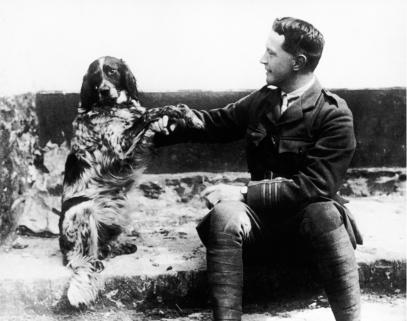
Just after receiving word he was appointed consulting surgeon to the British Army, the first Canadian to be so honoured, McCrae fell seriously ill with pneumonia. On January 28, 1918, six days after being admitted to hospital, McCrae died. He was 46 years old. He was buried with full military honours in Wimereaux Cemetery, near Boulogne, France. The large funeral was attended by hundreds of mourners, from generals to nurses and medical orderlies. His horse, Bonfire, led the burial procession, its master's boots reversed in the stirrups.
McCrae's burial site is commemorated by a large plaque at the main cemetery entrance and by a memorial seat built into a wall nearby. His family home at Guelph, Ontario, has been preserved as a museum, with a memorial cenotaph and garden of remembrance. It is "In Flanders Fields" that remains his most meaningful memorial, It was translated into many languages, and led to the poppy being adopted as the Flower of Remembrance for the war dead of Britain and the Commonwealth. To this day, John McCrae's poem is read aloud at Remembrance Day ceremonies held every November 11th throughout each nation of the British Commonwealth.

I originally wrote this post in 2003 for my son who was nine at the time.
August 31, 2010
Paris Walks Part 2 - Two Cafés on the Boulevard Saint Germain


When we’re in Paris – we walk. Apart from being a little trepidatious of using the Metro, we have lots of time and everything is just so beautiful, I wouldn’t want to miss it by being underground.
I’d done a lot of reading about Paris in the 20’s. Hemingway’s "A Moveable Feast", "The Autobiography of Alice B, Toklas", Morley Callaghan’s "That Summer in Paris" And I am also a big enthusiast of Kiki, Man Ray, Foujita and the gang. Some of their favourite places to drink and write are in Montparnasse, just south of today’s walk. But two famous restaurants are on today’s trail.

Café De Flore - 172 Boulevard St. Germain
Historically, this belle époque café was the former hangout of big thinkers such as Jean-Paul Sartre and the Existentialists and André Breton and the Surrealists, plus Trotsky, Apollinaire and writers like Ernest Hemingway, Truman Capote,and Lawrence Durrell. This landmark café is noted for people-watching from the terrasse and coffee, hot chocolate, croissant, welsh rarebit, quiche, croque-monsieur can be enjoyed for a inflated price. French intelligentsia and film star still stops in. Upstairs, play readings are held on Mondays and philosophy discussions on the first Wednesday of the month, both at 8pm, in English.
They’re open from 7:00 in the morning to 1:30 the following morning. Their website and e-mail seems to be defunct, but they can be reached through the phone:
telephone: 33 (0)1 45 48 55 26
Les Deux Magots - 6 place Saint-Germain-des-Prés
Found just next door, Les Deux Magots is the rival to The Cafe de Flore. This is another of Paris’s most famous cafes. Oscar Wilde frequented Les Deux Magots. Maybe he conjured up The Happy Prince while sipping a wine. Maybe Saint Exupery imagined his Little Prince here. Sartre, Hemingway and Apollinaire patronized the place and Dora Maar met Picasso here. Taking its name from the wooden statues of the Confuscian wise men which still oversee the room, these two “magots” are the only remains left from the old silk shop that in 1885 became a bar. Salads, eggs and cheese plates, deserts and sandwiches made from that criminally expensive Polaine bread are available. The Deux Magots literary prize has been awarded to a French novel every year since 1933.

They’re open from 7:30 in the morning to 1:30 the next day.
phone 33 (0)1 45 48 55 25
August 7, 2010
The Library
My folks, a librarian and a library technician, would have loved this. I think it's a clever spoof of an already clever ad.
July 28, 2010
Hells Bells

Ramsay's a lot calmer on his other show "The F-Word", but he still named his doomed Christmas turkeys after other famous TV chefs. Nice. I've seen one episode in total and it included a challenge where Hugh Fearnly-Whittingstall made the better dessert. I could almost see steam coming from Ramsay's ears. Tooooot!
Everyone professes to be wound up tighter than a top these days. So why waste our time watching someone so un-Zen. He's no Lorenza De'Medici or Jacques Pepin.
Give this guy the cold shoulder. I'm going to focus more on the Slow Food Movement. That's more my style.
July 9, 2010
New Agatha Christie Mystery

Christie enthusiast Jennifer Grant bid on a canvas trunk during a 2006 sale at Greenway House. Auctioneers Bearnes, Hampton and Littlewood presided over the auction in which Grant bid on the trunk. Unbeknownst to them, the trunk, marked with the initials CMM for Clara Margaret Miller who was Agatha Christie's mother, contained a locked stongbox without a key.
The strongbox was a talking point at dinner parties for the intervening years and Grant, obviously not as curious as one might think, finally opened the box in early 2010 and found treasure. In it she found a crocheted bag containing a hoard of gold sovereigns, a diamond ring and a buckle-shaped brooch.


Grant's research revealed that Christie's mother's jewelery did indeed consist of a "diamond buckle, diamond crescent, and diamond engagement ring."
Grant contacted the Antiques Road Show to help her with valuation and authentication John Benjamin from the BBC's Antiques Road Show valued the coins at ₤5,500, the ring between ₤2,500 and ₤3,000 and the brooch at ₤5,500 to ₤7,000. But he said the items could be worth much more if these treasures were proved to be the Christie diamonds. My little grey cells don't have strain too much to come to the conclusion that these are Christie family jewels.
Photos Jeff Gilbert at telegraph.co.uk.
March 6, 2010
Thora Dardel

In Thora's memoirs she recounts her first meeting with Modigliani
"Modigliani ...drew me piece by piece on several sheets of paper which he then spread out edge to edge. All his figures had such long necks and bodies that he usually needed two or three sheets of paper for each person that he drew when he drew on the Rotonde's small stationery. Then he wrote Italian verse on the drawings and gave them to me. I thought he was extraordinarily fascinating. Then one day some time later Modigliani asked Nils Dardel if he was allowed to paint my portrait. The question was of course relayed to me, who of course was happy and overwhelmed."Later she goes on the describe the modelling session.
"Modigliani's studio was on the top floor of a house on rue de la Grande Chaumiere. His floor was covered with a carpet of trod on charcoal and matches. He almost fainted when I asked him to sweep the floor. I think he had worked several years to make it look like that. A large table with his painting stuff, a glass, a bottle of rum was the whole environment, plus two chairs, some canvases and an easel. He drank often and easily - against the cough, he declared and he really did cough a lot. It was cold and miserable outside but in his studio corner there was a charcoal stove that he did up well. Modigliani put a large canvas on the easel and drew me. I got the same El Greco-like lines and the same figure as all the women in his art had. The likeness of me was therefore not very good. I returned on several occasions and sat for the portrait and liked Modigliani more and more."

Thora married Nils Dardel. During the 20s she worked as a photographer and journalist for a Swedish magazine.
Years ago I came across the top photograph of Thora Dardel in my "Desert Island" book, Kiki's Paris. The photo inspired me to paint another Montparnasse lady.
I had forgotten that I'd ever seen this picture, when just the other day I stumbled across Dora's photo again and recognized her hat. Because I was just inspired by her hat, my humble painting is not at all a true likeness. But is it closer than Modigliani, I wonder? Anyway, I call her Marianne, not Thora, because she reminds the rest of my family of my step-mother-in-law.

with notes from the Dictionary of Artists Models ed. Jill Berk Jimenez, Thora Dardel, Billy Klüver and Julie Martin.
January 14, 2010
Theme Thursday - "Surfacing"

"I can't believe I'm on this road again." My sentiments exactly. Lately, when I’m heading up to my folks place on the four-lane black-top, sometimes clear, sometimes centre-bare, depending on the weather I can’t believe it either. Wasn’t I just here?
For the unnamed narrator in Margaret Atwood’s 1972 novel Surfacing, it’s a different matter – she didn’t expect to be returning ever again.
Surfacing is written from the point of view of a young woman who travels with her boyfriend and another young couple to a remote island on a lake in
While revisiting her childhood house she comes face to face with her past. Recalling past events and emotions while trying to piece together her father’s disappearance, she finds herself sinking into a "Lost Weekend". Her history overtakes her, driving her mad and forcing her to go walkabout. She becomes “undone.”
Flooded with her memories and grief for an unborn child, the “surfacer" realizes that going home means entering another time, and she needs to come up for air. Funny, it’s never been that bad for me.
I read Surfacing years ago and I have to say it didn’t resonate with me like The Yellow Wallpaper, a short story written by Charlotte Perkins Gilman 80 years before Margaret Atwood’s Surfacing. But that will have to wait for another time.
For other Theme Thursday contributors please clink here. http://themethursday.blogspot.com/2010/01/thursday-january-14-2010-surface.html
December 22, 2009
Rupert Annuals
Did I ever mention that I like Rupert Bear? Could you guess? Rupert Annuals were a part of my early childhood with my English Grandmother sending them to us in Canada. "Ruperts" were what I read in bed Christmas morning before the rest of the older folks got up.
So colourful, magical and innocent - I couldn't wait to go back to Nutwood again. I started collecting them for myself in my 20s and then subsequently acquiring them for my son.
Here are some of my all-time favourite covers. Do you think I have a penchant for Chinese lanterns and brightly coloured fish?!
Thanks Daily Express!
 1969
1969
 1960
1960
 1950
1950

1949
 1945
1945
So colourful, magical and innocent - I couldn't wait to go back to Nutwood again. I started collecting them for myself in my 20s and then subsequently acquiring them for my son.
Here are some of my all-time favourite covers. Do you think I have a penchant for Chinese lanterns and brightly coloured fish?!
Thanks Daily Express!
 1969
1969 1960
1960 1950
1950
1949
 1945
1945
December 20, 2009
A Child's Christmas in Wales - by Dylan Thomas

I'm repeating myself, yet again, but it's worth it. Here's Dylan Thomas', A Child's Christmas in Wales. It makes me nostalgic for something I've never experienced. Reading it is a delight but we have an old snap, crackle and pop vinyl recording that we listen to with friends every Christmas. Please check out the links if you need definitions. Enjoy!
One Christmas was so much like another, in those years around the sea-town corner now and out of all sound except the distant speaking of the voices I sometimes hear a moment before sleep, that I can never remember whether it snowed for six days and six nights when I was twelve or whether it snowed for twelve days and twelve nights when I was six.
All the Christmases roll down toward the two-tongued sea, like a cold and headlong moon bundling down the sky that was our street; and they stop at the rim of the ice-edged fish-freezing waves, and I plunge my hands in the snow and bring out whatever I can find. In goes my hand into that wool-white bell-tongued ball of holidays resting at the rim of the carol-singing sea, and out come Mrs. Prothero and the firemen.
It was on the afternoon of the Christmas Eve, and I was in Mrs. Prothero's garden, waiting for cats, with her son Jim. It was snowing. It was always snowing at Christmas. December, in my memory, is white as Lapland, though there were no reindeers. But there were cats. Patient, cold and callous, our hands wrapped in socks, we waited to snowball the cats. Sleek and long as jaguars and horrible-whiskered, spitting and snarling, they would slink and sidle over the white back-garden walls, and the lynx-eyed hunters, Jim and I, fur-capped and moccasined trappers from Hudson Bay, off Mumbles Road, would hurl our deadly snowballs at the green of their eyes. The wise cats never appeared.

We were so still, Eskimo-footed arctic marksmen in the muffling silence of the eternal snows - eternal, ever since Wednesday - that we never heard Mrs. Prothero's first cry from her igloo at the bottom of the garden. Or, if we heard it at all, it was, to us, like the far-off challenge of our enemy and prey, the neighbor's polar cat. But soon the voice grew louder.
"Fire!" cried Mrs. Prothero, and she beat the dinner-gong.
And we ran down the garden, with the snowballs in our arms, toward the house; and smoke, indeed, was pouring out of the dining-room, and the gong was bombilating, and Mrs. Prothero was announcing ruin like a town crier in Pompeii. This was better than all the cats in Wales standing on the wall in a row. We bounded into the house, laden with snowballs, and stopped at the open door of the smoke-filled room.
Something was burning all right; perhaps it was Mr. Prothero, who always slept there after midday dinner with a newspaper over his face. But he was standing in the middle of the room, saying, "A fine Christmas!" and smacking at the smoke with a slipper.
"Call the fire brigade," cried Mrs. Prothero as she beat the gong.
"There won't be there," said Mr. Prothero, "it's Christmas."
There was no fire to be seen, only clouds of smoke and Mr. Prothero standing in the middle of them, waving his slipper as though he were conducting.
"Do something," he said. And we threw all our snowballs into the smoke - I think we missed Mr. Prothero - and ran out of the house to the telephone box.

"Let's call the police as well," Jim said. "And the ambulance." "And Ernie Jenkins, he likes fires."
But we only called the fire brigade, and soon the fire engine came and three tall men in helmets brought a hose into the house and Mr. Prothero got out just in time before they turned it on. Nobody could have had a noisier Christmas Eve. And when the firemen turned off the hose and were standing in the wet, smoky room, Jim's Aunt, Miss. Prothero, came downstairs and peered in at them. Jim and I waited, very quietly, to hear what she would say to them. She said the right thing, always. She looked at the three tall firemen in their shining helmets, standing among the smoke and cinders and dissolving snowballs, and she said, "Would you like anything to read?"

Years and years ago, when I was a boy, when there were wolves in Wales, and birds the color of red-flannel petticoats whisked past the harp-shaped hills, when we sang and wallowed all night and day in caves that smelt like Sunday afternoons in damp front farmhouse parlors, and we chased, with the jawbones of deacons, the English and the bears, before the motor car, before the wheel, before the duchess-faced horse, when we rode the daft and happy hills bareback, it snowed and it snowed. But here a small boy says: "It snowed last year, too. I made a snowman and my brother knocked it down and I knocked my brother down and then we had tea."
"But that was not the same snow," I say. "Our snow was not only shaken from white wash buckets down the sky, it came shawling out of the ground and swam and drifted out of the arms and hands and bodies of the trees; snow grew overnight on the roofs of the houses like a pure and grandfather moss, minutely -ivied the walls and settled on the postman, opening the gate, like a dumb, numb thunder-storm of white, torn Christmas cards."
"Were there postmen then, too?"
"With sprinkling eyes and wind-cherried noses, on spread, frozen feet they crunched up to the doors and mittened on them manfully. But all that the children could hear was a ringing of bells."
"You mean that the postman went rat-a-tat-tat and the doors rang?"
"I mean that the bells the children could hear were inside them."
"I only hear thunder sometimes, never bells."
"There were church bells, too."
"Inside them?"
"No, no, no, in the bat-black, snow-white belfries, tugged by bishops and storks. And they rang their tidings over the bandaged town, over the frozen foam of the powder and ice-cream hills, over the crackling sea. It seemed that all the churches boomed for joy under my window; and the weathercocks crew for Christmas, on our fence."
"Get back to the postmen"
"They were just ordinary postmen, found of walking and dogs and Christmas and the snow. They knocked on the doors with blue knuckles ...."
"Ours has got a black knocker...."
"And then they stood on the white Welcome mat in the little, drifted porches and huffed and puffed, making ghosts with their breath, and jogged from foot to foot like small boys wanting to go out."
"And then the presents?"
"And then the Presents, after the Christmas box. And the cold postman, with a rose on his button-nose, tingled down the tea-tray-slithered run of the chilly glinting hill. He went in his ice-bound boots like a man on fishmonger's slabs.
"He wagged his bag like a frozen camel's hump, dizzily turned the corner on one foot, and, by God, he was gone."
"Get back to the Presents."
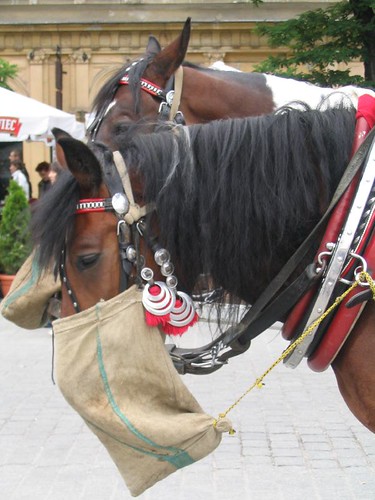
"There were the Useful Presents: engulfing mufflers of the old coach days, and mittens made for giant sloths; zebra scarfs of a substance like silky gum that could be tug-o'-warred down to the galoshes; blinding tam-o'-shanters like patchwork tea cozies and bunny-suited busbies and balaclavas for victims of head-shrinking tribes; from aunts who always wore wool next to the skin there were mustached and rasping vests that made you wonder why the aunts had any skin left at all; and once I had a little crocheted nose bag from an aunt now, alas, no longer whinnying with us. And pictureless books in which small boys, though warned with quotations not to, would skate on Farmer Giles' pond and did and drowned; and books that told me everything about the wasp, except why."



Go on - the Useless Presents."
"Bags of moist and many-colored jelly babies and a folded flag and a false nose and a tram-conductor's cap and a machine that punched tickets and rang a bell; never a catapult; once, by mistake that no one could explain, a little hatchet; and a celluloid duck that made, when you pressed it, a most unducklike sound, a mewing moo that an ambitious cat might make who wished to be a cow; and a painting book in which I could make the grass, the trees, the sea and the animals any colour I pleased, and still the dazzling sky-blue sheep are grazing in the red field under the rainbow-billed and pea-green birds. Hardboileds, toffee, fudge and allsorts, crunches, cracknels, humbugs, glaciers, marzipan, and butterwelsh for the Welsh. And troops of bright tin soldiers who, if they could not fight, could always run. And Snakes-and-Families and Happy Ladders. And Easy Hobbi-Games for Little Engineers, complete with instructions. Oh, easy for Leonardo! And a whistle to make the dogs bark to wake up the old man next door to make him beat on the wall with his stick to shake our picture off the wall. And a packet of cigarettes: you put one in your mouth and you stood at the corner of the street and you waited for hours, in vain, for an old lady to scold you for smoking a cigarette, and then with a smirk you ate it. And then it was breakfast under the balloons."


"Were there Uncles like in our house?"
"There are always Uncles at Christmas. The same Uncles. And on Christmas morning, with dog-disturbing whistle and sugar fags, I would scour the swatched town for the news of the little world, and find always a dead bird by the Post Office or by the white deserted swings; perhaps a robin, all but one of his fires out. Men and women wading or scooping back from chapel, with taproom noses and wind-bussed cheeks, all albinos, huddles their stiff black jarring feathers against the irreligious snow. Mistletoe hung from the gas brackets in all the front parlors; there was sherry and walnuts and bottled beer and crackers by the dessertspoons; and cats in their fur-abouts watched the fires; and the high-heaped fire spat, all ready for the chestnuts and the mulling pokers. Some few large men sat in the front parlors, without their collars, Uncles almost certainly, trying their new cigars, holding them out judiciously at arms' length, returning them to their mouths, coughing, then holding them out again as though waiting for the explosion; and some few small aunts, not wanted in the kitchen, nor anywhere else for that matter, sat on the very edge of their chairs, poised and brittle, afraid to break, like faded cups and saucers."


Not many those mornings trod the piling streets: an old man always, fawn-bowlered, yellow-gloved and, at this time of year, with spats of snow, would take his constitutional to the white bowling green and back, as he would take it wet or fire on Christmas Day or Doomsday; sometimes two hale young men, with big pipes blazing, no overcoats and wind blown scarfs, would trudge, unspeaking, down to the forlorn sea, to work up an appetite, to blow away the fumes, who knows, to walk into the waves until nothing of them was left but the two furling smoke clouds of their inextinguishable briars. Then I would be slap-dashing home, the gravy smell of the dinners of others, the bird smell, the brandy, the pudding and mince, coiling up to my nostrils, when out of a snow-clogged side lane would come a boy the spit of myself, with a pink-tipped cigarette and the violet past of a black eye, cocky as a bullfinch, leering all to himself.


I hated him on sight and sound, and would be about to put my dog whistle to my lips and blow him off the face of Christmas when suddenly he, with a violet wink, put his whistle to his lips and blew so stridently, so high, so exquisitely loud, that gobbling faces, their cheeks bulged with goose, would press against their tinsled windows, the whole length of the white echoing street. For dinner we had turkey and blazing pudding, and after dinner the Uncles sat in front of the fire, loosened all buttons, put their large moist hands over their watch chains, groaned a little and slept. Mothers, aunts and sisters scuttled to and fro, bearing tureens. Auntie Bessie, who had already been frightened, twice, by a clock-work mouse, whimpered at the sideboard and had some elderberry wine. The dog was sick. Auntie Dosie had to have three aspirins, but Auntie Hannah, who liked port, stood in the middle of the snowbound back yard, singing like a big-bosomed thrush. I would blow up balloons to see how big they would blow up to; and, when they burst, which they all did, the Uncles jumped and rumbled. In the rich and heavy afternoon, the Uncles breathing like dolphins and the snow descending, I would sit among festoons and Chinese lanterns and nibble dates and try to make a model man-o'-war, following the Instructions for Little Engineers, and produce what might be mistaken for a sea-going tramcar.


Or I would go out, my bright new boots squeaking, into the white world, on to the seaward hill, to call on Jim and Dan and Jack and to pad through the still streets, leaving huge footprints on the hidden pavements.
"I bet people will think there's been hippos."
"What would you do if you saw a hippo coming down our street?"
"I'd go like this, bang! I'd throw him over the railings and roll him down the hill and then I'd tickle him under the ear and he'd wag his tail."
"What would you do if you saw two hippos?"
Iron-flanked and bellowing he-hippos clanked and battered through the scudding snow toward us as we passed Mr. Daniel's house.
"Let's post Mr. Daniel a snow-ball through his letter box."
"Let's write things in the snow."
"Let's write, 'Mr. Daniel looks like a spaniel' all over his lawn."

Or we walked on the white shore. "Can the fishes see it's snowing?"
The silent one-clouded heavens drifted on to the sea. Now we were snow-blind travelers lost on the north hills, and vast dewlapped dogs, with flasks round their necks, ambled and shambled up to us, baying "Excelsior." We returned home through the poor streets where only a few children fumbled with bare red fingers in the wheel-rutted snow and cat-called after us, their voices fading away, as we trudged uphill, into the cries of the dock birds and the hooting of ships out in the whirling bay. And then, at tea the recovered Uncles would be jolly; and the ice cake loomed in the center of the table like a marble grave. Auntie Hannah laced her tea with rum, because it was only once a year.
Bring out the tall tales now that we told by the fire as the gaslight bubbled like a diver. Ghosts whooed like owls in the long nights when I dared not look over my shoulder; animals lurked in the cubbyhole under the stairs and the gas meter ticked. And I remember that we went singing carols once, when there wasn't the shaving of a moon to light the flying streets. At the end of a long road was a drive that led to a large house, and we stumbled up the darkness of the drive that night, each one of us afraid, each one holding a stone in his hand in case, and all of us too brave to say a word. The wind through the trees made noises as of old and unpleasant and maybe webfooted men wheezing in caves. We reached the black bulk of the house. "What shall we give them? Hark the Herald?"

"No," Jack said, "Good King Wencelas. I'll count three." One, two three, and we began to sing, our voices high and seemingly distant in the snow-felted darkness round the house that was occupied by nobody we knew. We stood close together, near the dark door. Good King Wencelas looked out On the Feast of Stephen ... And then a small, dry voice, like the voice of someone who has not spoken for a long time, joined our singing: a small, dry, eggshell voice from the other side of the door: a small dry voice through the keyhole. And when we stopped running we were outside our house; the front room was lovely; balloons floated under the hot-water-bottle-gulping gas; everything was good again and shone over the town.
"Perhaps it was a ghost," Jim said. "
Perhaps it was trolls," Dan said, who was always reading.
"Let's go in and see if there's any jelly left," Jack said. And we did that.
Always on Christmas night there was music. An uncle played the fiddle, a cousin sang "Cherry Ripe," and another uncle sang "Drake's Drum." It was very warm in the little house. Auntie Hannah, who had got on to the parsnip wine, sang a song about Bleeding Hearts and Death, and then another in which she said her heart was like a Bird's Nest; and then everybody laughed again; and then I went to bed. Looking through my bedroom window, out into the moonlight and the unending smoke-colored snow, I could see the lights in the windows of all the other houses on our hill and hear the music rising from them up the long, steady falling night. I turned the gas down, I got into bed. I said some words to the close and holy darkness, and then I slept
November 27, 2009
Biblioburro


As the daughter of a small town librarian who took me on deliveries in the near north of Ontario in a bright yellow bookmobile, I was tickled to learn about the Biblioburro, a traveling library that distributes books to young Colombian readers from the backs of two donkeys.
I’d been watching TVOntario and saw the story of Luis Soriano included in Alberto Manguel’s – Empire of the Word.
Initiated over a decade ago in the La Gloria area of Colombia, Luis Soriano delivers books twice-monthly to small villages in his area thanks to his donkeys, Alfa and Beto. With a hand painted Biblioburro sign tucked under his arm, it’s a ritual he repeats almost every weekend in Colombia’s war-weary countryside.
Soriano is by profession a primary school teacher. He developed his whimsical take on the bookmobile after witnessing how the power of reading transformed his students who were struggling to live through conflict. Biblioburro was created from the belief that providing books to people who do not have them can somehow improve the lives in this impoverished region.
When he himself was young, the violence of bandit groups was so bad that Soriano’s parents sent him to live with his grandmother near the Venezuelan border. He returned at 16 with his high school diploma and took a job teaching reading to schoolchildren.
In the 1990s, Colombia’s long internal war had drawn paramilitary bands into the area surrounding his hometown of La Gloria, intimidating the local population. It was through this violence that Soriano would travel to communities with his donkeys and a portable library that started with 70 books. He’d take with him some reading texts, volumes of the encyclopedia and novels from his personal stash. Children still await Luis Soriano at stops along the way to hear him read from his selection before they can borrow the books.
Thanks to donations, as of 2008 his collection of books numbered 4,800 volumes. A community library in Santa Marta, nearly 180 miles away has hired him as a satellite employee and the library shares a portion of its $7,000 budget with him. He lives with his wife and kids in a small house with books piled to the ceiling. On his teacher’s salary of $350 a month the budget is tight. He and his wife, Diana, opened a small restaurant, La Cosa Política, two years ago to help make ends meet.
Please check out Luis's blog. http://elbiblioburro.blogspot.com/
photos taken from www.nytimes.com
September 13, 2009
Snozzcumbers and Frobscottle and Roald Dahl's Birthday

Born today in 1916, Roald Dahl wrote many books for adults but he is renowned for his children's stories.
Here's the best list I could compile. As a family we read most of these. I asterisked our favourites. Do you have a favourite Roald Dahl story?
The Gremlins (1943)
James and the Giant Peach (1961) *
Charlie and the Chocolate Factory (1964) *
The Magic Finger (1 June 1966)
Fantastic Mr Fox (9 December 1970)
Charlie and the Great Glass Elevator (9 January 1972) A sequel to Charlie and the Chocolate Factory.
Danny, the Champion of the World (30 October 1975)
The Enormous Crocodile (24 August 1978)
The Twits (9 October 1980) *
George's Marvellous Medicine (21 May 1981)
The BFG (14 October 1982) *
The Witches (27 October 1983)
The Giraffe and the Pelly and Me (26 September 1985)
Matilda (21 April 1988)*
Esio Trot (19 April 1990)
The Vicar of Nibbleswicke (9 May 1991)
The Minpins (8 August 1991)
The Victoria and Albert (V&A) Children's Museum in London recently hosted an exhibition entitled Snozzcumbers and Frobscottle, featuring the collaboration of Roald Dahl and illustrator extrordinaire, Quentin Blake. That would have been fun but unfortunately I live on the wrong side of the pond.
roalddahl.com also has a great interactive website that would appeal to kids around 8-10.
Illustration from The BFG © Quentin Blake
September 10, 2009
The Count's Sketchbook
 A remarkable sketchbook containing over 80 spectacular watercolours by Count Amadeo Preziosi, is one of the highlights of London's Bonhams’ Fine Art Auctioneers next Travel and Exploration Sale.
The sketchbook accompanied the watercolour artist, Count Amadeo Preziosi (1816-1882) on his Grand Tour of Europe in 1875, which he titled ‘Souvenir de mon dernier voyage’ (Remembrance of my last journey) and is estimated to sell for £320,000-500,000. A better and more revealing image can be seen at http://www.artdaily.org/index.asp. The one I’ve used really doesn’t do it justice.
Preziosi’s album documents, in glorious technicolour, every stop on his momentous journey, beginning and ending in Constantinople (Istanbul), but also includes Romania, Hungary, Germany, England, France, Italy and Malta.
Giles Peppiatt, Head of Travel and Topographical Pictures at Bonhams Auction House says: “To find one picture by Count Preziosi would be a pleasure, but to find no fewer than 81 of his works in his own personal sketchbook is astounding. The book provides a brilliant insight into a lost world, one that our forbears inhabited just 135 years ago, but a world utterly transformed. Yet one can page through this remarkable document and marvel at images that architecturally are still intact. This is an object that is more than the sum of its parts because of it is one man’s overview of Europe in works of delicate beauty.”
The fascination for Constantinople in 19th century Europe made the city a popular destination for western travelers. Many of them, including artists Thomas Allom, Eugene Delacroix, Alexandre Decamps and Eugene Fromentin, illustrated what they saw and did, leaving a legacy of paintings and engravings depicting the city’s mosques, palaces, fountains and squares. But Preziosi’s portrayals of the citizens of Constantinople are full of original detail not to be found in the work of others. The artist’s appreciation for locals in their colourful traditional clothing is evident among the pages.
Born into a wealthy and aristocratic Maltese family, Preziosi had been passionate about art since childhood, further carrying out his avocation by studying at the Paris Academy of Fine Arts. His father was strongly opposed to his artistic inclinations and so Amadeo high-tailed it to Turkey. Having studied in France, Prezsiosi was well-aware that European painters were flocking to Constantinople. He set out in 1842, traveling to Italy and then on to Constantinople, intending to stay for two years. Amadeo Preziosi loved the city and intended to spend the remainder of his life in Constantinople.
Despite his father’s appeals Preziosi refused to return to Malta, where the other members of his family followed ‘respectable’ careers. Preziosi remained true to his passions of painting and Constantinople. He married a woman there and the couple had four children. When he was 65, he was wounded by his own gun following a hunting expedition. Count Amadeo Preziosi is buried in the Catholic cemetery in Yeşilköy, where his grave still stands today.
Sources: http://www.artdaily.org/index.asp. Please check out this site.
and http://www.atamanhotel.com/friends/friends-preziosi.html
Below are some examples of Preziosi's work, not included in Bonham's sale found at Wikimedia.


September 9, 2009
Alice B. Toklas moves in

I never liked Gertrude Stein. I think her poems are wretched and that she was a domineering, manipulating person. I don’t know what Alice B. Toklas saw in her (maybe it was her Tender Buttons) but on this day in 1910, Alice B. Toklas became the lifetime house mate of Stein.
Gertrude who had been sharing a house with her brother Leo for many years, met Toklas in 1907. Leo and Gertrude were the children of a railroad executive who made prudent investments in San Francisco’s cable car lines, therefore making his offspring wealthy and able to travel and live without really working.
Alice would later write that when she met Gertrude Stein: "She was a golden brown presence, burned by the Tuscan sun and with a golden glint in her warm brown hair." I’d like to know who her optometrist was.
Alice was a chain smoker with a slight moustache. She had a penchant for great hats and cool earrings. Every morning for an hour she manicured, buffed and painted her finger nails. In 1908 Alice used those tidy fingers to type manuscripts for Gertrude Stein.
1909 found Alice staying with Gertrude and Leo in Paris. On September 9, 1910, she moved in to 27, rue de Fleurus permanently. Toklas took the reigns of Stein's household. Leo packed his trunk in 1914.
The two women turned their Parisian home into an important artistic and literary salon, where they entertained Picasso, Matisse, Hemingway, Fitzgerald, and many others. Alice was an excellent cook and fond of art, decorating, tapestry and flowers. She was left to entertain the wives of many of the painters Gertrude held court with.
In 1933 The Autobiography of Alice B. Toklas was written by Gertrude Stein and is basically Stein’s memoirs. I enjoyed reading it, as I love reading about that time period in Paris but Ernest Hemingway called it a 'damned pitiful book'; Henri Matisse was offended by the descriptions of his wife; Georges Braque thought Stein had misconstrued Cubism; and Leo Stein deemed it to be a “farrago of lies”.
I have the The Alice B. Toklas Cookbook in my collection. Used, it smells strongly of smoke and I can pretend it was actually Alice’s.
For those who are curious, the "B" in Alice B. Toklas’s name stands for Babette.
image: Gertrude Stein, Alice B. Toklas and their poodle Basket. France, 1944.Photograph by Carl Mydans.
Gertrude who had been sharing a house with her brother Leo for many years, met Toklas in 1907. Leo and Gertrude were the children of a railroad executive who made prudent investments in San Francisco’s cable car lines, therefore making his offspring wealthy and able to travel and live without really working.
Alice would later write that when she met Gertrude Stein: "She was a golden brown presence, burned by the Tuscan sun and with a golden glint in her warm brown hair." I’d like to know who her optometrist was.
Alice was a chain smoker with a slight moustache. She had a penchant for great hats and cool earrings. Every morning for an hour she manicured, buffed and painted her finger nails. In 1908 Alice used those tidy fingers to type manuscripts for Gertrude Stein.
1909 found Alice staying with Gertrude and Leo in Paris. On September 9, 1910, she moved in to 27, rue de Fleurus permanently. Toklas took the reigns of Stein's household. Leo packed his trunk in 1914.
The two women turned their Parisian home into an important artistic and literary salon, where they entertained Picasso, Matisse, Hemingway, Fitzgerald, and many others. Alice was an excellent cook and fond of art, decorating, tapestry and flowers. She was left to entertain the wives of many of the painters Gertrude held court with.
In 1933 The Autobiography of Alice B. Toklas was written by Gertrude Stein and is basically Stein’s memoirs. I enjoyed reading it, as I love reading about that time period in Paris but Ernest Hemingway called it a 'damned pitiful book'; Henri Matisse was offended by the descriptions of his wife; Georges Braque thought Stein had misconstrued Cubism; and Leo Stein deemed it to be a “farrago of lies”.
I have the The Alice B. Toklas Cookbook in my collection. Used, it smells strongly of smoke and I can pretend it was actually Alice’s.
For those who are curious, the "B" in Alice B. Toklas’s name stands for Babette.
image: Gertrude Stein, Alice B. Toklas and their poodle Basket. France, 1944.Photograph by Carl Mydans.
August 27, 2009
White Castle


Oh, I've been searching for hours for the picture and article to go with what I am about to tell you, but no luck. I'll have to wing it.
In light of my most recent post I had to share a quote I read from the owner of an all-white apartment. The apartment had a great view over Manhattan. So in order to showcase the view the owners decided to go for a pure white decorating scheme.
And it was white. And meticulous. There was not another colour in the mix. And there were no personal accessories.
I've never seen it's equal.
When asked why they had no books around, one of the owners answered,
"We already know how to read..."
To top it off, they had 11 TVs, including one in the hall outside the toilet.
I guess they don't need books because their design philosophy speaks volumes...

Top image is one of my bookcases.
Second image from Wallpaper*. A bookcase designed by Gianni Botsford for his father's collection of 16,000 books. I wonder if he knows how to read?
Bottom image from Domino. Photograph by Donald McPherson.
Subscribe to:
Posts (Atom)