Showing posts with label Canada. Show all posts

June 23, 2014

Café De Flore - Un Film Fantastique


The themes of music and love tie Paris in the 60s together with contemporary Montreal and wrap the whole story up in a completing knot in the last seconds of the movie. Café de Flore is an epic love story that covers two lifetimes. It recalls the destinies of Jacqueline, the Parisian mother of a Down Syndrome child, and Montreal DJ Antoine and the women orbiting around him.  It raises the question if soul-mates can last forever.


The character of Antoine is deftly portrayed by Quebec rocker Kevin Parent in his first acting role. The sharp-edged Jacqueline is played by the ex-Mrs. Depp, Vanessa Paradis. 

Café de Flore is stunning - expertly crafted - yet has only made about 20% of what the film cost. This mostly Canadian cine-gem would be a contender for Best Film if it were made in Hollywood. People would be laying prostrate at the feet of director Jean Marc Lavallee as the new great auteur.  Although the ending could only be called bittersweet, I fully recommend that you watch it.  

January 7, 2014

NO NO NO This is not Van Gogh.


"I myself still find photographs frightful and don’t like to have any, especially not of people whom I know and love." 
Vincent Van Gogh, to his sister Willemien, September 19, 1889.*

 Hold everything. There's something WRONG on the internet! Since I first posted this deflating article 4 years ago, this erroneous photo has shown up everywhere on the web as being a genuine photograph of Vincent Van Gogh, even Wikipedia. What is the world coming to?! In a nutshell, the photographer and the studio indicated on the bottom of this carte-de-visite is located  in SAINT-HYACINTHE, QUEBEC, CANADA. A quick Google tells me there is only one SAINT-HYACINTHE in the world, and it's not in Belgium. The 1901 Canadian Census also indicates that Victor Morin lived in Saint-Hyacinthe and worked as a photographer.


Researchers shouldn't bend the facts to fit their stories. Please pass this on. 
Here's the rest of my post from July 2009. 

While I was trying to find a photo of Van Gogh to accompany another post I happened upon this photo, supposedly of Vincent Van Gogh. It came to light about 5 years ago and was on display at the Seton Gallery at the University of New Haven in an exhibition titled Discovering Vincent van Gogh: A Forensic Study in Identification.

The man in the photograph does bear a striking resemblance to Van Gogh. The information found on the 4 1/2" X 5 1/2", photograph circa 1886, identifies the photographer as Victor Morin, 42 RUE ST. FRANCOIS, ST HYACINTHE.

The photograph was discovered in the early 1990s by a customer flipping through an album of photographs, mostly of clergymen, dating back to the late 19th century at an antique dealer's in Massachusetts. The man who found the picture saw the resemblance to Vincent Van Gogh and took the photograph to a photo historian who had previously worked on identifying images of Abraham Lincoln and Ulysses Grant. The expert was convinced it was Vincent, contesting the veracity of earlier known photos of Vincent, believing them to be his brother instead.

Tests were performed on the photograph by a forensic institute also in New Haven. Investigators matched the size of the forehead, the shape of the eyes and even individual hairs.They too believed this to be Van Gogh stating, "Even the most minute detail matched up, even the smallest hairs on the beards matched up,"

The Van Gogh Museum in Amsterdam has contested that the picture is the artist. And rightly so.  I’d really like this to be a photo of Vincent Van Gogh – my stomach flipped when I saw it. I love Van Gogh, his letters and his myth. But alas, it’s just wishful thinking. Despite Van Gogh’s hard life, the subject of the photo looks older than the 33 years Vincent would be in the photo. But the quickest Google verifies the photographer Morin as being located in St. Hyacinthe, Quebec, Canada. There is no other St. Hyacinthe. Not Belgium like the expert says. You just can't bend the facts. (Ancestry.com backs this up as in 1901 Victor Morin is listed as a photographer on the 1901 Canadian Census)

Considering Vincent van Gogh was hungry enough to eat paint and borrowed money constantly from his brother, I don’t think Vincent came to La Belle Province and had his photo taken.

Thanks to an article at Guardian.co.uk, The Guardian, Tuesday 24 February 2004, David Teather
*http://vangoghletters.org/vg/letters/let804/letter.html

April 23, 2013

The Lighthouse - A Toronto House History


A few years ago I wrote that I  live in a red brick Victorian row house. It’s 17 feet wide and three storeys tall. It's positioned in the middle of seven identical houses,on a regular street in a regular Toronto neighbourhood. (see previous post)

About a decade ago my friend Laurie and I pieced together the history of who lived here from 1892 to 1997 through the directories at the Toronto Reference Library. The additional help of Ancestry.com and the L.D.S. helped me create a chronological record of who lived in our house.

Through this research I knew that a family, I'll call them the Le Bruns, had lived here from 1919 until the late 1950s. I had found notebooks under the floorboards in my bedroom written by a chap named Albert Le Brun focusing exclusively on what he wanted to to with a female colleague at the nearby tire factory. The name Le Brun is also etched into a brick at the back of my house. 

Fast forward to just the other day when I should have been studying for exams, when I Googled my street number and the name Le Brun. Seconds later, I found out that the father, Joseph Le Brun, had written a 190-page memoir of his life in my house and it was to be found at the public library at the end of my street. Again my house is just an ordinary shabby-chic house in the middle of thousands of others. But somehow, the history of my house could be found at the library. 

The only thing that could make this house stand apart is that it was once the home of 13 children.

As soon as the library opened the next day, I sat down with the memoir and took copious notes. I've never been so tempted to steal a book.

In 1919 Joseph Le Brun, a French Canadian from the Penetang area bought the house. He was a translator for R.L. Lister and Massey Harris, a large farm equipment company. At the beginning of his marriage, he and his wife Anne and family moved about between Lafontaine, Ontario, Quebec City and his in-laws in Toronto's East End while the house was rented out. A crazy coincidence is that in 1988, I lived on the same east end street, this time not the same house. Swanwick Avenue is just another run-of-the mill address. I lived at 32 - seventy years earlier they lived at number 14. 

The first Le Brun child died from drinking unpasteurized milk. The remaining 13 all lived under my roof at one time. 

Paul was a bookworm. He liked to invent things and went on to invent some rocket firing equipment for the Air Force. At the end of his life in Nova Scotia, he donated his stellar cactus collection to Dalhousie. 

Alda worked at Eaton's and Simpson's. Somehow the news made it into the Toronto Star when she fell down the stairs. Olive, who married late had many jobs. She was an independent woman. Martin was in the Merchant Marine. He also rode the rails. Emma was an artist who studied in New York. Surprisingly, she drew from live nude models at Toronto's Western Tech High School! That would be unheard of now. 

Albert, who wrote the notebooks found under my floor, was mentally handicapped as I had predicted. He got kicked out of the Brighton Theatre for eating onions. He loved the movies and went twice a week for the rest of his life. 

John liked boating and swimming. He worked on the boats that ferried between Toronto and St. Catharines.

There were twins Marie Therese and Lucille. Marie Therese somehow ended up working in the Pathology department at St. Barts in London. Lucille was another accomplished artist. Her father's memoir shows a meticulously copied picture of the Sleeping Pope. This picture hung in my husband's family kitchen for years. Another strange touchstone. 

Henry loved horses. He spent his summers at a riding school at the corner of Galley and Sunnyside - that's were Garden Avenue School is now.  He took care of the horses so he could use the swimming "tank" at Sunnyside Amusement Park at the foot of Roncesvalles. 

Walter was the moody one. Probably bi-polar, he wouldn't eat Christmas dinner with family. Through the Toronto Star I found out he was in trouble with the law. He stole a car and punched a cop. He left home in the 50s and was never heard from since. The fact that he was called "chicken heart Walter" may have contributed to feelings of ill will. (I know that he went on to lead a normal, productive life in Calgary). 

Dorothy loved the song "I've Got You Under My Skin". She joined the convent at 18, but left after 15 years and became a teacher. The baby Joseph was the first LeBrun to have a bike and he was the most sentimental about this house. He became a printer and although seventeen years younger, he became the warden of his brother Albert when his father got too frail to look after him. 

The memoir was filled with lots of other interesting things, like how six of the kids were quarantined for polio in the garage for 12 days. That there were chicken pens in the backyard. That they used 100 loaves of bread over two weeks to feed every mouth. 

The 15 of them were only ever together for one meal. The age difference of the children would account for this. When Paul returned from the war he was 27 - his youngest brother was five. I have a photo of this occasion. Paul and Alda, Olive, Martin, Emma, Albert, John and the twins Marie Therese and Lucille, Henry, Walter, Joseph and Dorothy, Mom and Dad are posed in my living room in front of where the french doors dividing the living room an dining room once were. And a happy bunch of ghosts they are. 

More Googling revealed that four Le Bruns are living in the Toronto area. Another awesome coincidence, and I don't bandy that word about lightly, is that Dorothy, 78,  and I have Facebook friend in common, and that she was on the same tour of Greece that my long time childhood friend took. Dorothy and my friend are regularly at the same "pizza night" and I probably have already met her. But she will be coming by officially to the house later this Spring.

Dorothy told me the house was nicknamed "The Lighthouse". I like that. It was probably called the Lighthouse because of all the stairs and the fact that it was a beacon to the Le Brun children in the neighbourhood. I have a large framed photograph of a lighthouse at the top of the attic stairs. Just like everything else - it fits together. 


December 14, 2012

The Clever Pup's Guide to Making Christmas Work - Enjoy.... A Real Tree.

copyright Hazel Smith
Ten days to go and if you haven't already bought your tree, make sure to get  a real one.  I always enjoy a real tree. It makes Christmas work for me and the preparations just make me a little more mindful. Oh, and the smell when you come down to breakfast the next day! Sure, you have to water it and you get needles all over the place but it's worth the fuss. 

I always want to purchase the tree a little earlier, but I think we will wait until my son gets home form university. Because we are lucky urbanites we are used to having a tree-seller on the next block.  After dinner, (it always happens at night) the three of us put on our worst coats - because there's always sap - and  visit the hatchet-faced Polish twins who set up around the corner. They've seen us for fifteen years but now they are missing. This year we will have to visit the Chinese grocery on the next block or the chic florists on the way.   I get to pick and it seems we always come home with a balsam, about 7 feet tall. The fellows carry it home lengthwise between them.

We let it settle for a bit and then I have a freak-out about how fast time is racing by. Didn't I just do this? Seriously, I just did this 3 months ago? Didn't I?

Lights go on first. Then Vince Guaraldi's A Charlie Brown Christmas goes on the turntable And, then, let the decorating begin.

December 1, 2012

The Clever Pup's Guide to Making Christmas Work - Listen - Loreena McKennitt


No, this isn't Helen Mirren in a red wig. It's the fabulous Canadian singer and harpist, Loreena McKennitt. We have a long tradition of listening to her in our house at Christmastime and it's a tradition I plan to continue.

A Midwinter's Dream is a seasonal collection featuring Loreena on vocals and harp. Her musical influences range from Celtic to classical to Middle Eastern. Her exotic arrangements of  “The Holly and the Ivy,” and “God Rest Ye Merry, Gentlemen,” are as much a part of Christmas in our house as a Charlie Brown Christmas.

Loreena's first foray into Christmas music was the exquisite and far-too-short A Winter Garden: Five Songs for the Season. Of the recording Loreena said " I hope some of the scent of frankincense and myrrh comes through." And it does. There is some duplication with A Midwinter's Dream above, but it's shorter and sweeter. 

More winter tunes are found on To Drive the Cold Winter Away. Ethereal, it really is the kind of music to listen to in a half-darkened room with your feet tucked under a blanket. You have to have glass of good red wine with you too. 

I tear up listening to these samples. I guess Loreena McKennitt makes Christmas work for me.

November 25, 2012

The Clever Pup's Guide to Making Christmas Work - Get Outside - Talk a Walk

The title of these posts is a bit grandiose, but Christmas has changed in my house. My companions for the holidays are three adult males - my son, my husband and my brother. I love them to bits but Christmas is sinking into a blur of late mornings, too much beer and the Godfather trilogy. They don't even eat my baking! So for the next month I'm going to post about what I think captures the true essence of the season. So wonder as I wander. Follow me.

Dobson Trail, New Brunswick, Winter

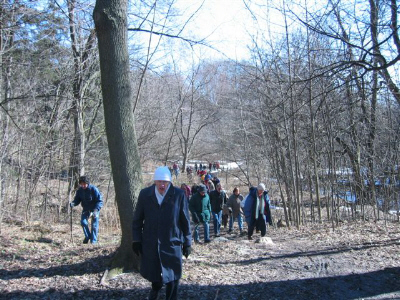
Is your collar pulled high, hat tugged low? Get your mittens out of the chest. It's time for a winter walk. And according to the weather specialists, winter's almost here. Take a long deep breath of the cold, nose-prickling air and pack a thermos of warming hot chocolate. There are places rural and urban to walk on a winter's day. If you're out in the forest, pick a well-marked trail and maybe lay a virtual trail of bread-crumbs by marking your trail with coloured tape. My brother who is a hiker extraordinaire, decorates some of his winter walks with small ornaments or bells that he's bought at the dollar store. it's quite magical to see them there.

Peter J. Thompson/National Post
 Colonel Samuel Smith Park in Toronto's Kipling and Lakeshore area is a wonderous place to visit in any season. Extending out into Lake Ontario, it's home to a marina, a bird sanctuary, and places for a brave dog to swim. Trails through a variety of trees and plants lead to a network of paths through Humber College. It's delightful to see what the college has done with the buildings of the old Ontario Asylum, once located on the grounds of what is now Sam Smith Park. It will soon be cold enough to take advantage of the Toronto's only ice skating trail located here. Skaters can lace up in the Power House Recreation Centre. This 19th-century red brick building once piped warmth to the adjacent asylum. It is now restored with its brick smokestack cathedral celings and three-storey windows intact.

November 24, 2012

The Clever Pup's Guide to Making Christmas Work - Meaningful Gifts - Child's Own Studio

The title of these posts is a bit grandiose, but Christmas has changed in my house. My companions for the holidays are  three adult males - my son, my husband and my brother. I love them to bits but Christmas is sinking into a blur of late mornings, too much beer and the Godfather trilogy. They don't even eat my baking! So for the next month I'm going to post about what I think captures the true essence of the season. So wonder as I wander. Follow me. 

Vancouver artist Wendy Tsao creates custom-made toys based on children's quirky drawings. Her company is called Child's Own Studio, and just look at what she can do. Wendy has been making these "softies" since 2007 and has created about 400 of these little wonders since then. They are an uncanny representation of what the little Picassos have drawn. Her waiting list is probably about as long as my arm, but maybe for next Christmas....I think this is an idea that would be a welcome gift for mums too. These creations  are a wonderful expression of childhood. The following is an article from the Daily Mail about Wendy's creations.  http://www.dailymail.co.uk/femail/article-2151007/Brainchild-Mother-starts-business-making-real-life-cuddly-toys-kids-paintings.html


I remember little monsters like this.


All photos Child's Own Studios. All rights reserved.

September 8, 2012

Hotel Belvedere

Wow. I finally got out of town for a night. If you're anything like me - and I think you are - I don't find the cookie-cutter uniformity of (dare I say it) American-style hotels very appealing. My husband and I stayed in the 20-room Hotel Belvedere in Kingston, Ontario in the early 90s and apart from the removal of the Georgia O'Keeffe's on walls the place is still as charming as it was over 18 years ago.

Once a fabulous hotel, it faded into obscurity as a rooming house. It was transformed back into a fabulous place again in the 80s. For the price of a room at the Holiday Inn or the Marriott or the Radisson, one can experience unique rooms decorated with antiques, wrestle with quirky showers and breakfast on the prettiest terrace this side of Italy.


  We've stayed in four rooms over the years and we've liked every one. After returning to our room at night we joked, "Shame there's no turn-down service." If you're anything like the moaners on Trip Advisor with an inflated sense of entitlement this place is not for you. But I dont't think you are.

Here's a link to their splendid place. http://www.hotelbelvedere.com/index.php plus a couple of pictures via Tripadvisor and my husband.

Top Floor, Second from the right

Where you can park your car - now where can I park these complimentary banana skins?


In the vaults there's a picture of a 29-year-old me sitting on these stairs


May 25, 2012

The Boyd Gang: Toronto Outlaws - continued


Hours before Lennie Jackson and Steve Suchan were to be brought to court to answer for Detective Tong’s murder, the Boyd Gang staged a second dramatic escape that made them the most wanted men in the Canada.

Just before dawn on September 8, 1952, the four slipped out through the bars onto a wall. To their horror, there was a cop stationed at the base of the wall. They lay on the top of the wall for a few minutes watching the cop and wondering what to do next. Unexpectedly, the officer walked across the lane and entered the nearby Riverdale Hospital. It didn't take them long to drop to the ground and disappear down the hill into the wilds of the Don Valley.

Once again a huge manhunt ensued. The reward for information leading to the gang's capture hit $26,000 causing hundreds of phone calls and letters to the police. They were holed up in an old barn near Yonge and Sheppard Streets. They were spotted many times. Most people thought they were just hobo's seeking shelter, but some became suspicious and called police.

On September 16, 1952 police closed in on the barn and surprised the gang. They were arrested without incident and returned to the familiar Don Jail. They would never escape jail again.

Steve Suchan and Lennie Jackson were hanged in Dec. 1952, while Boyd and Willie Jackson were sent to Kingston Penitentiary. Boyd was sentenced to eight life terms, but he was paroled for good behavior in 1966. He lived quietly under an assumed name in British Columbia. Edwin Alonzo Boyd died quietly at age 88 on May 17, 2002.


May 17, 2012

The Boyd Gang: Toronto's Outlaws - part 1


Daring Edwin Alonzo Boyd and his gang burst onto the front pages of Toronto newspapers due to a series of well-executed bank robberies and two breakouts from Toronto's Don Jail. Edwin Boyd's escapades are detailed in the current movie known in the US as "Citizen Gangster"

Boyd's swashbuckling style of hopping bank counters and lightning fast hold-ups riveted Toronto residents. The Boyd Gang's reign as Canada's most notorious crooks was relatively short but their escapades nearly made them local heroes until two of the members ruthlessly shot down two detectives, killing one.

Boyd was the son of a police-officer. With his face plastered with make-up and cotton stuffed in his cheeks to disguise his appearance, he robbed his first bank in September 1949. He escaped with the loot even though the bank manager shot at him as he fled.


To see how well his disguise had worked, a few days later, he walked into the same bank and changed a twenty dollar bill with the teller he'd robbed. Since he wasn't recognized he decided to sharpen his skills and become a full time bank robber.

Boyd continued robbing banks, sometimes with his a partner, sometimes solo. At one robbery the bank manager grabbed a gun from a desk drawer and popped off a few shots at Boyd who returned fire. He had no choice but to turn and run without the money. Another time, Boyd was chased in his car by a bank employee, barely escaping.

Edwin Alonzo Boyd went on to hold up several more banks until his first capture in October 1951. His luck ran out on his last attempt. Everything went wrong. His partner was caught and squealed on him. He was soon behind the iron bars of the infamous Don Jail.

At the Don Jail, Boyd made friends with another bank robber, “Tough" Lennie” Jackson and a small-time crook, Willie “the clown” Jackson. The three hatched a sensational escape plan, added Steve Suchan (AKA Valente Lesso) to their ranks, and the legend of the Boyd Gang was born.

Lennie Jackson had a wooden foot. It came in handy to hide things, like hacksaw blades. The three of them used the concealed blades to saw through the bars on an outside window. On November 4, 1951, the three slid through the opening and dropped to the prisoner's exercise yard below. Lassoing the top of a surrounding wall with some tied bed sheets they climbed to freedom.

Steve Suchan had arranged a hide-out in Cabbagetown that they could reach quickly. Realizing they would need money to keep in-hiding for a while, they pulled off the biggest hold-up in Toronto's history.

After splitting the stolen money, Lennie Jackson and Steve Suchan left for Montreal and Edwin Boyd and Willie Jackson hid at Suchan's parents  in the west end of Toronto. 

After Suchan's father stole most of the loot out from under them, the rest of the gang headed to Montreal and there they lived until Willie Jackson was returned to the Toronto Jail after being arrested for gun possession. They then drifted back to Toronto hiding out in houses on Sorauren Avenue with Suchan's folks and with his girlfriend Anne Camero in a rented house on Wright Avenue, the street where I live today.

On March 6, 1952, Police Detectives Edmund Tong and Roy Perry pulled over a black car containing Suchan and Lennie Jackson at the corner of College Street and Lansdowne. As Police Officer Tong approached the vehicle, he was gunned down and fell to the ground in a heap. They then peppered the police car with bullets. Perry was wounded in the arm, but Tong was to die several days later, but not before naming his killer, "Suchan."

The relentless manhunt was on. Suchan and Jackson who had escaped to Montreal were captured after a lengthy shoot-out. Though he had nothing to do with the shooting, Boyd felt the pressure. Boyd was the only gang member left to be captured.

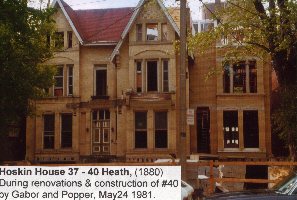
Detective Payne discovered that Edwin Boyd was to move into an apartment he had rented on Heath Street. Hidden in a neighbour's house, Detective Payne watched Boyd move into the flat. Wanting to avoid a shootout, he waited until he was sure everyone was asleep. At the crack of dawn the police crept inside the house and captured Boyd and his wife while they were still in bed.

Boyd was once again a resident of the Don Jail and, incredibly, was put back with the other three gang members. With some metal, a file and saw blades, they were able to make a workable copy of one of the guard's keys. They could now get out of their cells in order to saw through some bars leading to freedom.

Just hours before Lennie Jackson and Steve Suchan were to be brought to court to answer for Detective Tong’s murder, the Boyd Gang staged a second dramatic escape that made them the most wanted men in the Canada.


Find out what happens to Toronto's outlaws in an upcoming entry.

January 12, 2012

The Elephant and the Dove - Diego Rivera and Frida Kahlo at the AGO

In the autumn of 2012  the Art Gallery of Ontario will exhibit works by Mexican artist Frida Kahlo and her on again, off again husband Diego Rivera. Frida & Diego: Passion, Politics and Painting will feature works by the two artists, primarily drawn from the Museo Dolores Olmedo in Mexico city. The works to be exhibited will highlight Rivera and Kahlo’s lives, both together and apart, their politics and how their passionate views and activism influenced their work. The exhibition will be at the AGO from Oct. 20, 2012 through Jan. 20, 2013. Frida & Diego: Passion, Politics and Painting is presented in collaboration with the High Museum of Art in Atlanta, Georgia, which will display the exhibition in February 2013. 
Photo by Carl van Vechten via Wikipedia
 Frida Kahlo is a fascinating woman who should never be dismissed as the lady with the eyebrows who painted only portraits of herself. Her paintings were described by the Surrealist André Breton as “a ribbon around a bomb,” She was called a Surrealist by some, but she resisted the label and claimed she painted her reality, not her dreams. Rivera's and Kahlo's work show their support for the Communist movement, as well as the concept of Mexicanidad, an identification with Mexico’s indigenous roots.

Frida's relationship with the muralist Diego Rivera was a tempestuous one. They married in 1929. They divorced in November 1939 only to remarry in November of 1940. It seemed to be a case of "can't live with him, can't live without him". Early in their relationship they had a double studio/house built in San Angel; separate living quarters joined by a bridge. Rivera, despite his 300 pounds, was catnip for the ladies. Frida had many affairs with both men and women including Leon Trotsky, sculptor Isamu Noguchi and Jaqueline Lamba, the wife of André Breton. Many photos of Diego and Frida can be viewed on the PBS site.
riveraexperts.com


Hayden Herrera's biography of Frida Kahlo is an excellent read. Adapted from Herrera's book was the equally-excellent 2002 biographical film Frida. The movie was directed by Julie Taymor, currently avoiding brickbats for the Spiderman play. The movie is up there on my list of top 20 films and it's worth seeing.

Can't wait for October.

December 21, 2011

The Clever Pup's Christmas Gift Ideas - Humanitarian Gifts

Doing your part to make the world a better place is just a click away. Here are some charitable Christmas present suggestions.

We sponsor a little boy called Norbert in Kenya through Plan Canada. Plan Canada promotes their "Gifts of Hope" at this time of year. One goat for a village costs $75. This gift provides the possibility of a livelihood and income. Imagine what a flock of 12 could do. Ten mango trees would set you back only $100. They are planted in school gardens and their juicy and nutritious fruit provide an incentive to come to school. I especially like the idea of the Motorcycle Ambulance. For people living in remote communities without healthcare services, this $150 gift is a lifeline: it brings healthcare workers to isolated villages and it carries people from those villages to community health centres.

We also give monthly to Médecins Sans Frontieres (Doctors without Borders). They were established in 1971 by a small group of French doctors who had worked in Biafra. Upon their return, they were determined to find a way to respond rapidly and effectively to public health emergencies, with complete independence from political, economic and religious influences. MSF is one of the world's leading independent international medical relief organizations, working in nearly 60 countries worldwide and with operational centres in 19 countries.

If something doesn't happen soon at the Toronto Zoo, our illustrious mayor Rob Ford will probably let the animals out to graze in the backyards of Eastern Scarborough. I used to sponsor a Matchies Tree Kangaroo. I bet you didn't even know they existed. Bob Barker's rescuing our elephants. Why not "come on down" and  sponsor your favourite zoo animal.


Moosoneepuppyrescue.com
For those ready to have a dog in their life there is the Moosonee Puppy Rescue. My Toronto neighbourhood is teaming with kind-hearted people who have adopted these dogs. Here's a bit about the Rescue. The Moosonee Puppy Rescue began in 2003. In the isolated First Nations communities of Moosonee, Moose Factory, Attawapiskat, Fort Albany and Kashechewan, dogs are left to face a life of neglect. Overbreeding occurs and as there are no veterinarian services in these communities, dogs may be trapped or shot. These puppies have amazing temperaments (I know 2 personally), but puppies take a lot of attention and devotion. If you're ready to take the leap, contact Sharron at Moosonee Puppy Rescue. If you can't take a dog, there are other ways to help out by purchasing crafts and photographs created in support of the dogs. Or you can donate by visiting this page.

The Memory Project will provide every living Canadian veteran of the Second World War and the Korean War with the opportunity to share their memories through oral interviews and digitized artefacts and memorabilia.  This nationwide bilingual project will create a record of Canada’s participation these wars as seen through the eyes of thousands of veterans. I think this is a great idea. As I cry more at each passing Remembrance Day, I thought I'd better donate.

thestop.com
Another Toronto foundation that I think is just great is The Stop. The Stop strives to increase access to healthy food in a manner that maintains dignity, builds community and challenges inequality. Better than a food bank, The Stop provides frontline services to the community including community kitchens, bake-ovens and markets, a sustainable food production and educational centre with a state-of-the art greenhouse. They have after school programs and summer camps focusing on teaching kids positive attitudes towards healthy eating. The Drop In is a safe place where anyone can enjoy delicious food. And speaking of dropping in - Jamie Oliver dropped in for a half-hour whistle-stop but ending up touring The Stop's Green Barns and After School programs for two hours. "Amazing", he said. There are many ways to give. Become a member for $50.

November 25, 2011

Hey, I Could Do That or Lemieux Breaks Record for Canadian Art


1910 Remembered (1962) depicts artist Jean Paul Lemieux as a child, standing between his parents who were soon to separate. Looking out from the canvas between his two stern, statue-like parents, Lemieux seems both hopeful and sad. The light on the parents seems cloudy, unclear, perhaps reflecting their mood at the time. I'm joking when I said I could do that, but they do looking amazingly simple, don't they.  Here are a few more examples of Lemieux. I love this one called Summer. Unfortunately the only repro I could find was on a postage stamp. I would definitely give this one house room.

Julie et l'Universe

The Evening Visitor
Lemieux (1904-1990) was a master of placing his subjects on the canvas. His stark horizons and his fields of snow or grass recreate a feeling of immensity I remember as a small child. Lemieux's work came from his imagination. He painted indoors without live models. To me his people are just another element of shape and colour. Although they do have such sweet faces.

I should be working on my other art paper today but my brother distracted me with the news that Nineteen Ten Remembered sold for $2.34 million, breaking a record for post-war,contemporary Canadian art sold at auction. Here are some details, pre-sale. Heffel.com has a listing of some of the other prices realized

Jean Paul Lemieux's northern views are an easy sell 

By John Pohl, Montreal Gazette Visual Arts critic
 
November 18, 2011< MONTREAL - The auction sale last spring of a Jean Paul Lemieux painting, Les Moniales, for $1.02 million has brought a number of the artist's works off the walls of collectors' homes and onto the market. One of them is Nineteen Ten Remembered, a painting well known through reproductions. It shows the artist as a boy with his soon-to-be-split-up parents, who are placed on either edge of the painting. The scene is set in the cold, barren northern landscape, overhung with the grey sky that Lemieux made his own.

This painting and eight others by Lemieux will be sold by Heffel Fine Art Auction House in Toronto on Thursday. The estimated selling price of Nineteen Ten Remembered has not been divulged, but it is likely to be more than $1 million, meaning the only way it will ever find an honoured place in a public museum in Canada is if the buyer donates it.

As popular as Lemieux's paintings of landscapes and figures are in Quebec, it may be fitting for one of his greatest works to find a home outside Quebec, or even Canada. For Lemieux shunned his reputation for being a Québécois painter par excellence, as art historian François-Marc Gagnon pointed out in an interview and in a short essay he wrote for the Heffel catalogue. Lemieux wanted to be known as a painter of the "north," not as a painter of a certain locale, and was exhilarated by the recognition he won in Moscow and Prague when his paintings were exhibited there in 1974. It proved to Lemieux that his art was universal, Gagnon said.

At home, Lemieux was at odds with his contemporaries, the Automatistes. The Montreal Museum of Fine Arts collected the abstract paintings of the Automatistes, and the Musée nationale des beaux-arts du Québec collected Lemieux. Gagnon suggested that the museum in Quebec City or the National Gallery in Ottawa would be a more likely home for Nineteen Ten Remembered, should it ever make its way to a public institution.

But, of course, anyone willing to spend more than $1 million on a painting should be able to enjoy it in the privacy of his or her home, sitting on a sofa, as Gagnon said, "with tears in their eyes.
 
Riopelle Grande fête
Lemieux gave Nineteen Ten Remembered to his daughters, who sold it to a member of the Archambault family, who sold it to the neighbour who has consigned it to the auction. That collector is also putting a Riopelle on the market with an estimated value of $900,000 to $1.2 million.  Grande fête is an abstract made of strokes of red-brown, blue and yellow organized by black and white lines. Riopelle painted it in 1952, when his reputation in Paris was beginning to take off, Gagnon wrote. Grande fête is one of six Riopelles in the auction.

More than 25 well-known Quebec artists are represented in the auction, accounting for almost half the 179 paintings. One group of 16 paintings came out of a bank vault in Old Montreal, the property of François Dupré, who owned Montreal's Ritz-Carlton Hotel until his death in 1966. Dupré collected works by Canadian Impressionists and displayed them in the hotel; they went into storage in 1987. David Heffel, president of the auction house, said a family member contacted Heffel about the paintings. "It was a great surprise," he said. "It was a nice call to get from Europe."

The Dupré collection includes paintings by Emily Carr, A.Y. Jackson, Cornelius Krieghoff, Maurice Cullen, Clarence Gagnon, Marc-Aurèle de Foy Suzor-Coté and James Wilson Morrice, whose Régates à Saint-Malo from 1904-05 is expected to fetch $200,000 to $300,000.Heffel said the estimates are conservative. The average sale price has been twice the low estimate, he said. The paintings were on display at Galerie Heffel on Sherbrooke St. last week. To see them now, in reproduction, go to heffel.com

November 13, 2011

Clotilde's Adventures in Canada


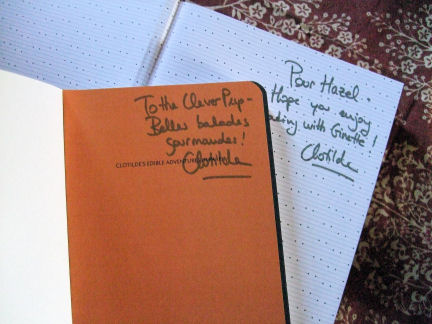
Yesterday, November 12, I had the pleasure of meeting Clotilde Dusoulier, creator of the Chocolate & Zucchini blog, while she was here in Toronto.

Usually Paris-based, Clotilde has just wrapped up two weeks here in Canada as the Gastronomic Writer in Residence at the Stratford Chef's School about 2 hours outside Toronto. Clotilde started Chocolate & Zucchini in 2003 and the lucky girl signed a book deal in '07. C&Z, along with the odious Sartorialist, were the first two blogs I followed when I finally entered the blogging universe.

The Cookbook Store at Yonge Street and Yorkville Avenue is where the book signing was held. Clotilde was there, promoting a book she has edited entitled  The Art of French Baking originally written in the 1930s by Ginette Mathiot. I also took my copy of Clotilde's Edible Adventures in Paris for her to sign. I poured over that book before I went to Paris in 2010. I actually didn't follow too much of her advice, but with cross-referencing I got to know the Arrondissements a little better.

When I got to The Cookbook Store at the appointed time there was just the staff plus about five fans. I thought I was in for a very intimate meeting. I wish it had been so. Clotilde was delayed because of highway issues. After a 20-minute wait there were about 30 gathered in the tiny shop.
Clotilde is lovely,  fresh and sounds just what I thought she would. At  just 30 years old she has an amazing life ahead. Living in Montmartre, writing a blog about food, having that content put into book form, traveling the world. - I'm deeply envious. Here are some pictures I took.


November 11, 2011

John McCrae: In Flanders Fields


John McCrae, a Canadian soldier, doctor and a poet is best remembered for his poem, "In Flanders Fields". Born in Guelph, Ontario in 1872, he was educated at Guelph Collegiate and the University of Toronto medical school.

As a youngster John joined the Highland Cadet Corps at the age of 14, and at 17 he joined the Militia Field Battery commanded by his father. By 1896 he achieved the rank of Lieutenant. In the meantime he was training to be a doctor at the University of Toronto. During this period he wrote poetry. Sixteen of his poems were published in various magazines.

In 1898, along with his degree in medicine, John received a gold medal from the University of Toronto for his high marks. When the South African War (Boer War) started in October 1899 John felt it was important to fight. He was commissioned to lead an army from Guelph. Though suffering from chronic asthma, he served in South Africa for a year. While stationed there, seeing the poor medical treatment of sick and wounded soldiers disturbed him.

After returning to Canada and resigning from the military, John picked up his life where he had left off. He resumed his studies and went on to become assistant pathologist at Montreal General Hospital. In 1905 he set up his own practice as well as continuing work at several hospitals.

When the Great War broke out in August 1914, John was among the first to enlist. He was appointed brigade surgeon to the First Brigade Canadian Forces Artillery. Just before he left, he wrote to a friend:

"It is a terrible state of affairs, and I am going because I think every bachelor, especially if he has experience of war, ought to go. I am really rather afraid, but more afraid to stay at home with my conscience."

John sailed for England with the First Contingent on Oct. 3, 1914. After spending four months on the Salisbury Plain, the First Contingent moved to France in early February 1915 and by the 10th of March, John would first experience the fighting of the Great War at Neuve Chapell. He had taken his favorite horse, Bonfire, with him to France, but had few riding opportunities for some time.

McCrae helped the wounded from the trenches near Ypres, Belgium. This area, which is traditionally called Flanders, was the sight of some of the heaviest fighting of the Great War. In April, the Germans launched their initial chlorine gas attack against French troops who were fighting next to the Canadians. The French collapsed as the gas overcame them and it was left to the Canadians to fill the gap and stop the advancing Germans.

On May 2nd Lieutenant Alex Helmer, a friend of John's, was killed in the fighting and buried beneath a simple wooden cross. John wrote his most famous poem the next day and it was Alex's death some say inspired John to write the poem that has become symbolic for the suffering and loss of the Great War. In Flanders' Fields was first published in the British magazine Punch in Dec 1915 and became the most popular poem of the War.

Soon after the poem was written John was transferred to No.3 Canadian Field Hospital in France as Chief of Medical Services. This move away from the front would spare John from some of the dangers of war but not the horror, for here John would treat thousands of the wounded evacuated from the trenches after battles such as the Somme, Vimy Ridge, Arras and Passchendaele.

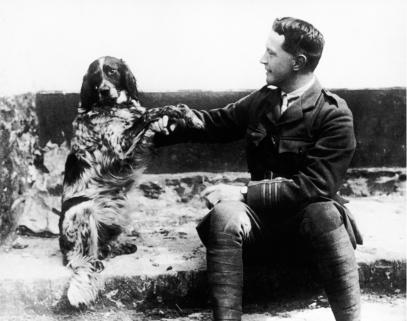
During the summer of 1917 John was troubled by attacks of asthma and bronchitis possibly aggravated by the gas he inhaled at Ypres. His health deteriorated noticeably. He lost much of his enthusiasm, and took frequent solitary rides on Bonfire, accompanied by his spaniel , Bonneau, a stray rescued from the battlefield.

Just after receiving word he was appointed consulting surgeon to the British Army, the first Canadian to be so honoured, McCrae fell seriously ill with pneumonia. On January 28, 1918, six days after being admitted to hospital, McCrae died. He was 46 years old. He was buried with full military honours in Wimereaux Cemetery, near Boulogne, France. The large funeral was attended by hundreds of mourners, from generals to nurses and medical orderlies. His horse, Bonfire, led the burial procession, its master's boots reversed in the stirrups.

McCrae's burial site is commemorated by a large plaque at the main cemetery entrance and by a memorial seat built into a wall nearby. His family home at Guelph, Ontario, has been preserved as a museum, with a memorial cenotaph and garden of remembrance. It is "In Flanders Fields" that remains his most meaningful memorial, It was translated into many languages, and led to the poppy being adopted as the Flower of Remembrance for the war dead of Britain and the Commonwealth. To this day, John McCrae's poem is read aloud at Remembrance Day ceremonies held every November 11th throughout each nation of the British Commonwealth.


I originally wrote this post in 2003 for my son who was nine at the time.