Showing posts with label The Germanophile. Show all posts

April 8, 2011

Tim Mälzer – Germany’s Delicious Dish


The first time I watched Tim Mälzer on Bavarian television I didn’t know if I was watching a chef or an ex-con. With his stubbly scalp and his rascally looks Tim Mälzer was no Jamie Oliver but while I watched, he prepared a 3-course meal in 30 minutes.

Mälzer was born in Hamburg in 1971. He is inevitably compared to his English friend Jamie Oliver as both are brash young celebrity chefs; Oliver - world-wide and Mälzer - Germany, but just for now…

Mälzer is probably Germany’s most influential chef. 1.5 million viewers tune in nightly to his show on Germany’s Vox network. Although I can only understand one word in 100, I can tell that he’s witty, hip and fast. He cooks meals in real time at break-neck speed. His popular, albeit, bad-boy image has derived from his devotion to Rock & Roll and customized pick-up trucks. On a DVD I have of Mälzer, he actually has the F-word on his tee-shirt. Oh, those crazy Europeans! His 3rd restaurant (in the works) is rumored to be in a former prison.

His avoidance of things “gourmet” has won him fans while critics steer clear. Mälzer’s motto is “fast, easy, delicious.” On his TV show, "Schmeckt Nicht, Gibt´s Nicht" (roughly translated: “We don’t do tasteless”) he favours simple dishes that can be cooked at home by anyone with the slightest interest in food. I hear that at one of Mälzer’s Hamburg restaurants, the lunch menu is only €8 because that’s what his customers can afford. At his most famous restaurant, The White House (Das Weiße Haus), he dispensed with a menu and prepared what he felt like.

He met Jamie Oliver in 1997 when the two of them worked at Carluccio’s Neal Street Restaurant in London. He spent 18 months in London which included a short stretch at the Ritz Hotel, which he says he quit the day after a badgering head chef caused a sous-chef to have a nervous breakdown. “I cannot stand bullies in the kitchen”, says Mälzer. Gordon Ramsay beware. You catch more flies with sugar.

A multiple award winner, Tim received the Golden Camera prize in 2006, as Germany’s most popular television chef. He’s sold millions of books and DVDs. The Rosenthal china company has developed a “Tim” collection of tableware called "Mahlzeit!". He is widely parodied on YouTube.

Today he’s grown his hair back and he’s really quite handsome in a gapped-tooth kind of way. I bought myself a DVD set from Amazon.de and every time I watch it, I learn a little more German. There is so much more to Germans than just beer and sausages.

Here’s a link to Tim Mälzer’s website. It’s in German only but I would recommend having a look. http://www.tim-maelzer.de/

schmeckt gut, Tim

Tschüss

photos were borrowed from http://www.tim-maelzer.de/ . Danke

March 9, 2010

Edmund Dulac

Edmund Dulac, 1882-1953 was a French book illustrator prominent in the early part of the 20th Century, during the so-called "Golden Age of Illustration." I find his work fabulous and evocative. We must have had a book illustrated by Dulac when I was a child, but I can't remember. I have a huge affinity for Chinese lanterns. I think Edmund Dulac and Rupert Bear are jointly responsible for that.

He began his career studying law at the University of Toulouse, but switched full-time to art. He moved to London in 1904, becoming a citizen in 1912. At the age of 22 Dulac began illustrating for Dent and then Hodder & Stoughton. The Leicester Gallery would commission paintings from Dulac and sell the rights to Hodder & Stoughton. The publisher would publish one book a year and the Leicester Gallery would sell Dulac's paintings.

Many books were published under this collaboration: The Arabian Nights, The Rubaiyat of Omar Khayam, Sleeping Beauty and Other Fairy Tales and Hans Christian Andersen to name a few.

 His illustration for the Emperor's New Clothes reminded me of our view from our balcony in Regensburg. It doesn't really look that close, but I've included it anyway.But if I were to crane my neck, buildings just like the one's Dulac depicted were everywhere. Just like the hotel we were staying in. That's our balcony above the first white umbrella in the picture below.
 Now that was a great hotel.

June 21, 2009

The Blue Rider in the Yellow House


“You can imagine the opposite.”

Scrawled in violet neon across the yellow Italianate façade of Lenbachhaus these words make you pause and say “it doesn’t get much more opposite than that”. Inside too, Munich's Lenbach House exhibits distinct styles of art. Here advocates of Romanticism and Biedermeier share space with the proponents of the "Blaue Reiter" movement.


My son and I had been to the Paläontologisches Museum in Munich, and while that was fun, mainly from an architectural standpoint, he nixed the idea of anymore museums. Little did I know that the yellow building we had been looking out upon was The "Städtische Galerie im Lenbachhaus", the former villa of the "painter prince" Franz von Lenbach, The palatial house had been on my list. So I told him "Just 45 minutes."

Franz von Lenbach was a Bavarian who spent most of his career in Munich. Remembered as a portraitist, his Venetian style of painting appealed to the aristocracy and rulers of Germany. He met and befriended Otto von Bismarck in 1878. Lenbach painted the Iron Chancellor nearly one hundred times during his career. Richard Wagner, Franz Liszt, and William Gladstone were other subjects.

Lenbach’s fame gained him the title of "Malerfürst" or “Painter Prince”, and the accompanying commissions made it possible for him to build palatial house for his family and himself. Gabriel von Seidl designed his Florentine villa and the years 1887 – 1891 saw its construction on Munich’s Königsplatz. After his death, Lenbach’s house was turned into a museum.

Today Lenbachhaus owes its reputation as an internationally significant museum to its unique collection of works by the group of artists known as “Der Blaue Reiter” or "The Blue Rider". “Der Blaue Reiter” was a group of expressionist artists who established themselves in Munich in 1911 and contributed greatly to the development of abstract art. The museum contains examples of works by Wassily Kandinsky, Gabriele Münter, Franz Marc, Paul Klee, and August Macke.

Many examples of “The Blue Rider” contained within Lenbachhaus are courtesy of Gabriele Münter. Once Kandinsky´s pupil and companion she left many of their works to Lenbachhaus on the occasion of her eightieth birthday in 1957.

In addition, Lenbachhaus also offers a look at the 19th century Munich painters such as Lenbach himself, his teacher Carl Theodor von Piloty, August von Kaulbach, and Franz von Stuck.

Also on display are works by members of the Munich Secession founded in 1892, including painters such as Lovis Corinth, Max Slevogt and Fritz von Uhde. Some of the rooms have kept Lenbach’s original design and it’s staggering just how rich an artist could be. The 45 minutes I allotted myself was not enough. Next time I’ll be at my leisure and also visit the amazing gift shop and restaurant on the terrace.

Städtische Galerie im Lenbachhaus

http://www.lenbachhaus.de/cms/index.php?id=41&L=1

Address: Luisenstraße 33, 80333 München

Phone: (089) 233 320 00

Opening Hours: Tue. – Sun. from 10 a.m. to 6 p.m., Mon. closed

A daily ticket is 12 Euros with reductions for concessions.

May 20, 2009

Hotel Orphée


Real life intervenes today; dog walking, paid work and a visit from the window salesperson. Windows made me think of the amazing view we had from our hotel in Regensburg the Hotel Orphée when we stayed in the Bavarian town in 2006.

Our balcony was as big as our room and overlooked the town square with the city hall on one side and a view down Wahlenstraße to the left. Eye-tickling blue lobelias festooned the cast iron railings.

A great memory to top this off was that despite votive candles on both the café tables on the balcony we had no matches. Junior Pup and I watched as Husband Pup left the hotel with a candle in hand walked down the cobblestones to a nearby restaurant and came back up the dark street with the lit candle.

The Hotel Orphée is undoubtedly the coolest hotel I have ever stayed in. Absolutely beautiful and a great deal too.

Please check out their link. http://www.hotel-orphee.de/english/

I leave you with two non-digital photos of our views.

March 31, 2009

German Film


I see that two of my blogging freundin, Willow and Anna at Mit Herz und Hand, have been talking about German films today. I thought I’d better jump into the fray. The German movies in my collection are as follows:

Mostly Martha, a food and relationship movie, is one of my all-time favourites in any language. I just want to crawl up and live inside this film. An obsessed chef becomes the guardian of her niece and a zesty Italian helps her see the light and relax. There is an Americanization of Mostly Martha called No Reservations. While the American film follows the movie verbatim, the German version is much more real. This film also introduced me to the great music of Paolo Conte. The movie stars Martina Gedeck and the gorgeous Italian Sergio Castellitto. Marry me!

Run Lola Run, known as Lola Rennt, is so hip it hurts. It involves two young lovers, a theft (die tache! die tache!) and three possible endings. Oh, and lots of running. It’s different from any other movie I’ve seen. It stars Franca Potente and Moritz Bleibtreu.

Moritz (Pillows-for-Lips) Bleibtreu also stars in Im Juli. Serendipity leads a mild mannered teacher on the trip of a lifetime. This movie is really fun and edgy. If you watch it you will be deceived by the first 10 minutes, but stick to it.

What To Do In Case of Fire is the story of a group of happy-go-lucky German revolutionaries who left a bomb behind in 1980s Berlin only to have it explode 10 years later when everyone has gone on with their lives to various degrees of success. I’m a push-over for an ensemble cast. This film features the sternly handsome Til Schweiger who I saw at the Frankfurt airport!

Nirgendwo in Afrika – Nowhere in Afrika is a movie we first saw at our local repertory cinema. My son received it from us at Christmas. Willow did a good job describing it. I’ll send you over to her place.

We also own the complete Heimat series. This is an amazing tour-de-force. Made for TV, it chronicles the Simon family from 1918 to the mid-1990s. It was written and directed by Edgar Reitz and was made over 20 year span. It’s a big investment of time, but it’s a masterpiece.

March 28, 2009

Wo ist Waldo?


My liebling is in Munich for a few days. He has plenty of business meetings and schmoozing to keep him busy but he also has a lot of time on his hands. We are too old and disinterested to Twitter. We don't tweet. He won’t even use a mobile phone. So between the times when I can reach him on a land line, I wonder what he’s up to.

The Atzinger is a good bet. It’s a legendary student pub with a lively mixed clientele situated across from the Ludwig-Maximilians-Universität. The food is hardy; wurst abounds. I hear it’s been renovated and has a lovely new decor. Maybe they’ve had a change of staff too.

When the three of us were in the Atzinger in 2003, our waiter was large, red-faced and wore a wrestling belt/truss thing on the outside of his clothes. Despite his obvious German-ness, he looked exactly like a thug from an Ealing Comedy and wanted to tear our heads off. Whenever we said "Danke" for our beer or our meals, he’d yell "BITTE" in the most unusual and unconvincing manner. We spent most of that meal trying to determine what we’d done to piss him off. I don’t know if the Atzinger still has that student-bar feel but one good thing; it would be less smoky, since Germany passed the no-smoking rule in restaurants.

Atzinger, Schellingstr. 9, 80799 Munich, Phone 089/28 28 80. Open daily 10-3 clock

Maybe he’s across the road from the Atzinger at News Bar. News Bar is one of those kind of essential places that fills a niche. It’s got a wide ranging menu but I think when I was there with my son in 2006, all we had was onion soup and cream cheese on a bagel. I tried so hard to order our meals in German but our waiter was determined to take our orders in English. It’s a fairly comfortable, cosmopolitan place, that’s not too different from restaurants at home. It’s modern and it’s cool.

It’s called News Bar because they have at least three televisions tuned to news channels and a wide range of international newspapers and magazines displayed on the back wall. Akbar and Jeff are on the wall confessing their dislike for one another.

News Bar, Amalienstrasse 55 http://www.newsbarmunich.de

Now, I only have a passing relationship with the traditional Max Emanuel Brauerei on Adalbertstrasse. Will Waldo be there? I was there with him in 2005 and although it has a real Munich feel inside, my liebling, who has been there since, says it has an astonishing beer garden in its back court yard. I remember ice-cream. It’s been around for over 100 years so it’s seen a lot of stuff. Despite its being in the middle of Munich’s Schwabing neighbourhood it’s very quiet.

They also have a large dance floor in a separate room at the back. There are salsa classes there several nights of the week with Tango every Tuesday. When I excused myself to visit the WC I happened upon the dancers in the back room. Incongrous in this Bavarian beer hall, it felt like a scene from the Tango Lesson.

Max Emanuel Brauerei, Adalbertstraße 33, 80799 München www.max-emanuel-brauerei.de/

So where is my liebling; my Waldo? I’d say - first Max Emanuel, then the Atzinger, then News Bar. He’ll probably surprise me by going somewhere new. I hope so.

top picture: Atzinger, http://www.muenchenblogger.de/

middle: News Bar, http://www.pointoo.de/

bottom: Max Emanuel, http://www.max-emanuel-brauerei.de/

March 27, 2009

The Walled City


Two great historic images of Munich via www.alte-landkarten.de

Saturday Morning - Samstag Morgen


Good morning, ladies and gentlemen.

The time in Munich is ten o'clock. The temperature this morning is six degrees Celsius and cloudy. Thank you for flying Air Canada / Star Alliance.


Guten Morgen, Damen und Herren.

Die Zeit in München ist zehn Uhr. Die Temperatur heute Morgen ist sechs Grad Celsius und wolkig. Vielen Dank, dass Sie für den Flug Air Canada / Star Alliance.

Yawn!!

March 13, 2009

Mit Herz und Hand


Jonathan Borofsky's 6-storey-tall Walking Man was completed in 1995 and can be seen on Munich's Leopoldstrasse as can mein Liebe in less than a month.

Speaking of things German, Anna at Mit Herz und Hand has completed her 7 random things. Please pay a visit to her unique and clever site.

January 6, 2009

Meersburg - Part 3


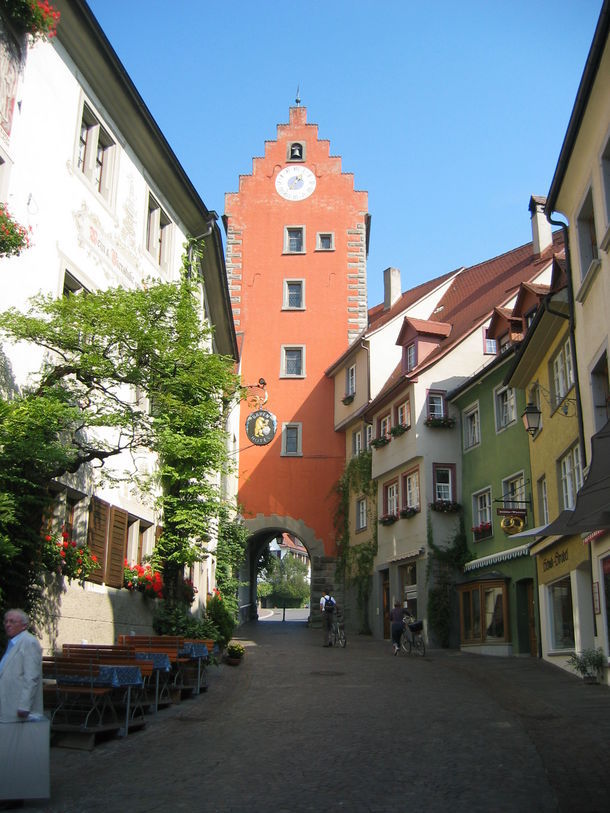
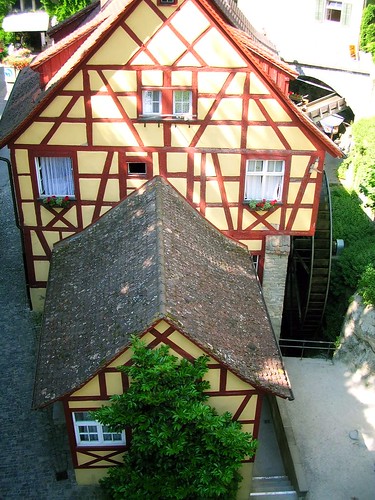
To the north of the Meersburg's Schlossplatz lies the Marktplatz, with attractive half-timbered buildings and the eye-catching Obertor or Upper Gate built between 1300-30 stuccoed in bright orange. Some of Meersburg's prettiest hotels are located in this part of the upper town including the Gasthof Zum Bären circa 1605 where we were booked, with its pretty oriel windows and plaster mural of bears, hence "Bären".

Chef/Owner Michael Gilowsky oversees the Zum Bären and its traditional dining room where we enjoyed the best meal of our trip. To drink, we had a white wine from the Bodensee's own vineyards. One of Mr. Gilosky's waitresses asked me if I knew the English for the Eierlikör or Egg-Liqueur sauce that my fried banana was floating in. I suggested "custard" but the alcoholic content led me to believe I was mistaken. Egg-Liqueur was just fine. Noah had his first schnitzel here, which he enjoyed almost as much has his spaghetti ice cream.

Northwest of the Marktplatz, behind the Gasthof Zum Bären is a former Dominican convent now occupied by the Bible Gallery, the Municipal Library and the Municipal Museum. But we'll have to save that for another time.

Next morning the weather had cleared. When I pushed open the window of our room at the Zum Bären, I was overlooking the heads of the vendors at Meersburg's Saturday market. Bright and early, merchants were selling meat, fish, and vegetables plus honey and candles.

While taking the cobblestone Steigstrasse towards the ferry dock, George braced himself, walked into a stationery shop and asked, in German, for a print of Meersburg's Old Castle. An attractive link between the upper and lower towns, Steigstrasse is lined with colourful houses and cafes. Various walls lining this steep street are adorned with gargoyles, some old and some new, and each business has an ornate wrought iron sign dangling over its door.

After walking around Meersburg's lower town and peering at the menus of its many restaurants, we sauntered unceremoniously onto the 11 o'clock ferry for Konstanz. With the balmy wind in our faces we watched Germany and the old castle receding and we wished we'd stayed longer. We'll be back.

The Gasthof Zum Bären located at Marktplatz 11 has a German only website at http://www.baeren-meersburg.de/. Tel.: 07532 - 43220 Fax: 07532 - 432244
email:
post@baeren-meersburg.de

Double rooms start at 82 Euros and go to 108 Euros

Meersburg - part 2


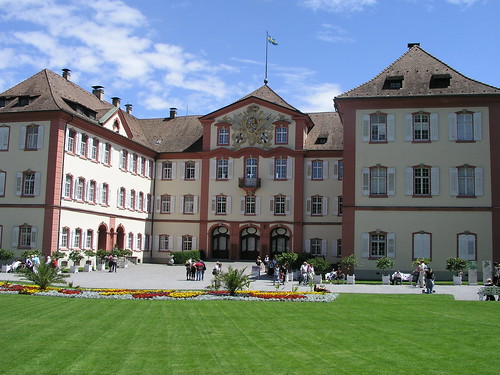
Just east of the Altes Schloss's drawbridge, the pink Neues (New) Schloss overlooks the Meersburg's lower town. Built in 1710 as the baroque residence of Prince Johann Franz Schenk von Stauffenberg, the new castle includes the Prince Bishops' residence, complete with outstanding ceiling murals and exquisite plasterwork creations. The City Gallery (Städtische Galerie)is found on site.

Located on the 1st floor, the gallery shows works of artists who established themselves in Meersburg in the 1920s and 30s and features Hans Dieter, Waldemar Flaig and Kasia von Szadurska. Paintings features Meersburg and Lake Constance motifs are also featured.

As Noah explored the Neue Schloss's neatly trimmed pattern of gardens, George and I gazed over the terrace toward Switzerland and the island of Mainau in the middle-distance. A short ferry-ride to the south, Mainau is a privately owned island paradise. However the Swedish Count and Countess Bernadotte welcome visitors to their exotic and unexpectedly tropical island.

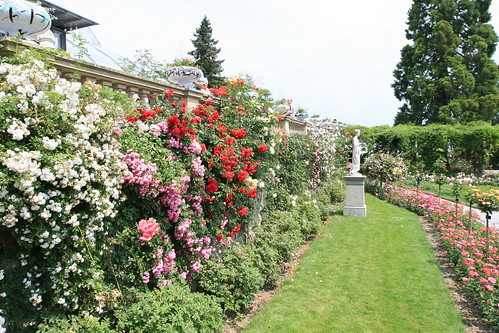
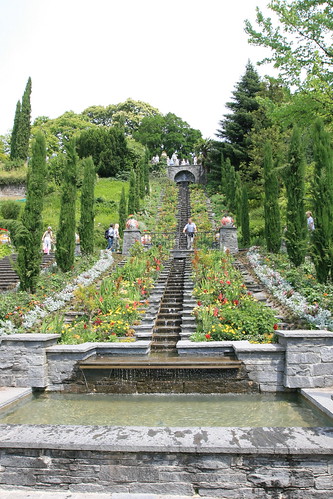
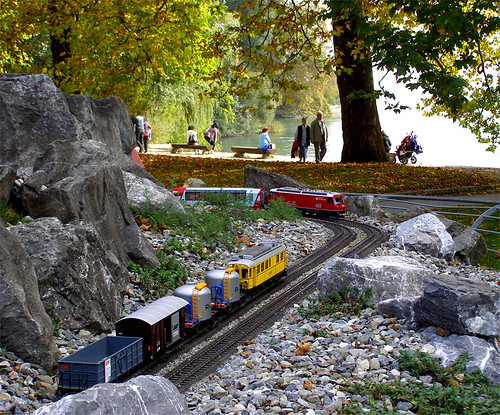
Throughout the unique microclimate of the Insel Mainau paths lead to a butterfly house, a vineyard, a rose garden and an arboretum. Palm trees and oranges grow here. In addition to the island's many fountains is an impressive Italianate garden with a water staircase. Kids have an area to themselves with pony rides and a model railway. At the heart of Mainau is its baroque castle and adjoining church. There are at least half a dozen places to eat, from fine dining in the Chestnut Garden, to a snack at the Butterfly Bistro or just a beer on one of the terraces.

Back on the mainland, across the cobbles of the Schlossplatz is the esoteric yet compelling Zeppelin Museum. Overseen by a hovering bee of an attendant this private museum has 15,000 artifacts relating to airships. Collector Heinz Urban has amassed a huge personal collection of zeppelin relics including uniforms, girders, gauges and models. In fact Count Ferdinand von Zeppelin was born just across the Bodensee in Konstanz. Noah, a big fan of ironic tragedy, was impressed to see the melted cutlery from the Hindenburg. Oh the humanity! Our trip through the small museum was prefaced by an in-depth, German only, video.

If you go:

The Meersburg Zeppelin Museum is located at Schlossplatz 8. March until the middle of November its open from 10:00 a.m until 6:00 p.m. Admission is Adults 3 Euros, children 2 Euros. An informative website is found at www.zeppelin-kurier.de

The Gallery in the Neues Schloss is open every day from 10:00 am to 1:00pm and 2:00 until 6:00 pm. from April to October. Adults are 4 Euros and Children 1 Euro.


The Island of Mainau is open all year round. Family tickets are available Adults are 12.90 Euros, children 4.50 Euros. More information can be found at www.mainau.de

Meersburg - Germany's Oldest Inhabited Castle


The wind howled behind us as the three of us advanced through the dining hall of the old castle. Shivering, we rushed past the ancient windows as arrows of rain lashed the metre thick walls.

Manoeuvring past the sword-wielding sentries, we made it past the oubliette; the pit from where no man returns. The rain needled our faces as we ran down the ancient flagged stairs only to find ourselves in the romantic teashop on the terrace.

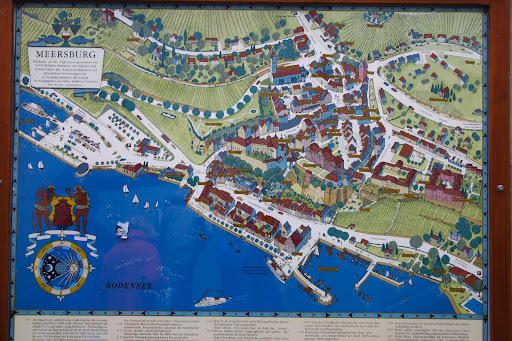
The teashop of the Altes Schloss Meersburg was closed that day but thankfully not the rest of the castle. Altes Schloss or Old Castle Meersburg eponymously dominates the town of Meersburg, a medieval German village of 5,500 situated on the northern shore of the Bodensee in the state of Baden-Württemberg; a short ferry ride from where Germany and Switzerland hold hands in Konstanz.

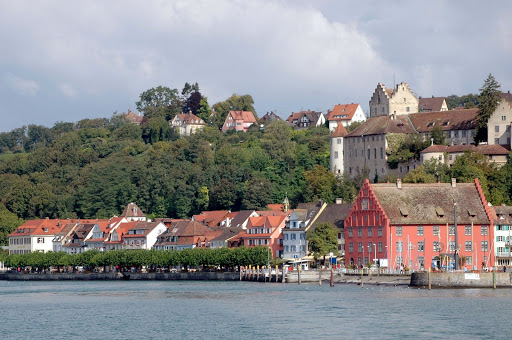
Meersburg is picturesquely situated on a steeply sloping hillside, with an upper town and a lower town. With its paint box colours and winding lanes Meersburg is a gem of medieval architecture.

While medieval in appearance, Meersburg has the air of a seaside town. An abundance of small hotels and restaurants line the Seepromenade, Meersburg's own little stretch of the Bodensee. Tethered yachts jostle in the waters known alternately as Lake Constance. Switzerland is clearly seen just 5km away.

Less than an hour earlier my husband George, my then 9-year-old Noah and I madly dashed to catch the bus departing hourly from the train station of nearby Friedrichshafen. Sitting cheek by jowl with a busload of gum-cracking German students I hadn't much hope for Meersburg.

The milk-run took a somewhat suburban route. But the 14th century lay just beyond the clock tower where the bus ambled to a halt. Despite the stinging rain and increasing wind, our spirits were buoyed by at the sight of the pretty town revealed within.

Resolving to shoehorn as much as we could into the allotted afternoon we headed across the drawbridge to the castle.

Schloss Meersburg known also as Burg Meersburg is Germany's oldest inhabited castle, founded in 628 by King Dagobert, the king of the Franks. With guide in hand we navigated chronologically through the thirty furnished rooms that gave us a taste of castle life from the 7th to the 19th century.

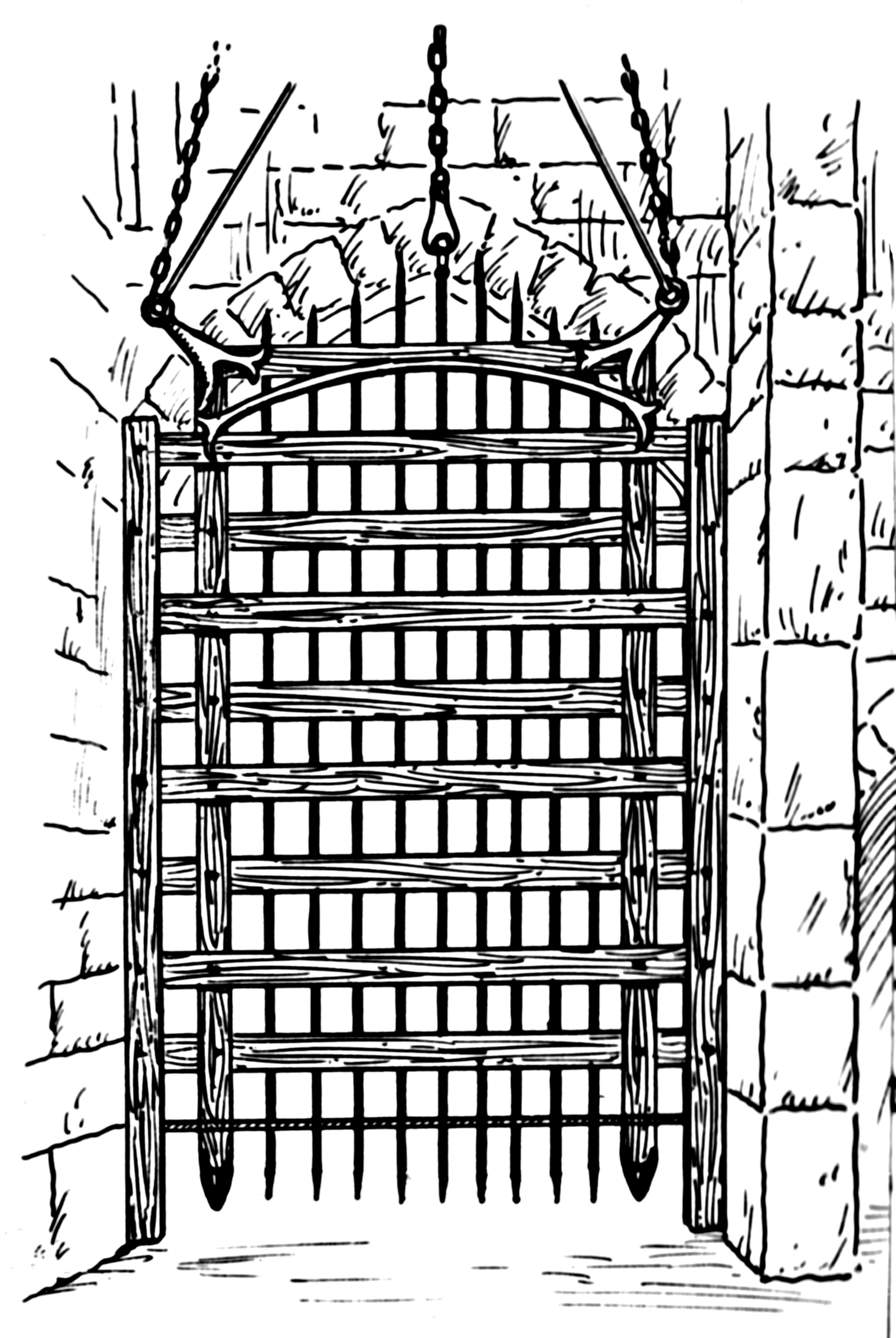
Once over the drawbridge and under the castle's yawning portcullis we weaved throughout the five towers of the ancient bastion like Dumas' Musketeers or Robin Hood's Merry Men. The spear-wielding sentinels are silent but the relics of a bloodier age are here, armour, helmets, axes and clubs. Piles of large stones are roughly stacked inside the windows, a reminder of when the enemy could have been brained by a well-aimed rock.

Moving cautiously amid the heavy timberwork we found the castle's kitchen with its fireplace big enough to sleep four. Of interest to Mum was the kitchen's stone sink that drained out a window about 25m above the ground.

The three of us peered down into the goose-bump inducing depths of well-like pit where prisoners were left to die. Noah surmised that there must have been a trapdoor for food. I don't think it was a consideration.

The more ancient of the castle's chambers were rudimentarily furnished with a smattering of rough-hewn benches and refectory tables. Deer pelts placed on the deep windowsills were the only attempt at providing warmth. More sumptuous were the rooms once occupied by the 17th century Prince Bishops and by the resident poet who lived and died here in the 19th century.

During her visits to Meersburg, revered German poet Annette von Droste-Hülshoff stayed in the Old Castle, which in the 1840's belonged to her brother-in-law. In the Altes Schloss Meersburg Droste-Hülshoff's study and the room she in which she died are open to visitors.

If you go:
The town of Meersburg has a website www.meersburg.de
Visitor Information: Meersburg Tourist Office is located at Kirchstrasse 4 (tel. 07532/440400) and is open Monday to Friday 9am to 12pm and 2pm to 4:30.

Zurich is the nearest international airport 80km (49 miles) away.

Meersburg is reached from Switzerland in the south by ferry that departs Konstanz every 15 minutes during the day. The trip takes 15 minutes.
www.sw.konstanz.de/verkehr/faehre/fahrplan_eng.htm

By Bus: Meersburg is not served by train. The nearest rail stations are in Überlingen 14km (9 miles) away, or in Friedrichshafen 17.5km (11 miles). From Friedrichshafen station, buses depart for Meersburg at 30-minute intervals. Buses display number 7395 on the front.

By Car -- Meersburg can be accessed by car via the E54 from Überlingen or Friedrichshafen or from the North via Highway 33.

Altes Schloss Meersburg is located at Schlossplatz 10. Tel.: 07532 / 80000
March to October its open 9.00 - 6:30, November to February 10.00 - 6.00. Admission is 8.50 Euros for adults, 5.50 Euros for children

November 21, 2008

Wintertime in Garmisch-Partenkirchen


One of the very best Christkindlmarkts is held in Partenkirchen on Ludwigstrasse where Santa Claus arrives every evening in his sleigh. Concerts with Alphorn groups are held during the market.

The world's best examples of the nativity scenes known as Krippe are found in the Town Museum on Ludwigstrasse complete with angels, camels, elephants and a heavenly host of other biblical characters.

Musical festivities include an "Old Russian Christmas" with an ensemble from Russia and an annual charity concert benefiting the children's hospital in Munich featuring Bavarian music.

In the nearby town of Grainau, children can participate in an evening hike into the forest. Children walk along a snowy trail carrying lit lanterns to a clearing in the woods where a Christmas story will be read to them around a bonfire.
An open-air New Years Party happens in the historic Ludwigstrasse.