Showing posts with label The Suitcase. Show all posts

September 8, 2014

Light Luggage - Paris for a Week, Perhaps.

Mais Oui.

easy packing

 Hey everyone. I came across an article on Oh Happy Day - How to Pack for 2 Weeks to France in a Carry-On. It inspired me.

It's a pretty good, informative article. I'm a light packer too. Although my last Paris trip (2010, sigh) was only for a week, I think even Jordan has packed too much. Pack whatever floats your boat, but for my comfort a lighter suitcase is a better suitcase.

I would never pack 4 pairs of shoes. One extremely comfortable pair of boots or shoes on your feet should do. Two at a pinch. Shoes are heaviest, most clumbersome things to pack. Alegria shoes are the most comfortable thing I travel in. They are hell to pack though (and no backwoods hiking!) so I wear them on the plane. Security loves their huge soles!

If going in autumn  I would pack my most flattering, comfortable dress and a stand-out tunic or sweater dress for colour. Black tights and leggings, a black double-knit mini (or 2), a black turtleneck, a white shirt,  and a pair of black pants can be mixed and matched. Pick whatever colour,  but it's easier if its monochrome.  I would pack a heavy-knit wrap-around top and a light jersey cardi. A graphic t-shirt dress to sleep in. ( I will explain)  Everything can be dressed up with a colourful scarf or some chunky jewelry.

Things I would change from my last trip. I would add is a good pair of jeans and to switch the shoes for knee boots. I have to admit that no women I saw in Paris looked overly dynamic - Just jeans, leather boots, scarves galore and a good hair cut. I saw one really great coat on someone in the 4th Arrondisement, but all the craziness that one sees on the Sartorialist for example, must have been reserved for some other time and place because I saw none of it.

I would also tone down the stand-out tunic. I wore an orange sweater-dress from IVKO and I know that I was the only person in Paris wearing orange that day. It was obvious I was an out-of-towner,  Parisians still prefer dark colours. But if you want to stand out, go right ahead. I still might. I did wear a somewhat bright dress from Boden and was mistaken (from the back) for a French women's friend!

No PJs I just slept in a  long t-shirt dress. If you want to go to the disco. Wash it in the sink, dress it up with jewelry and accessories. I took a Roots Test Pattern T-shirt dress to sleep in (not the expensive Stella McCartney above). Needless to say (because I'm shy) I did not wear it out to a disco.

I've can come up with at least eight outfits from the above. Good luck if you are traveling this autumn. Bon Voyage.

 
I created the top collage on Polyvore. I haven't quite got the hang of it yet.

December 22, 2011

Swiss Christmas


The wide variety of Christmas customs throughout Swiss villages reflects centuries of winter isolation that townsfolk endured when the heavy snow eliminated travel between mountain valleys. Their celebrations seem anything but neutral.

In the canton of Vaud, a Christmas lady named Tante Arie is a bearer of gifts. Represented as an old woman, half fairy, half witch, she comes down from a mountain on Christmas Eve riding a donkey. She brings gifts for good children but birch rods or dunce caps for the naughty ones.

Usually on December 6, the feast of St. Nicholas, Swiss school children parade through their villages, ringing bells of all sizes. The bells alert the villagers that a gift is expected from each household along the way. The gifts are usually some good things to eat or drink.

swisscommunity.org 
The children's parade in the town of Weinfelden happens the last Thursday before Christmas. The children in the town parade through the streets with decorated beets. These beets have been hollowed out and lit from within with a candle. After singing carols in the town square, the children go to their schools where they dine on sausage and bread. At the same time, adults go the local tavern or coffeehouse, and the town council holds its annual budget meeting! Oh those crazy Weinfeldians!

myswitzerland.com 
In the village of Ziefen, several dozen young bachelors walk a traditional route through the streets every Christmas Eve. The tallest bachelor dons a white beard and leads the procession while carrying a sooty rag attached to the end of a long pole. All the young bachelors wear oversized, long, dark coats and each wears a tall, black, top hat made of cardboard. Many of these hats are more then six feet high. Quiet a few onlookers get a face full of soot.

Celebrations are relatively quiet in the village of Hallwil where seven girls, 13 or 14-years-old, act out an ancient custom. A veiled Weihnachtchild (Christmas child), dressed in white, and six companions in rose-colored gowns visit village families in the evening. The Weihnachtchild greets the families with a silent handshake and distributes cake or cookies to the children while the other girls sing a carol. The departure of this group is also silent.

There is a crazy, yet ancient New Years Eve tradition in the town of Laupen. After dark on December 31, participating schoolboys, in three boisterous groups, meet on the hill at the local castle and proceed down to the village. In the first group are the "bell ringers", who swing large bells heard for miles around.

Next, the "broom men", carry long poles with bunches of juniper branches tied to the top. The third, and most bizarre group, the "bladder men" carry pig's bladders filled with air. The procession stops at various locations along the route as the leader recites a poem to the old year and wishes the crowd a happy new one. During the poem, the broom men wave their juniper brooms over the heads of the crowd. At the end of journey, the broom men and the bladder men, all armed with inflated pig's bladders, proceed to "beat" the onlookers, especially young ladies, until their weapons are in shreds.

August 23, 2011

Go - Stephen Bulger Gallery

Ruth Orkin
“I’m totally contained. I’m self-assured. I own the street. I’m walking in total confidence. I’m not in the least flustered or bothered or apprehensive.” That's what Ninalee Craig says. Although most would say her eyes betray a fear. But Ninalee Craig should know - 60 years ago she was known as Jinx Allen, the subject for Ruth Orkin's An American Girl in Italy.

Fernando Morales for the Globe and Mail
Ninalee Allen now lives in Toronto. In a recent Globe and Mail article she relays her feelings about Italy and her feelings towards the picture.

The Stephen Bulger Gallery in Toronto is presenting an exhibition of Ruth Orkin's work. Visitors can study Orkin's contact sheets and she how the Jinx Allen image fits in with other images of the celebrated American girl shopping, haggling, laughing about her oversized lira, and riding side-saddle on a scooter. Jinx Allen ran the gauntlet twice past the 15 mostly unemployed Italian men on August 22, 1951 to achieve the picture.

The exhibition, Ruth Orkin, American Girl in Italy- 60th Anniversary is at the Stephen Bulger Gallery, 1026 Queen Street W., Toronto, until Saturday at 6 pm, August 26th.  I'd better hop on my scooter and get going!


with files from John Allemang/The Globe and Mail.

April 23, 2011

Beatrix Potter's Cottage


Hilltop was one of the homes of children's author, Beatrix Potter. As requested in her will, the interior has been left as if she had just “gone out to the post" with a fire burning in the hearth, and cups and saucers at the ready for visitors. It’s a time capsule of Beatrix Potter’s full life. Every room contains a reference to a picture in a 'tale'. The lovely cottage garden is a delightful tumbledown mix of flowers, herbs, fruit and vegetables.


Beatrix Potter bought Hill Top in 1905 with the royalties from her first few books. She wrote her early books from her parents home in London, but they were inspired by her annual holiday visits to England’s Lake District.  Although almost forty, she could not stay in her beloved new home because she was expected to take care of her parents in London. She visited it whenever she could. After her marriage to William Heelis in 1913 she was able to settle in the Lake District permanently. Beatrix wrote many of her famous children's stories in the small 17th century stone house. Characters such as Tom Kitten, Samuel Whiskers and Jemima Puddleduck were created here, and the books contain many pictures based on the house and garden.


Eventually Beatrix  went on to own 15 farms and over 4,000 acres of land in the area. Beatrix loved animals and went on to be a farmer and a well-known breeder of sheep.

Hill Top
Near Sawrey, Hawkshead, Ambleside, Cumbria LA22 0LF
Telephone: 015394 36269 Fax: 015394 36811 Email: hilltop@nationaltrust.org.uk

top image: geograph.uk 
2nd image: Stephen Robson for the National Trust Properties
3rd. The World of Peter Rabbit, Frederick Warne and Co. Copyright 2002

April 21, 2011

Eggs


While in Germany and Austria in the Spring of 2003 we were pleased to see the breakfast rooms of the pensions we stayed in were nicely decorated for Easter. Pink and yellow puffball chicks, rabbits with barrows and twig trees decked out with eggs made an Easter tableau in each window sill. Nothing could compare however to the shop window we saw in Salzburg. At the corner of Judengasse and Getreidegasse, probably less than a minute’s walk from Mozart’s birthplace, was a shop that sold only Easter eggs.

These weren’t chocolate Easter eggs (though I wish they had been) but dozens after dozens of perilously delicate eggs shells, each one hand-decorated to suit just about any taste.

The shop called Easter in Salzburg sold eggs for Halloween, eggs for Christmas, eggs for birthdays. Personalized eggs. Some were very elegant; others just for kids. The deceivingly large store showcased over a hundred thousand of these little oval beauties over two floors. An ostrich egg bearing a picture of Mozart cost €150, but a modestly decorated chicken’s egg was priced around €2. Despite the reasonable price, I had content myself with some photos. I wouldn’t have managed to get a single egg back to my hotel room.

April 2, 2011

There was a Crooked House


One of the strangest buildings in the world is the  Krzywy Domek an irregularly-shaped building in Sopot, Poland, that makes you feel as if you're passing through the hall of mirrors in a funhouse. Built in 2004 the Krzywy Domek, whose name translates into English as the "Crooked House" is 4,000 square metres in size and is part of Sopot's Rezydent shopping center.

It was designed by Szotyńscy & Zaleski who were inspired by illustrations found in  fairytales. Here's link to the site.

Photo: Broca

December 2, 2010

Final Installment - It Was the Best of Days, It Was the Worst of Days, It Was My Last of Days

Side-street in Auvers-Sur-Oise. Pissarro painted it
At the information centre at the Chateau Daubigny I picked up more maps and a city bus schedule. Auvers left me feeling like Alice down the Rabbit Hole and the more maps the better. I never get lost.....everybody tells me where to go! Kidding aside, this town had me seriously muddled.

I hope Daubigny did not mind as a hurriedly left his museum and crossed his famous garden to start my tour.


My first stop was the Absinthe Museum on rue Alphonse Callé. I found the pretty stone building with its green shutters fairly easily. But how to get in? I ended up in the alley behind the property fittingly called Allée de la Fée Verte. I did find the appropriate gate, but the Absinthe Museum had been closed since September 15th.

Bottle -drying rack - perfect for the whine-y tone of this post.
Next -  the house of Doctor Gachet at 78 rue Dr Gachet. The town of Auvers-Sur-Oise is beautiful and seemingly  unchanged since Vincent Van Gogh was there 120 years ago. Thatch may have been replaced with tile, but on the cobbled side streets you are able to pretend you're walking in his footsteps. Just squint and the cable dishes and overhead wires disappear.


One of the reasons I think I had a hard time finding places is that the majority of dwellings are found behind stone walls and not readily marked. Another reason is that street names have a nasty habit of changing names. Rue de Lery turns into Rue Victor Hugo which turns into Rue Dr. Gachet plus an appendix of a street is also called Rue Dr. Gachet. I found Dr. Gachet's house after about 15 minutes.


But I was reluctant to enter in case I was foiled again. For the first time in my trip I was ready to go home. I wanted to curl up on the cobbles, call home (had my phone been working) and tell my husband to come get me. I was aware that the transit strike was still on and I hadn't seen a single coach since I'd been deposited by one three hours earlier. I took some pictures of Gachet's house and headed off to find the very friendly Chateau Auvers.

Lost again. From the very Three Musketeers-court yard. I tried to find the ticket office through the wrong grotto-like entrance and found myself in the upper garden. Retracing my steps through the pretty grounds was not a problem and I found the ladies at the Chateau to be charming and welcoming. I was there to see a multi-media tour called A Trip Back to the Time of the Impressionists and it was fantastic.

With headphones I walked among the displays detailing the Paris Apartment and the turn-of-the-century costume. The ridicule that the Impressionists endured was spotlighted as a drawing of an auction sale sprang to life. A thickly velvet upholstered hallway featured images of the famous grande horizontals - or if you prefer, courtesans. My favourite part of the whole place was a cabaret. I had to wait at swinging doors for the next show and when you entered you were faced with an extremely evocative nightclub scene with bentwood chairs and illuminated spritzer bottles. I found it thrilling. Another highlight was waiting for a "train" to take me through the French countryside. Through the aid of projections I was taken past the Ile de la Grande Jatte and several other country scenes featured in the Impressionists work.

Multimedia Impressionist Tour- photo found on Flickriver by Lucy 99
The Guingette of the Luncheon of the Boating Party was the snack bar but I hurried past it and Monet's life-size hay stacks. I was starting to seriously worry about how I was going to get home.

I descended the hill from the Chateau and made note that a city bus was stopped at the bottom. I headed back to the train station and waited for a bit, looking for a coach similar to the one I took earlier that morning. There had only been 5 other tourists on that bus and I hadn't seen them for hours. The train station was closed because of the strike. I walked to the Town Hall to see if they had any ideas. The Town Hall was closed for the strike. I walked back to where I saw the city bus. Lo and behold one was there. I ran, in my chunky shoes, to catch it. He pulled away without me up the hill marked To Pontoise.

I walked back to the forecourt of the train station where the coach driver said he would pick us up and waited for about 15 minutes. Though well-equipped with maps and a city bus schedule I had no idea where the city buses went or which bus stop to wait at. I did not want to be taken further out of my way.  I toyed with the idea of walking to Pontoise where I had originally been dropped off my by train, but I really had no idea which way to go. Being stranded overnight in beautiful Auvers-Sur-Oise was not the worst thing in the world but I had a plane to catch the next day.

I walked back toward where the city bus had pulled away from me. Practically mewling, I asked a French couple if they had any idea about buses. Non. I took out my bus schedule and cross-referenced it with the schedule on the pole and determined that some sort of bus would be by in 25 minutes. I waited and waited and a bus finally did appear but on the other side of the street.  To Hell with it. I ran across the road. Asked the driver Gare Pointoise?. Oui. and with my little ticket that I started my adventure with in the morning I boarded.

The return portion of my trip was nowhere near as smooth as my morning trip up to Pontoise. After 15 minutes the bus pulled into the train station. Options for trains were sorely limited. Out came my transit map. There were only 3 trains scheduled. One to Gare du Nord, one to the Opera station and a third to a place I'd never heard of. My best bet was Gare du Nord, or Paris Nord as it's called on the Metro system. I had an hour to wait.

The train became increasingly full as it passed through the 20-or-so stations that lined the route into Paris. And it just barfed passengers out onto the platform as we arrived at Paris Nord. I was getting pretty adept at reading the electronic information boards found on the platforms. The rolling strike was now in full swing. There was only one option. One train to the next station. Chatelet les Halles. That train came in and quickly filled with the miasma of people heading downtown. I don't care what anyone says, there are more pickpockets in Paris and I held on to my purse for dear life.

After spewing everybody out at Chatelet les Halles there were no further options. I waited on the appropriate platform but the overhead information board was blank. I found a monitor that said as of October 13 there would be no train service between Chatelet and the much further south Denfert Rochereau. If I could read this - why couldn't  anybody else. Throngs of people were waiting on the platform, hoping that something would happen. But it didn't. I was dismayed, but I would probably have to walk the rest of the way  to the hotel. I was tired, hungry and I hadn't used the facilities in several hours. Plus it was cold.

Luckily for me I had walked that route just the day before. It wasn't so bad. Locals were reveling in cafes as if nothing unusually was happening. I tried to reduce my blood pressure. Paris at 8 at night was great. Bright and alive. I realized that this was just a part of my journey and I enjoyed my walk home. I crossed the Pont au Change and saw the illuminated Eiffel Tower with its beaming spotlight. I made a mental note that this was the last time I'd be seeing the Tower for a while. I crossed the river and walked the hill to the hotel.

This trip took me 4 hours and 15 minutes from the time I became panicky at Auvers to the time I walked into my hotel. The first thing I did at the hotel was to order a taxi for my trip to the De Gaulle the next day. I couldn't risk this experience again.

My cab was on time. There were no disruptions at the airport. I was 4 hours early for my flight.

And that, gentle readers, is the end of my trip to Paris. Till next time.


November 29, 2010

Van Gogh's Bedroom

After acquiring my ticket to Van Gogh's bedroom, I was allowed up the back stairs to a darkened room in order to watch a very poignant film on Van Gogh's life in Auvers-Sur-Oise. The director-types from the lunchroom downstairs were already there. I was happy to have beat the crush of the budgies downstairs. That would have spoiled my whole experience.

The screening-room consisted of a low bench at the front and a higher bench against the wall. When I chose the lower, one of the movie-men addressed me and what little French I have enabled me to understand that they said, "Madame, this is not Truffaut. Please sit on the this banquette." I had a vague recollection of what they were on about - the puppet scene from Truffaut's The 400 Blows.

After confirming that I could only take photos of Vincent's room from the stairs, I climbed to the 3rd floor and found myself in a room of palpable sadness. A tiny caned chair focused under a skylight was the only furniture in Vincent's bedroom. The effect was one of great loneliness.

I placed myself where I thought the head of Vincent's bed would be and imagined the pain and despair he endured during the two days it took him to die. Had his little bed once made the scratches in the wall? Had he made the nail holes once upon a time by hanging one of the 70 paintings he had created while there?

The Maison de Van Gogh, which is what the museum and restaurant compound is called, is trying to acquire an original Van Gogh to hang in this room. Behind some Plexiglas is a copy of a letter Vincent wrote to Theo stating that "some day or another I believe I will find a way to have my own exhibition in a cafe".  Someday or another this room will host one of Vincent's paintings.

Next door to Vincent's room is the bed chamber of another Dutch painter who had stayed at the Auberge. He had heard Vincent's moans and cabled Theo to come at once.

Vincent died July 30, 1889 with Theo at his side.

For more information please contact the Maison de Van Gogh

November 18, 2010

It Was the Best of Days, It Was the Worst of Days, It Was My Last of Days - Part 2

It was so cold when I got off the bus. It hadn't warmed up at all. I had 45 minutes to spare before my lunch reservation at the Auberge Ravoux.

Prepared with a couple of maps in hand, (thank you Google Maps), I headed off to find the church that Vincent painted and the graves of he and brother Theo. I found the church without problem. Auvers is dotted with panels denoting what views Van Gogh had painted. I think he painted 70 pictures in the 70 days he was there. I was surprised to find the "Church at Auvers" was not as squat as Vincent had painted it.


Then off to the cemetery. Despite the interpretive panels, Auvers-sur-Oise is not very well marked. I found a fingerpost with the word "Cimetière." and followed it. Minutes later I found myself on a deeply rutted farmer's road climbing a hill of dirt and deeply wishing I'd remembered my coat or at least my gloves. When I crested the hill, it all came into place. I was walking in the exact place that Vincent Van Gogh had walked a 120 years earlier. This was the place where Vincent had painted one of his very last paintings, Wheatfield with Crows. And there were crows. And it was bleak. The wheat had long been harvested, and a green stubble remained. But here were the three converging roads denoted in green in Vincent's painting. I stopped, tried to be less word-weary and was mindful of where I was.


The cemetery, like a large pen,  was a few hundred feet to my right. How ironic that the cemetery where Vincent lay was visible from where Vincent had painted what some say was his "suicide note to the world".

With my back to the cemetery wall, some other bleak vantages


The people of Auvers must be tired of rubber-neckers like me because again there was a dearth of signage and if it hadn't been for the man with the video camera it would have taken me a long time to walk the perimeter of the graveyard looking for the Van Gogh brother's graves.

I found the simple gravestones. Recently cleaned, they must have been some of the oldest stones in the cemetery. I paid my respects, thinking what lay beneath. The art, the legend, the books, the letters between the two brothers, the films, the mystery - this is what it all comes down to right here. I took a video clip for my husband so I could share the experience with him and I pocketed a few leaves of ivy from the grave to take to him back home.


Next: My Lunch at the Auberge Ravoux, In the Attic Where Vincent Died and Almost Stranded.

November 17, 2010

It Was the Best of Days, It Was the Worst of Days, It Was My Last of Days - Part 1

La Mairie D'Auvers-Sur-Oise, Hazel Smith 2010
La Mairie D'Auvers-Sur-Oise, Vincent Van Gogh, 1890


October 13 was the day I had planned to go to Auvers-sur-Oise, the last home of Vincent Van Gogh and the place where he died. I had lunch reservations at the Auberge Ravoux at noon. The Auberge Ravoux is the location where Vincent lived during his last 70 days. He died of a self-inflicted gunshot wound under the eaves of the inn. This was an outing I should have saved for when my husband was with me. He’s the life-long Van Gogh aficionado. I wish I had.

I’d prepared and planned for this trip but with threats of rolling strikes from the transit unions, it turned into a bit of a make-shift day. My almost-obsessive-compulsive self said that if I was thwarted 3 times in getting there, I’d scrap the plans and spend my last day sight-seeing in Paris.

I left the Hotel du Pantheon before 9. Today it was cold for the first time - just a few degrees above freezing. I went down to the closest Metro to me, Luxembourg, and the gates were shut with a notice that said “closed for the day”. Strike 1.

I walked up to the Saint-Michel station and thankfully it was open. I had been planning on getting to Gare du Nord and taking a commuter train to Pointoise and then another to Auvers-sur-Oise but according to maps, I could get to Pointoise by taking the subway all the way. On a day like today I thought that I should take the first opportunity that presented itself so I found my way onto the platform that would lead me to Pontoise.

Announcements and the video boards said that service on the RER Line A was down to 1 train in 5. That was fine with me because the worst service of any European transit I’ve ever been on is better than Toronto’s at its best. The trip took an expected hour and 15 minutes. I wondered why so many commuters got off at Porte Maillot, then I figured that it was close to La Defense and the cluster of office buildings I’d seen earlier from the minibus. The trip was pleasant. I saw the backside of many small villages. Sleep was the only thing threatening now.

I got off at Pontoise and looked around for the clusters of people and the signs saying “this way for the platform to Auvers-sur-Oise” There were none.

Confused, I went into the station building itself to ask. The lovely girl in the wicket told me nicely “no trains today” Strike 2. She pointed me to a white coach out in the forecourt, where the station master, who looked exactly like Gauguin, had just popped the trunk open and was toying with the engine. Strike 3. But I’d made it this far and there was no going back.

The bus was broken but everyone piled onto another. We drove all through the town of Pontoise dropping off people with their shopping and then down the road 4 or 5 miles to Auvers-sur-Oise. When delivering the 5 or 6 tourists destined for the Van Gogh experience, the bus driver, in his best English, said ‘I will be back for you. Not at the town hall but at the train station.” This seemed to satisfy everybody, myself included and I got off the bus.

à bientôt!

November 14, 2010

Still Walking

After leaving Galeries Lafayette, I walked around the much-too-large Opera and down Avenue de l'Opera. It was coming-home-from-work time and because of the strike the streets were extremely congested. I veered off at the rue des Pyramids and soon found myself at rue de Rivoli. I've decided I do not like the rue de Rivoli. It's an annoying cross between tacky tourism and elitism.

A be-scarfed one asked me for money. "Madame, do you speak English." How could she tell? I was the only blonde wearing other than black for miles around. Then she presented me with a hand-written card asking for money. Persistent, I had to tell her "non" twice.

Crossing over into the Tuileries, I felt I was being followed, maybe by a colleague of hers. I was. I sat down on one of the cement benches and the malevolent Mr. Bean, who had seconds before been behind me, sat down next to me. I shot up like my bum was on fire and moved fast across Pont Royal. I watched the traffic on the river for a while and was sure he hadn't followed any further.

I walked down my beloved rue du Bac, then east along rue de l'Universite, and south along rue des Saints-Peres. Heading toward Boulevard Saint-Germain I knew something was up. Phalanxes of police in their dark blue armour were everywhere. Large balloons covered with  union logos meant I had found the demonstration. I carried on gingerly and found the picketing strikers marching up rue de Rennes.


I was moved, as I always am at public displays of emotion - I get a nose prickle meaning tears are seconds away. I must have watched the demonstration of people for at least 45 minutes with no sign of it letting up.

RE-SIS-TANCE! RE-SIS-TANCE! RE-SIS-TANCE!

SarKOsy, SarKOsy.

The assembly was very loud and emotional. Because of the issue at hand, the crowd was made up of old and young alike. It made any organized action in Canada look like kindergarten. I was in complete support of them, until the next day when their "greve roulant", rolling strike, would play havoc with my day.
This one roughly says,
"Every day, new businesses closures and layoffs are posted-Therefore what have the billions distributed to the bankers and bosses been used for?-To enrich the wealthiest people and impoverishing the population"
I tried to circumvent the crowd for a while by walking up rue du Four, but ended up actually walking beside the demonstrators for about another 20 minutes before I reached Boulevard Saint-Michel. At one point a professorial-type looked over near where I was and whooped. "Quoi?" I thought, looking around me. There was a spray-painted sign on the wall behind me stating "The strike is only the beginning." Oh dear.

This one was easier to translate:
"Down with the state, cops, and bosses"Listen
Read phonetically

I was going to take the side streets back to the hotel but the cops had shut the Boul'Mich to traffic and it was delightfully quiet.

This one was popular with a lot of photographers so I joined in. It's union propaganda pasted on a Rolex shop
 I arrived back at the hotel 7.5 hours after I started out with only a half hour break for lunch. Not as bad as the Musee D'Orsay day which had me on my feet for almost 9. But nothing, I was to find out, compared to tomorrow - my last and final day.

Gathered my thoughts at the hotel and then headed off again. I had a craving for French Onion Soup.

November 9, 2010

The Strike Turns the Clever Pup into a Flaneur Once Again

Galeries Lafayette
Just like dominoes... I saw a boy, 9 or 10,  trip into a display of mannequins at Galeries Lafayette and bang, bang bang, bang, bang - all five plaster ladies toppled onto the floor; their arms and legs falling off in the process. The poor kid. In passing I whispered, "C'est OK", but he started to cry despite his age. He told his mum he was hurt, but it was just his pride. The day before, my minibus driver told me that the word "gendarmes" meant "people with arms". Now these mannequins were "gens pas d'armes"

I started late. I was in no hurry and  prepared for the strike. After taking a video inside the Pantheon of  Foucault's original pendulum, I headed off to the Musee du Moyen Age (also known as the Musee Cluny) to see the tapestry of the Lady and the Unicorn, but I guess that will have to wait for next time because this Tuesday the Cluny was closed.

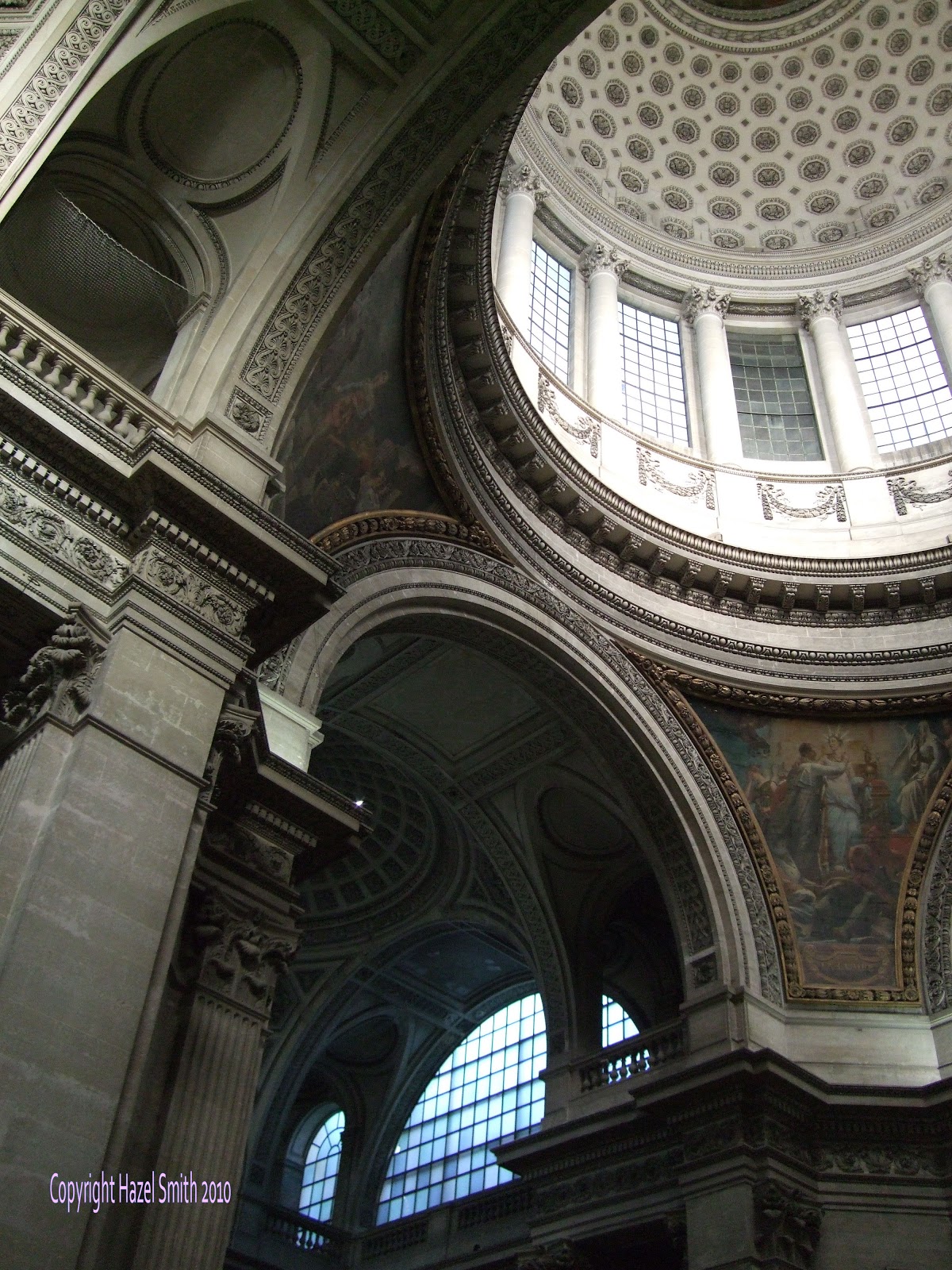
Interior of the Pantheon


Foucault's Pendulum tells me it's 11o'clock

I carried on across the Seine via the Petit Pont and was surprised to see the area south of the Pompidou on Rue Saint-Martin was a very pleasant pedestrian area.

Boulangerie, Rue Saint-Martin

North past the Pompidou and the punks with their dogs intent on chasing the pigeons into the trees, and left on Rue Rambuteau. Onward past Les Halles. Les Halles looks dramatic on the outside, especially from the bird's eye view I've seen  in Paris from Above, but it's just a big mall - I gave it a pass.

I stopped and collected my thoughts, organized my photos and checked my map on the terraced steps by Saint-Eustache with its adjacent labyrinth and giant buddha-like head.

The farthest point of today's orbit was the Galeries Lafayette, Paris's grand department store and by mid-afternoon I made it there.  But there's so much to see on the journey. Near Saint-Eustache is the Bourse, the Paris Stock Market with many well-heeled people lunching nearby. I came across Dehillerin, a fantastic cookware shop that Clotilde Dusolier mentions in Clotilde's Edible Adventures in Paris. A giant copper rooster was in the window. Was it a weather-vane or just a really cool objet d'art for the kitchen?
Coq of the walk

On my journey I found two covered galleries, or shopping arcades, Galerie Choiseul and Galerie Vivienne that I had made a mental note to find.  I actually did some browsing in a shop in the Galerie Choiseul and Galerie Vivienne is a splendid, glass-roofed place with great swathes of mosaic floor. I'd bought a book at the D'Orsay about Paris's covered passages because I didn't think I'd have to time find them. So I was pleasantly surprised when I did.

Mosaic Floor Galerie Vivienne


The Galeries Lafayette is a gem of the Belle Epoque. Its steel and glass dome rivals any kaleidoscope and has been designated as a historic monument.  I took a brass birdcage of an elevator up to the top level and walked the remaining way to the store's roof and found a smoggy (let's say steamy) panorama of the rooftops of Paris, with a view of the Eiffel Tower, Sacre Cour and the looming Opera ( which is much too big).

From the roof of Galeries Lafayette

Speaking of the Opera, the Galeries Lafayette itself resembles a giant theatre. Looking up, the the layers of floors with their brass railings and uniquely painted ceilings  resemble a turn of the century theatre. On the first floor I attempted to get to the balcony to take other photos but I was hindered by a champagne bar in the way!

Like a layer cake


After taking pictures of the superb stained glass dome, I needed sustenance and found a tea room to my liking on the third floor called Le Galfa.. I ordered something delicious that roughly translated into a beef muffin club sandwich and I ordered two macarons - A caramel and a pistacio. Yay. I gave in.

Le Galfa Tea Room, photo from Galeries Lafayette