October 31, 2011

True Halloween Love

My son, suffering through a mild case of lycanthropy, and my dog Jersey circa 2008.

October 28, 2011

Napoleon

Napoleon crops up a lot in my Art History and Paris Salon classes. The 19th-century French exalted him and then seemed cringingly embarrassed by him. Hindsight is 20/20. Byron seemed to prefer that Napoleon just fall on his sword, so distraught was he that Napoleon had been defeated and sent into exile. Despite the death of millions of Europeans after 17 years of war, Napoleon manages to remain a cultural icon. Many towns, streets and ships, even a pastry are named after Napoleon and his victories. Napoleon was just under 5 ft 7. (1.686m) Nelson was known to be 5 ft 6 and regarded as average in height. Heck, the average Frenchmen today is just 5'8". What gives?

Years ago, back in the days when I used to have fun, I was at a meeting of the Ontario Archaeological Society. The speaker was promoting the idea that Napoleon had been poisoned by arsenic which was evidenced, apparently, in his hair. So I was able to  hold a ziploc bag of Napoleon's reddish-brown hair in my hands. Talk about six-degrees of separation.

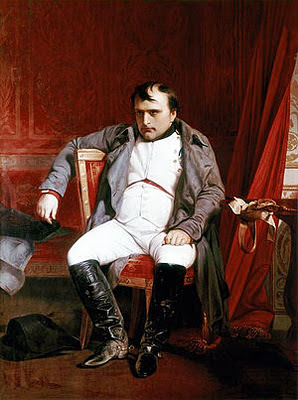
Note the differences in the pictures below. 

Napoleon Crossing the Alps J.L David, 1800.
Bonaparte Crossing the Alps, Delaroche, 1850

Napoleon on His Imperial Throne, Ingres 1806
Napoleon on His Imperial Throne, OOOPS,  
Napoleon at Fontainebleau, Delaroche, 1840


Here's one I couldn't resist. He must be Napoleon Bone-Apart.

corgiaddict.com

and

frenchpastrychef.com
There's a very enjoyable 2001 film called The Emperor's New Clothes starring Ian Holm as Napoleon. During Napoleon's exile on St. Helena, loyalists hire a doppelganger to swap places with him. While the imposter lives in luxury on the island, the real Napoleon returns to Paris in order to retake the throne. During Napoleon's journey back to France, the imposter dies. When Napoleon, Ian Holm, sets foot on French soil France is in mourning for him but he can't make anybody believe he is the real Napoleon. Antics ensue. Napoleon lodges with a widowed pumpkin seller and shows her little boy magic lantern slides of his exploits. I recommend this film if you have the chance.

Why is life worth living? It's a very good question. Um... Well, There are certain things I guess that make it worthwhile. uh...

like what... okay... um... For me, uh... ooh... I would say... what, Groucho Marx, to name one thing... uh... um... and Willie Mays... and um... the 2nd movement of the Jupiter Symphony... and um... Louis Armstrong, recording of Potato Head Blues... um... Swedish movies, naturally... Sentimental Education by Flaubert... uh... Marlon Brando, Frank Sinatra... um... those incredible Apples and Pears by Cezanne... uh... the crabs at Sam Wo's... uh... Tracy's face...

I should come up with my own list. I know that it would include my husband's eyelashes.

October 27, 2011

On Rue Descartes

photo: copyright Hazel Smith 2010

Photo copyright Hazel Smith 2010

Photo: copyright Hazel Smith 2010


The gist of this poem by Yves Bonnefoy is that although we pass a dirty city tree and look right through it, this is might be enough to remind us that it's still a part of nature, along with the sky, the birds and the wind. The poet asks the philosopher if he has looked at this tree on his street, if he did his thoughts will be freer.

October 25, 2011

Tempus Fugit

I can't believe it's been a more than a year. Before winter falls, here are some more pictures of Giverny.


October 18, 2011

Jacques-Louis David, The Tennis Court Oath [1791]


(Close to 6,000 hits on this post. I'm the must be the go-to-girl on The Tennis Court Oath.)

This pen and ink sketch by David was a precursor to a large scale painting that was left unfinished. It was to be painted on the basis of subscription and not enough subscriptions were sold to finish the work.

This is one of the most famous works of the French Revolution. A group forming an early sort of  representative government had been locked out of France's General Assembly. On June 20th, 1789, this group, dubbed the National Assembly, found their chamber door locked. They congregated at the nearby tennis court at Versailles and made an oath not to disband until the constitution of the France was settled. The oath signified the first time that French citizens formally stood in oppostion to Louis XVI.

The winds of change are blowing throw the window on the left. In the background and ominous bolt of lightning hits Versailles.

This fervid event may have been an overreaction as it was found that the doors to the Salle des Etats were closed because the King was still in mourning over the death of the Dauphin two weeks earlier. Hmmm. Riiight.... The Tennis Court Oath definitely greased the wheels on the road to the French Revolution.

The Oath was signed by 576 out of 577 members. In the bottom right of David's sketch one can see the lone dissenter, Joseph Martin-Dauch with his arms crossed and his head bowed.

Jacques-Louis David, The Oath of the Horatii [1774]

Another attempt to get names and dates firmly entrenched before my mid-term. I'm starting to dislike this uber-masculine painting; too much like Charleton Heston

Jacques-Louis David's The Oath of the Horatii is regarded as a paradigm of neoclassical art. The details are much sparser than those of Rococo painting and it is as if we have been transported back to 7th century Rome.

At the urging of their father, stoic sons swear an oath on their swords to defend their city at the cost of their own lives. David is beginning to depict political desires leading to the French Revolution and reaches back into classical history for a theme to represent a new ideal of politics; in this case, a scene from a Roman legend where sons from one of two warring cities agree to end the dispute by fighting the other.

The canvas is divided between men and women. The limp wives and children of the Horatii are on the right of the canvas. They are distraught, disbelieving. Their posture reveals them to be private, sentimental, maybe even hysterical. A boy is being cradled by his mother. Maybe she is trying to plug his ears against what the men are pledging. The boy, however, is interested; making eye contact with the men who make the oath.The men are erect, the women meltingly weak.

David's world would have been peopled by men. His friends, pupils and teachers were all male. He married late. To him, women were excluded from the virtues of bravery. Considering David was a big proponent for social change, his idea of woman was somewhat backward.

October 16, 2011

Jacques-Louis David, Belisarius Receiving Alms [1781]

While I don't like Neo-Classicism at all, "small R" republicans ate this stuff up in Revolutionary France.

Here is Jacques-Louis David in full Neo-Classicism. The people of late 18th century France loved Neo-Classicism. Through coded allegories these paintings were an attack on the French Monarchy.  Here Belisaurius, a victorious Byzantine general, is depicted by David. Belisaurius was falsely accused of treason and was blinded by Emperor Justinian. Belisaurius fell from grace, was banished and reduced to begging. David uses an ancient or antique visual style in order to summon up Greek or Roman heroic themes. In the painting he is recognized by one of his former soldiers who is shocked to see him in such a position. The woman embodies mercy.

Around 1781  a similar scenario happened to a count who had a dispute with the monarchy. I've forgotten the Compte's name but instead of being blinded and banished he was executed. People of the day would have known exactly was David was trying to say in his painting. David was a radical Jacobin and a member of the Committee of Public Safety, another way of saying he was a republican. He voted for the death of King Louis XVI which caused his monarchist wife to divorce him.

October 15, 2011

François Boucher, The Chinese Fishing Party [1742]

Boucher's painting, The Chinese Fishing Party, represents the exotic East and the luxury objects that were associated with it. In the 18th century Chinese silk, porcelain, spices and tea were objects of desire. They were an indication of one's social standing. 

François Boucher had a limited, superficial knowledge of Chinese culture. He has applied his ideals of Chinese iconography to a pre-existing mode of painting. 

October 14, 2011

Papillons

Click


Found on Le Divan Fumoir Bohemian
Papillons de Fanny Brawne capturés dans le  carnet de Caroline

François Boucher, Toilet of Venus [1751]

I've got to memorize 50 paintings for my Art History mid-term. I may as well kill two birds with one stone and feature my study notes here. 

François Boucher was the epitome of Rococo painters.  Rococo was the ornate style of courtly decoration in 18th Century France. Paintings like Boucher's would have been displayed as one among many. The court considered  paintings as part of the luxury trade and were regarded as an artisanal product along with luxurious furnishings and decorative artifacts  Not segregated away in a gallery; Rococo paintings were displayed in the luxurious rooms found in 18th century chateaus.

Here François Boucher's Toilet of Venus depicts the standard mythological scene of Venus. Boucher was fond of paiting erotic pastoral scenes with rosy female nudes. In this painting, jewels, silks and ornaments tumble over the edge of the stage and into our visual space as if they are being offered or on display. These objects bursting forth also represent the luxury which the patron or member of the court could afford.

This painting was commissioned by King Louis XV's mistress, Madame de Pompadour. She once had  fun playing the title role of Venus at Versailles. Madame de Pompadour was Boucher's patroness and he painted under her wing. Boucher painted the Madame de Pompadour several times. Their names were synonymous with the Rococo style.

Rococo died out by the time of the French Revolution. The frippery of the Rococo era was replaced with the order and the seriousness of Neo-Classicism whose subjects began to reflect the republican values of the masses.