Friday, November 25, 2011

Hey, I Could Do That or Lemieux Breaks Record for Canadian Art


1910 Remembered (1962) depicts artist Jean Paul Lemieux as a child, standing between his parents who were soon to separate. Looking out from the canvas between his two stern, statue-like parents, Lemieux seems both hopeful and sad. The light on the parents seems cloudy, unclear, perhaps reflecting their mood at the time. I'm joking when I said I could do that, but they do looking amazingly simple, don't they.  Here are a few more examples of Lemieux. I love this one called Summer. Unfortunately the only repro I could find was on a postage stamp. I would definitely give this one house room.

Julie et l'Universe

The Evening Visitor
Lemieux (1904-1990) was a master of placing his subjects on the canvas. His stark horizons and his fields of snow or grass recreate a feeling of immensity I remember as a small child. Lemieux's work came from his imagination. He painted indoors without live models. To me his people are just another element of shape and colour. Although they do have such sweet faces.

I should be working on my other art paper today but my brother distracted me with the news that Nineteen Ten Remembered sold for $2.34 million, breaking a record for post-war,contemporary Canadian art sold at auction. Here are some details, pre-sale. Heffel.com has a listing of some of the other prices realized

Jean Paul Lemieux's northern views are an easy sell 

By John Pohl, Montreal Gazette Visual Arts critic
 
November 18, 2011< MONTREAL - The auction sale last spring of a Jean Paul Lemieux painting, Les Moniales, for $1.02 million has brought a number of the artist's works off the walls of collectors' homes and onto the market. One of them is Nineteen Ten Remembered, a painting well known through reproductions. It shows the artist as a boy with his soon-to-be-split-up parents, who are placed on either edge of the painting. The scene is set in the cold, barren northern landscape, overhung with the grey sky that Lemieux made his own.

This painting and eight others by Lemieux will be sold by Heffel Fine Art Auction House in Toronto on Thursday. The estimated selling price of Nineteen Ten Remembered has not been divulged, but it is likely to be more than $1 million, meaning the only way it will ever find an honoured place in a public museum in Canada is if the buyer donates it.

As popular as Lemieux's paintings of landscapes and figures are in Quebec, it may be fitting for one of his greatest works to find a home outside Quebec, or even Canada. For Lemieux shunned his reputation for being a Québécois painter par excellence, as art historian François-Marc Gagnon pointed out in an interview and in a short essay he wrote for the Heffel catalogue. Lemieux wanted to be known as a painter of the "north," not as a painter of a certain locale, and was exhilarated by the recognition he won in Moscow and Prague when his paintings were exhibited there in 1974. It proved to Lemieux that his art was universal, Gagnon said.

At home, Lemieux was at odds with his contemporaries, the Automatistes. The Montreal Museum of Fine Arts collected the abstract paintings of the Automatistes, and the Musée nationale des beaux-arts du Québec collected Lemieux. Gagnon suggested that the museum in Quebec City or the National Gallery in Ottawa would be a more likely home for Nineteen Ten Remembered, should it ever make its way to a public institution.

But, of course, anyone willing to spend more than $1 million on a painting should be able to enjoy it in the privacy of his or her home, sitting on a sofa, as Gagnon said, "with tears in their eyes.
 
Riopelle Grande fête
Lemieux gave Nineteen Ten Remembered to his daughters, who sold it to a member of the Archambault family, who sold it to the neighbour who has consigned it to the auction. That collector is also putting a Riopelle on the market with an estimated value of $900,000 to $1.2 million.  Grande fête is an abstract made of strokes of red-brown, blue and yellow organized by black and white lines. Riopelle painted it in 1952, when his reputation in Paris was beginning to take off, Gagnon wrote. Grande fête is one of six Riopelles in the auction.

More than 25 well-known Quebec artists are represented in the auction, accounting for almost half the 179 paintings. One group of 16 paintings came out of a bank vault in Old Montreal, the property of François Dupré, who owned Montreal's Ritz-Carlton Hotel until his death in 1966. Dupré collected works by Canadian Impressionists and displayed them in the hotel; they went into storage in 1987. David Heffel, president of the auction house, said a family member contacted Heffel about the paintings. "It was a great surprise," he said. "It was a nice call to get from Europe."

The Dupré collection includes paintings by Emily Carr, A.Y. Jackson, Cornelius Krieghoff, Maurice Cullen, Clarence Gagnon, Marc-Aurèle de Foy Suzor-Coté and James Wilson Morrice, whose Régates à Saint-Malo from 1904-05 is expected to fetch $200,000 to $300,000.Heffel said the estimates are conservative. The average sale price has been twice the low estimate, he said. The paintings were on display at Galerie Heffel on Sherbrooke St. last week. To see them now, in reproduction, go to heffel.com

Tuesday, November 22, 2011

Finders Keepers - A Winslow Homer on the Rubbish Tip

This is such an interesting story. I hope I can do it justice. I originally saw it on BBC's "Fake or Fortune". As a genealogy and art history buff, some of the research gave me goosebumps.

Ok. Back in 1987, a fisherman, Tony Varney, found some art left lying around near the gate of a rubbish tip in the south of Ireland. Even though one of the pieces was signed Winslow Homer, Tony didn't know what he had. He didn't bother to research it at all and gave the painting to his daughter Selina who gave house room to other things her dotty old dad collected.


The small watercolour was of three white children wearing ethnic costume. Somehow in 2008, Tony and Selina got their wits together and took it to The Antiques Roadshow where it was confirmed by expert Philip Mould to be a work by Winslow Homer, one of America's most important 19th century artists and valued it at £30,000.

Philip Mould, art aficionado extraordinaire, cleverly knew that this painting would realize a higher price in US, where Winslow Homer is more highly esteemed. Mould had the painting packaged and sent off to Sotheby's in New York.

Phillip Mould's team of researchers went through the rest of the contents of Tony's cardboard portfolio. They found interesting things like a ticket to a costume ball at the Governor's Mansion in the Bahamas, a painting done by the Bahamian Governor's wife. They determined that Sir Henry Arthur Blake, the Governor of the Bahamas from 1884-1887, had his ancestral home in Ireland. Myrtle Grove, County Cork, was about three miles from the rubbish tip where Grandpa Tony found the painting.

Mould's lawyer was left to do due diligence and related to Mould, and the viewers, that the descendents who lived at Myrtle Grove were unaware of the painting and ignorant of the fact that they even owned it.  They had never registered a burglary.

Philip Mould jetted off to the archives in the Bahamas where he found on microfilm newspaper details of the costume ball at the Governor's mansion. Who was in attendance? Mr. Homer.  What were the children wearing? The same pseudo-Turkish costumes as in the painting. A later social notice said that Winslow Homer intended to paint the Blake children in their Turkish costumes. Eureka!

By this time, Sotheby's in New York had authenticated the watercolour and because of the provenance, had estimated that the picture would now reach at least $250,000 - about 5 times the original estimation.

So everyone back home in Coventry, England was very excited. The painting had been professionally cleaned and framed. It appeared in Sotheby's catalogue. Selina and her dad Tony went to New York for the sale. Twenty four hours before the sale, the Blake family in Ireland decided that "hey, that's our painting. We could use some of that lovely lolly to fix the roof of our ancestral home" (I'm paraphrasing).

Magnanimously, (I'm being sarcastic) they tell Selina she can go ahead and auction off the painting and she can keep 25% of the proceeds as a finder's fee OR auction it off and Sotheby's could hang onto the money until they could work  out ownership later. Selina, rightly pissed off, said the sale should go on and ownership could be worked out later.

The next day, ten, ten minutes before her lot was going to come under the gavel,  Blake's great-great grandson Simon Murray appeared in New York and said that Selina would have to take a 30% finders fee, but with out an agreement as to who owned the painting, he could not let the sale go on. Selina Varney rejected the revised offer and Sotheby's decided to withdraw the painting as they could not guarantee a good title to any potential buyer.

After this fracas at Sotheby's, the painting, now dubbed Children Under a Palm Tree,  was placed on the Art Loss Register. Why, I don't know. Covering their behinds, methinks. They know where it is now - under lock and key in Sotheby's New York. The family believe it disappeared from Myrtle Grove after a series of robberies in the 1980s, although Philip Mould notes that there was no crime reported. According to Great Grandson Simon Murray, his family didn't know that the painting was stolen until it was put up for auction at Sotheby’s. Simon Murray conducted further research among his family's papers and found a letter which described in detail the circumstances under which the painting was produced. When the Fakes or Fortunes episode aired in June 2011 ownership was still the subject of a legal dispute.

"I think we would rather keep it," said Simon Murray, who, as a lawyer, is still representing his family's interests. "It is such a special picture. The colours are wonderful. It's a very significant part of my family's history and we really want it back." Riiight...
youghalonline.com


The Varney's had the painting in their possession for two decades with no claim on its ownership and no report of any burglary on the part of the Blake/Murrays. I say that unless they can prove that Grandpa Tony stole the painting then tough titty. I say Finders Keepers.

Monday, November 21, 2011

Open the Gate


John Neville, a British-born Canadian stage and film actor has died in Toronto at the age of 86. He will always be Baron Munchausen to our family.

Thursday, November 17, 2011

Revolution in the Air?

I've been a lefty all my life; I believe in democracy and the social safety net. "Do unto others as you would have them do unto you" is how I live. But I don't really understand how the Occupy movement works.

We should increase the tax on the rich and put a cap on how much a CEO can pull in. Multinational corporations shouldn't be allowed to form and focus should be placed back on small businesses. Banking practices should be changed.

It seems to me that the Occupy movement should be focused on changing systems of taxation and banking regulations. But how can you shift the power away from the 1% without making changes at Federal level? On their own the banks and the bosses aren't going to say, 'Hey you're right, here's half a billion." There is no Bastille to storm.

I'm glad Occupy is out there making us aware of the inequalities. Undoubtedly Occupy has raised the awareness of those in the House of Commons too. The "underrepresented who represent the 99%" should get out and vote and be represented. Vote in Members of Parliament, or vote in representatives on all levels, who get bills passed to change banking regulations and taxation. Bills passed to forgive the debts of 3rd world countries.

Write a treatise. Get the NDP to present it in Parliament. Get the New Democrats to put forth a bill with your concerns. Again and again and again. Capitalism won't dissolve but it's worth a try. When the next election comes around, it'll be an issue, a plank in someone's platform. In Canada we live in a democracy but less than 60% of the eligible population bother to vote. Unfortunately voter apathy has left us with a majority Conservative government for at least 4 more years.

 It seems the Occupy movement is turning into an "us versus them" movement of the marginalized or under-employed who seem more pissed at the cops right now than the banks. I have to say that the Occupy website says more about who they are than what they want. There is "music in the cafes and night and revolution in the air" it just seems to be better focused.

Sunday, November 13, 2011

Clotilde's Adventures in Canada


Yesterday, November 12, I had the pleasure of meeting Clotilde Dusoulier, creator of the Chocolate & Zucchini blog, while she was here in Toronto.

Usually Paris-based, Clotilde has just wrapped up two weeks here in Canada as the Gastronomic Writer in Residence at the Stratford Chef's School about 2 hours outside Toronto. Clotilde started Chocolate & Zucchini in 2003 and the lucky girl signed a book deal in '07. C&Z, along with the odious Sartorialist, were the first two blogs I followed when I finally entered the blogging universe.

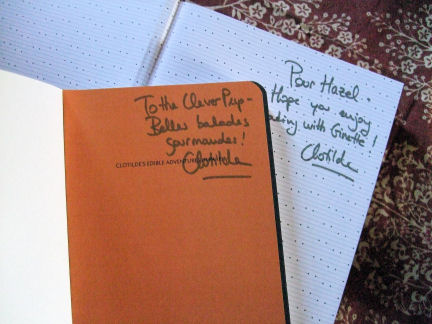
The Cookbook Store at Yonge Street and Yorkville Avenue is where the book signing was held. Clotilde was there, promoting a book she has edited entitled  The Art of French Baking originally written in the 1930s by Ginette Mathiot. I also took my copy of Clotilde's Edible Adventures in Paris for her to sign. I poured over that book before I went to Paris in 2010. I actually didn't follow too much of her advice, but with cross-referencing I got to know the Arrondissements a little better.

When I got to The Cookbook Store at the appointed time there was just the staff plus about five fans. I thought I was in for a very intimate meeting. I wish it had been so. Clotilde was delayed because of highway issues. After a 20-minute wait there were about 30 gathered in the tiny shop.
Clotilde is lovely,  fresh and sounds just what I thought she would. At  just 30 years old she has an amazing life ahead. Living in Montmartre, writing a blog about food, having that content put into book form, traveling the world. - I'm deeply envious. Here are some pictures I took.


Friday, November 11, 2011

French Soldiers of the Great War

I bought these compelling photos at an auction about ten years ago as part of the "contents of a drawer". I return to them again and again. I've found very little information about them as the names are so hard to read. The rotund fellow from the 54th Artillerie is the focus of the photos. I've tried to get in touch with descendents who may have an interest but to no avail.

 Still beautiful after 140 days on the campaign. December 12, 1914.

Just look at these guys! The stories they could tell. This one's titled After lunch at Bayonvillers, January 1915. Lignon Senior, far left is the father of Lignon Junior, far right. Joseph Marius Lignon died April 18th 1918, and was buried at the Locre Cemetery in Belgium.He is 23 at the time of this photo. The other man with the fine ears is called Moreau. Our fellow is called T.(or F.) Duroy or Duvoy. Bayonvillers is village east of Amiens, about 20km south of where the Battle of the Somme took place.

Taken Monday night the 18th of December, 1916 by the fellow on the far left in the picture below. Members of the 54th Artillerie and PAD 28 pay a visit to Madame and Mademoiselle de Labeniere and Mademoiselle de Finfe. Lignon Senior is seated at the left. Moreau is at the bureau behind him. Our soldier is at the vitrine behind Mlle. Finfe's head.

An interesting picture of a canal barge named Old Arras. Barthelmy, on the left,  took the photo above this one.

A very gloomy shot of soldiers transporting guns. My cavalier is sitting high in the saddle on the left. There are explosions visible on the horizon.

A mysterious photo captioned Breakfast in l'acayuna. I've tried to find that word but I can't. If that rings a bell with anyone please let me know. I'm pretty sure they are in officers quarters in a trench or near the Front. Dr. Sasportas is the doctor of the group. ( Nov. 17th I just solved this mystery. dans la cayuna, is really dans la cagna, which in this case means "dugout")

Here's the reverse of this photo with my scribbling. 


This one's captioned He sprawled a Bergere.  Bergere, I think in this connotation refers to the chaise lounges the soldiers are recuperating on. I don't know if this is my soldier or not. The patients are being treated to a musical interlude.

I'd be greatly interested if anyone out there could add anything to these scenarios. I've been unwilling to share them until now because they are precious to me.


All photos are property of Hazel Smith. Please seek my permission before using.

John McCrae: In Flanders Fields


John McCrae, a Canadian soldier, doctor and a poet is best remembered for his poem, "In Flanders Fields". Born in Guelph, Ontario in 1872, he was educated at Guelph Collegiate and the University of Toronto medical school.

As a youngster John joined the Highland Cadet Corps at the age of 14, and at 17 he joined the Militia Field Battery commanded by his father. By 1896 he achieved the rank of Lieutenant. In the meantime he was training to be a doctor at the University of Toronto. During this period he wrote poetry. Sixteen of his poems were published in various magazines.

In 1898, along with his degree in medicine, John received a gold medal from the University of Toronto for his high marks. When the South African War (Boer War) started in October 1899 John felt it was important to fight. He was commissioned to lead an army from Guelph. Though suffering from chronic asthma, he served in South Africa for a year. While stationed there, seeing the poor medical treatment of sick and wounded soldiers disturbed him.

After returning to Canada and resigning from the military, John picked up his life where he had left off. He resumed his studies and went on to become assistant pathologist at Montreal General Hospital. In 1905 he set up his own practice as well as continuing work at several hospitals.

When the Great War broke out in August 1914, John was among the first to enlist. He was appointed brigade surgeon to the First Brigade Canadian Forces Artillery. Just before he left, he wrote to a friend:

"It is a terrible state of affairs, and I am going because I think every bachelor, especially if he has experience of war, ought to go. I am really rather afraid, but more afraid to stay at home with my conscience."

John sailed for England with the First Contingent on Oct. 3, 1914. After spending four months on the Salisbury Plain, the First Contingent moved to France in early February 1915 and by the 10th of March, John would first experience the fighting of the Great War at Neuve Chapell. He had taken his favorite horse, Bonfire, with him to France, but had few riding opportunities for some time.

McCrae helped the wounded from the trenches near Ypres, Belgium. This area, which is traditionally called Flanders, was the sight of some of the heaviest fighting of the Great War. In April, the Germans launched their initial chlorine gas attack against French troops who were fighting next to the Canadians. The French collapsed as the gas overcame them and it was left to the Canadians to fill the gap and stop the advancing Germans.

On May 2nd Lieutenant Alex Helmer, a friend of John's, was killed in the fighting and buried beneath a simple wooden cross. John wrote his most famous poem the next day and it was Alex's death some say inspired John to write the poem that has become symbolic for the suffering and loss of the Great War. In Flanders' Fields was first published in the British magazine Punch in Dec 1915 and became the most popular poem of the War.

Soon after the poem was written John was transferred to No.3 Canadian Field Hospital in France as Chief of Medical Services. This move away from the front would spare John from some of the dangers of war but not the horror, for here John would treat thousands of the wounded evacuated from the trenches after battles such as the Somme, Vimy Ridge, Arras and Passchendaele.

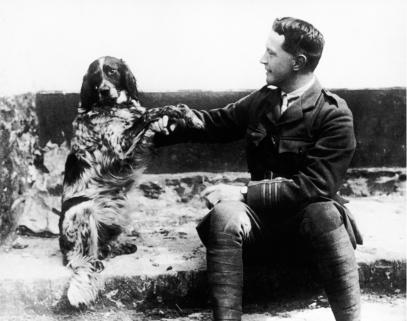
During the summer of 1917 John was troubled by attacks of asthma and bronchitis possibly aggravated by the gas he inhaled at Ypres. His health deteriorated noticeably. He lost much of his enthusiasm, and took frequent solitary rides on Bonfire, accompanied by his spaniel , Bonneau, a stray rescued from the battlefield.

Just after receiving word he was appointed consulting surgeon to the British Army, the first Canadian to be so honoured, McCrae fell seriously ill with pneumonia. On January 28, 1918, six days after being admitted to hospital, McCrae died. He was 46 years old. He was buried with full military honours in Wimereaux Cemetery, near Boulogne, France. The large funeral was attended by hundreds of mourners, from generals to nurses and medical orderlies. His horse, Bonfire, led the burial procession, its master's boots reversed in the stirrups.

McCrae's burial site is commemorated by a large plaque at the main cemetery entrance and by a memorial seat built into a wall nearby. His family home at Guelph, Ontario, has been preserved as a museum, with a memorial cenotaph and garden of remembrance. It is "In Flanders Fields" that remains his most meaningful memorial, It was translated into many languages, and led to the poppy being adopted as the Flower of Remembrance for the war dead of Britain and the Commonwealth. To this day, John McCrae's poem is read aloud at Remembrance Day ceremonies held every November 11th throughout each nation of the British Commonwealth.


I originally wrote this post in 2003 for my son who was nine at the time.

Thursday, November 10, 2011

Remembrance Day

.

Remembering Toronto's Fallen from World War II

Patrick Cain painstakingly mapped the homes listed as the next of kin addresses for 3,224 Toronto residents killed in World War II and marked each with a poppy. Please check out this poignant interactive tribute to Toronto's fallen by clicking here.

One at a time, the poppies are meaningful enough, a death on every corner - en masse they create a terrible bloody blot. 

http://www.openfile.ca/remembrance_day

A repost from a year ago today. 

Sunday, November 6, 2011

Work - I Could Watch It All Day Long

And so could essayist Thomas Carlyle. Carlyle promoted the nobleness of work in his 1843 essay Past and Present. Ever the critic, Carlyle can be seen sneering in the bottom right of Ford Madox Brown's Work, but I think he would have liked the result.

Madox Brown started Work in 1852 and finished it in 1863. It was the embodiment of the Protestant work ethic. Those in the Pre-Raphaelite Brotherhood, despite their radical thinking in artistic matters, wanted to be seen as hardworking members of the middle-class, not bohemian layabouts. To Madox Brown, the navvies at the centre of the painting were the heroes of the time. At the top of the painting on horseback is a Member of Parliament. His work is deemed irrelevant compared to that of the Hampstead ditch diggers. He and his wife are relegated to the shadows.

This painting reminds me very much of one of the singing and dancing tableaux from the film Oliver!  There is a hierarchy to the placement of people in Madox Brown's painting. The rich are at the top, the workers front and centre, women to the left. Carlyle and his colleague Rev. F.D. Maurice, the founder of the Working Man's College, represent the intellectuals. On the shady bank on the right, the unemployed sleep and picnic under a tree. To a modern eye, the people wearing sandwich boards in the far distance could represent strikers. There even seems to be a pecking order between the dogs in the foreground. The terrier with the the rope leash, a real ratter, seems to be ready to give the sweatered whippet "the what for".

There's an urchin in the foreground who looks no more than 12. She's wearing her mother's hand-me-down dress. She's not with the women on the left. She knows her place one day will be with someone like the labourers highlighted in the painting. She's perhaps getting a head start on her flirting.

The women on the left depict "women's work". The lady in the violet bonnet is distributing temperance brochures much to the chagrin of the man in the hole who's just had a leaflet drift by his face and the thirsty worker polishing off a pint.

The woman with the parasol manages to avoid work. And the flower seller at the front of the procession, well she's another piece of 'work'. Upon a closer look she is a he and the shifty eyes reveal that he has shirked the labour that Madox Brown idealizes. He is the antithesis of the hardworking navvies.

Thursday, November 3, 2011

Ohh! Rococo!


Even the cherubs look dismayed.

Baron de St. Julien asked Fragonard to depict him in the foreground of his 1766 painting, where he could "see the legs of this charming girl, and more, if you want to enliven your picture still further." The Baron was the Receiver General of the French Clergy; a tax collector. He is seen in the shrubbery by the rake, whereas his mistress's clueless husband, plays the cuckold, swinging his wife ever higher.

Fragonard's The Swing stands for the values of the time. Infidelity was a privilege of the 18th century French aristocracy. This promiscuity stood  for how courtly life was perceived. The idle rich running about sexually rampant seemed decadent. And it was corrupt, decadent and decaying. Rococo style would soon be replaced by the more moralizing Neoclassicism. Shimmering boudoirs gave way to solidity. Rococo curlicues smoothed into bold flat planes of colour.

The rising middle class in France preferred Neoclassicism and the moral enlightenment it was pointing toward. In a generation many of Rococo's patrons would have a date with Madame Guillotine.

Wednesday, November 2, 2011

Pumpkins Past

Photos: Pumpkin parade

This annual event is magical. It happens one minute from my back gate. Please click and take a look.