Saturday, January 10, 2009

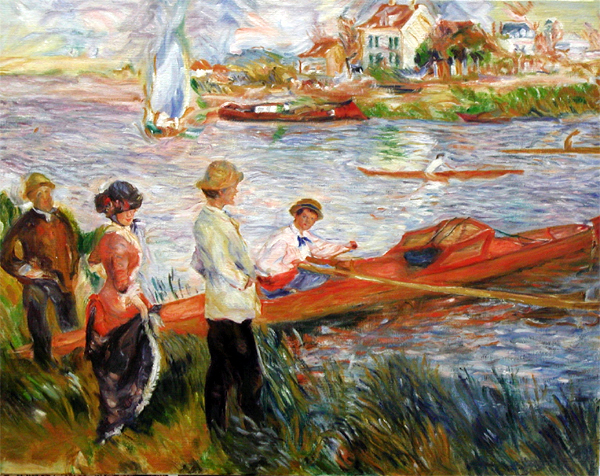
The Luncheon of the Boating Party


Yesterday Renoir’s Table arrived on my porch. It’s a truly beautiful book. Although it contains sixty recipes, I bought it for its inspiring photographs. Amid a well-written biography of Pierre-Auguste Renoir’s life the books collaborators Jean Bernard Naudin, Jean-Michel Charbonnier and Jacqueline Saulnier, have painstakingly recreated some of the settings of Renoir’s most famous paintings. The only thing missing is the people. The setting for the Luncheon of the Boating Party is there with all its details, but it’s as if the painting’s subjects have gone down to the dock to meet the canotiers.

Renoir’s Table flawlessly melds gastronomic details with a biographical sketch of Renoir’s life. The recipes created by Jacqueline Saulnier are well-researched dishes that Renoir might have enjoyed at the time. Because recipes found in this and Saulnier’s other books contain ingredients like goose fat, blanched calves-trotters, and boar’s heads; and amounts like 14 ounces of this and 1lb. 10 ounces of that, I end up never actually following the recipes, but instead being inspired by them. Though I have to say that the Empress Rice Pudding with candied fruit looks fairly tempting and easy…

I have the honour to possess other books compiled by various combinations of these talented collaborators. Toulouse-Lautrec’s Table and Monet’s Table are equally beautiful books and because Toulouse-Lautrec really liked to cook and the recipes found in Monet’s Table are from his personal cook’s recipe book, the recipes ring a little more true.

A work of historical fiction, The Luncheon of the Boating Party, by Susan Vreeland, published by Penguin was a Christmas present. Susan Vreeland's novel centres on famous French Impressionists and their work but specifically, Renoir’s the Luncheon of the Boating Party painted in 1881. I’m not very far into the book, but the research Vreeland has done retracing Renoir's steps while creating this painting and the research into the details of French café society sound like she probably had a lot of fun. This kind of avocation is right up my alley and I envy Vreeland. Despite her dedication I find the narrative sophomoric and strained.

A few years ago I read Renoir, My Father written by Jean Renoir, his movie-producing son. I devoured that book and at that time found out a lot about the Luncheon of the Boating Party, known in French as the Le Déjeuner des Canotiers. One fact being that the seated man in the singlet is famous Impressionist promoter and painter Gustave Caillebotte.

Inquisitive by nature, while at the Toronto Reference Library, I happened upon a Paris City Directory for 1912. I found Renoir’s address on Boulevard de Rochechouart and phone number. How cool is that! I also found Colette and Picasso, but that is for another time.

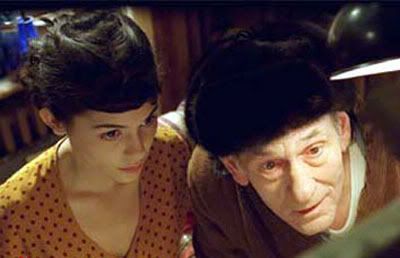
While The Luncheon of the Boating Party is a very famous painting and I seem to have known it all my life, it was the Glass Man in Jean-Pierre Jeunet’s Amelie that whimsically brought it into my circle of consciousness again. The Glass Man meticulously recreates the picture every year, but cannot seem to capture the essence of the one drinking girl until Amelie comes into his life.

The Luncheon of the Boating Party captures the essence of what my own private Paris is.

Thursday, January 8, 2009

Dance Me to the End of Love.....


Two different cover versions of Leonard Cohen’s 1984 song Hallelujah were topping the charts in England over the Christmas Holidays.
Alexandra Burke covered the song on an “Idol”–type TV show called the X-Factor overseen by American Idol’s Simon Cowell. Despite the fact that Leonard Cohen will earn a hefty royalty from sales and downloads of the single, the idea of “Hallelujah” being bandied upon on a TV talent show rubbed a lot of Leonard Cohen fans the wrong way.

Fans decided that they would rather hear Jeff Buckley’s 1994 version and used Facebook and MySpace, to promote mass downloading of Buckley’s Hallelujah.

Leonard Cohen wins either way. The popularity of the song has helped the 74-year-old singer-songwriter to overcome his financial troubles of recent years.

I received a CD this Christmas by another artist who covers Leonard Cohen. Madeleine Peyroux purrs like Billie Holliday in the studio and does an excellent cover version of Cohen’s Dance Me to the End of Love on the 2004 release Careless Love.

34-year-old Madeleine Peyroux was born in Georgia but lived in Paris during the formative years of 13 to 22. Gee why didn’t my parents think of that?!

Listening to Peyroux feels like toast and honey under a warm blanket. Madeleine has an amazing, sultry voice, wavering between happiness and sadness. On one track she performs “I’ll Look Around” a song originally sung by Billie Holliday. Peyroux manages to make both joy and heartbreak sound so good.

The CD was produced by Larry Klein, Joni Mitchell’s ex. Madeleine Peyroux also does a great version of Bob Dylan’s "You’re Gonna Make Me Lonesome When You Go".This is probably the main reason I got the CD for Christmas. My husband is a huge Bob Dylan fan.


Dance me to your beauty with a burning violin
Dance me through the panic 'til I'm gathered safely in
Lift me like an olive branch and be my homeward dove
Dance me to the end of love

Oh let me see your beauty when the witnesses are gone
Let me feel you moving like they do in Babylon
Show me slowly what I only know the limits of
Dance me to the end of love

Dance me to the wedding now, dance me on and on
Dance me very tenderly and dance me very long
We're both of us beneath our love, we're both of us above
Dance me to the end of love

Dance me to the children who are asking to be born
Dance me through the curtains that our kisses have outworn
Raise a tent of shelter now, though every thread is torn
Dance me to the end of love

Dance me to your beauty with a burning violin
Dance me through the panic till I'm gathered safely in
Touch me with your naked hand or touch me with your glove
Dance me to the end of love

"Hallelujah" - Leonard Cohen

Now I've heard there was a secret chord
That David played, and it pleased the Lord
But you don't really care for music, do you?
It goes like this
The fourth, the fifth
The minor fall, the major lift
The baffled king composing Hallelujah
Hallelujah
Hallelujah
Hallelujah
Hallelujah

Your faith was strong but you needed proof
You saw her bathing on the roof
Her beauty and the moonlight overthrew you
She tied you
To a kitchen chair
She broke your throne, and she cut your hair
And from your lips she drew the Hallelujah

Baby I have been here before
I know this room, I've walked this floor
I used to live alone before I knew you.
I've seen your flag on the marble arch
Love is not a victory march
It's a cold and it's a broken Hallelujah

Hallelujah, Hallelujah

There was a time you let me know
What's really going on below
But now you never show it to me, do you?
And remember when I moved in you
The holy dove was moving too
And every breath we drew was Hallelujah

Hallelujah, Hallelujah

You say I took the name in vain
I don't even know the name
But if I did, well really, what's it to you?
There's a blaze of light
In every word
It doesn't matter which you heard
The holy or the broken Hallelujah

Hallelujah, Hallelujah

I did my best, it wasn't much
I couldn't feel, so I tried to touch
I've told the truth, I didn't come to fool you
And even though
It all went wrong
I'll stand before the Lord of Song
With nothing on my tongue but Hallelujah

Hallelujah, Hallelujah
Hallelujah

Tuesday, January 6, 2009

Meersburg - Part 3


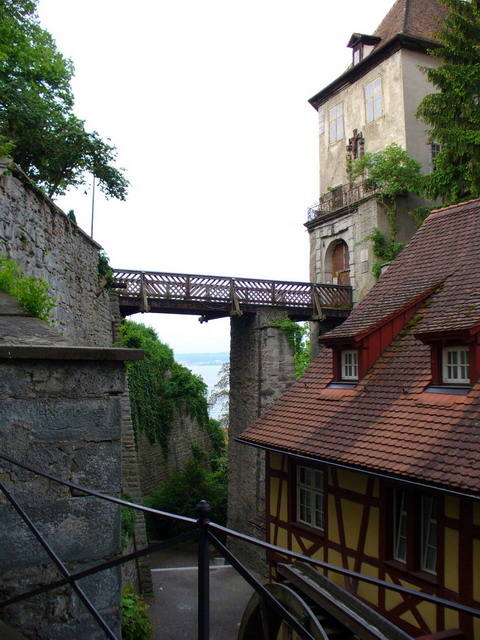
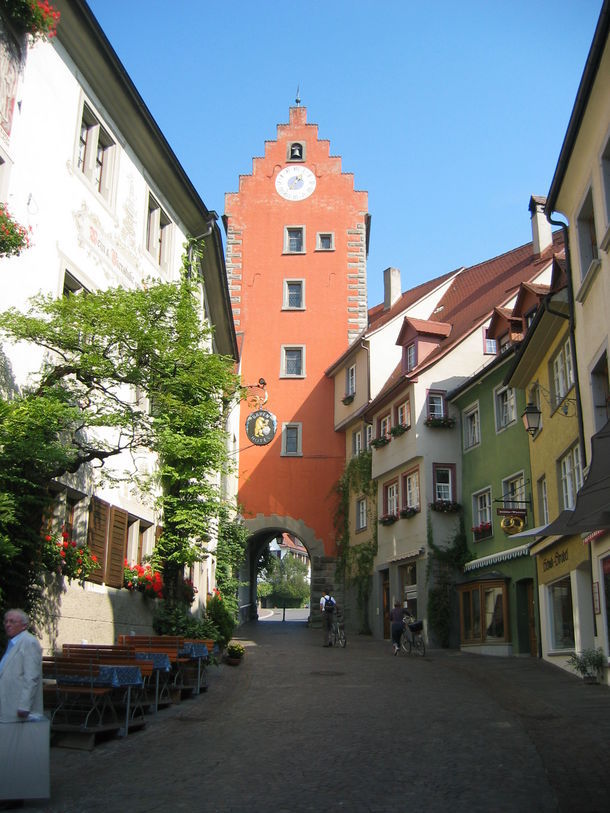
To the north of the Meersburg's Schlossplatz lies the Marktplatz, with attractive half-timbered buildings and the eye-catching Obertor or Upper Gate built between 1300-30 stuccoed in bright orange. Some of Meersburg's prettiest hotels are located in this part of the upper town including the Gasthof Zum Bären circa 1605 where we were booked, with its pretty oriel windows and plaster mural of bears, hence "Bären".

Chef/Owner Michael Gilowsky oversees the Zum Bären and its traditional dining room where we enjoyed the best meal of our trip. To drink, we had a white wine from the Bodensee's own vineyards. One of Mr. Gilosky's waitresses asked me if I knew the English for the Eierlikör or Egg-Liqueur sauce that my fried banana was floating in. I suggested "custard" but the alcoholic content led me to believe I was mistaken. Egg-Liqueur was just fine. Noah had his first schnitzel here, which he enjoyed almost as much has his spaghetti ice cream.

Northwest of the Marktplatz, behind the Gasthof Zum Bären is a former Dominican convent now occupied by the Bible Gallery, the Municipal Library and the Municipal Museum. But we'll have to save that for another time.

Next morning the weather had cleared. When I pushed open the window of our room at the Zum Bären, I was overlooking the heads of the vendors at Meersburg's Saturday market. Bright and early, merchants were selling meat, fish, and vegetables plus honey and candles.

While taking the cobblestone Steigstrasse towards the ferry dock, George braced himself, walked into a stationery shop and asked, in German, for a print of Meersburg's Old Castle. An attractive link between the upper and lower towns, Steigstrasse is lined with colourful houses and cafes. Various walls lining this steep street are adorned with gargoyles, some old and some new, and each business has an ornate wrought iron sign dangling over its door.

After walking around Meersburg's lower town and peering at the menus of its many restaurants, we sauntered unceremoniously onto the 11 o'clock ferry for Konstanz. With the balmy wind in our faces we watched Germany and the old castle receding and we wished we'd stayed longer. We'll be back.

The Gasthof Zum Bären located at Marktplatz 11 has a German only website at http://www.baeren-meersburg.de/. Tel.: 07532 - 43220 Fax: 07532 - 432244
email:
post@baeren-meersburg.de

Double rooms start at 82 Euros and go to 108 Euros

Meersburg - part 2


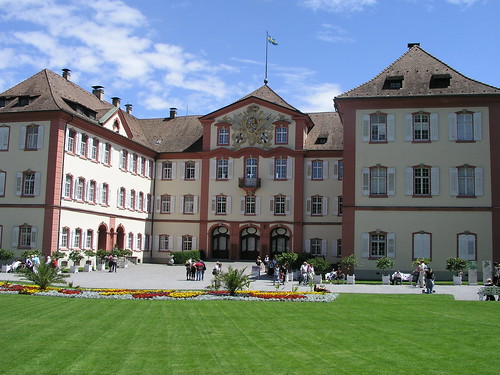
Just east of the Altes Schloss's drawbridge, the pink Neues (New) Schloss overlooks the Meersburg's lower town. Built in 1710 as the baroque residence of Prince Johann Franz Schenk von Stauffenberg, the new castle includes the Prince Bishops' residence, complete with outstanding ceiling murals and exquisite plasterwork creations. The City Gallery (Städtische Galerie)is found on site.

Located on the 1st floor, the gallery shows works of artists who established themselves in Meersburg in the 1920s and 30s and features Hans Dieter, Waldemar Flaig and Kasia von Szadurska. Paintings features Meersburg and Lake Constance motifs are also featured.

As Noah explored the Neue Schloss's neatly trimmed pattern of gardens, George and I gazed over the terrace toward Switzerland and the island of Mainau in the middle-distance. A short ferry-ride to the south, Mainau is a privately owned island paradise. However the Swedish Count and Countess Bernadotte welcome visitors to their exotic and unexpectedly tropical island.

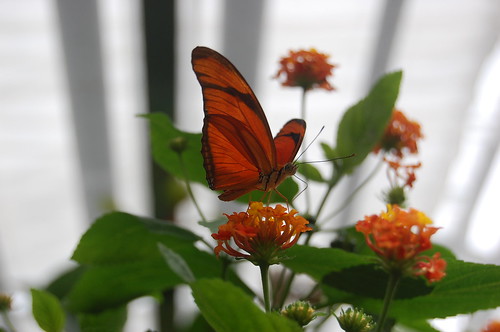
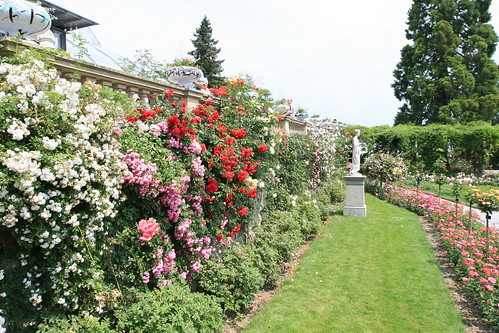
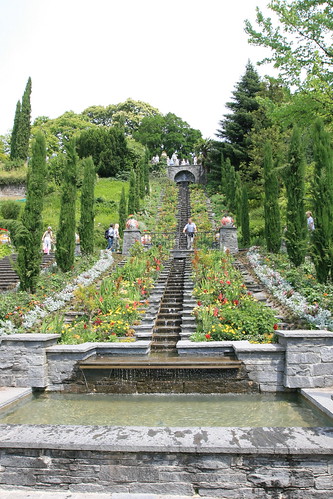
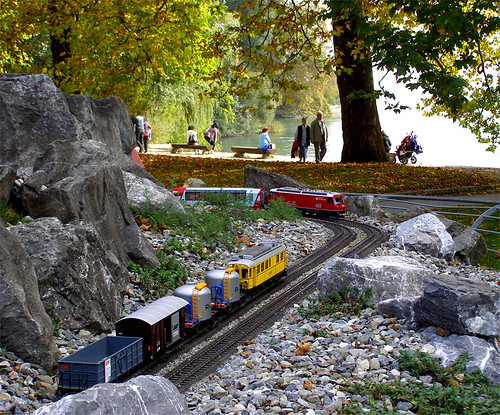
Throughout the unique microclimate of the Insel Mainau paths lead to a butterfly house, a vineyard, a rose garden and an arboretum. Palm trees and oranges grow here. In addition to the island's many fountains is an impressive Italianate garden with a water staircase. Kids have an area to themselves with pony rides and a model railway. At the heart of Mainau is its baroque castle and adjoining church. There are at least half a dozen places to eat, from fine dining in the Chestnut Garden, to a snack at the Butterfly Bistro or just a beer on one of the terraces.

Back on the mainland, across the cobbles of the Schlossplatz is the esoteric yet compelling Zeppelin Museum. Overseen by a hovering bee of an attendant this private museum has 15,000 artifacts relating to airships. Collector Heinz Urban has amassed a huge personal collection of zeppelin relics including uniforms, girders, gauges and models. In fact Count Ferdinand von Zeppelin was born just across the Bodensee in Konstanz. Noah, a big fan of ironic tragedy, was impressed to see the melted cutlery from the Hindenburg. Oh the humanity! Our trip through the small museum was prefaced by an in-depth, German only, video.

If you go:

The Meersburg Zeppelin Museum is located at Schlossplatz 8. March until the middle of November its open from 10:00 a.m until 6:00 p.m. Admission is Adults 3 Euros, children 2 Euros. An informative website is found at www.zeppelin-kurier.de

The Gallery in the Neues Schloss is open every day from 10:00 am to 1:00pm and 2:00 until 6:00 pm. from April to October. Adults are 4 Euros and Children 1 Euro.


The Island of Mainau is open all year round. Family tickets are available Adults are 12.90 Euros, children 4.50 Euros. More information can be found at www.mainau.de

Meersburg - Germany's Oldest Inhabited Castle


The wind howled behind us as the three of us advanced through the dining hall of the old castle. Shivering, we rushed past the ancient windows as arrows of rain lashed the metre thick walls.

Manoeuvring past the sword-wielding sentries, we made it past the oubliette; the pit from where no man returns. The rain needled our faces as we ran down the ancient flagged stairs only to find ourselves in the romantic teashop on the terrace.

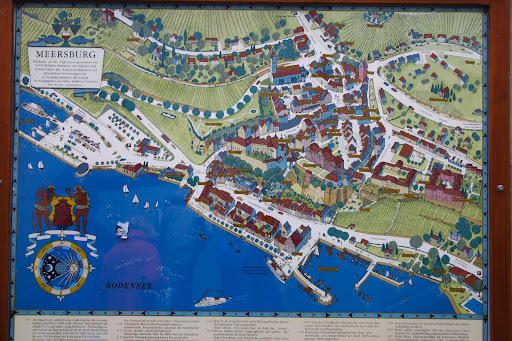
The teashop of the Altes Schloss Meersburg was closed that day but thankfully not the rest of the castle. Altes Schloss or Old Castle Meersburg eponymously dominates the town of Meersburg, a medieval German village of 5,500 situated on the northern shore of the Bodensee in the state of Baden-Württemberg; a short ferry ride from where Germany and Switzerland hold hands in Konstanz.

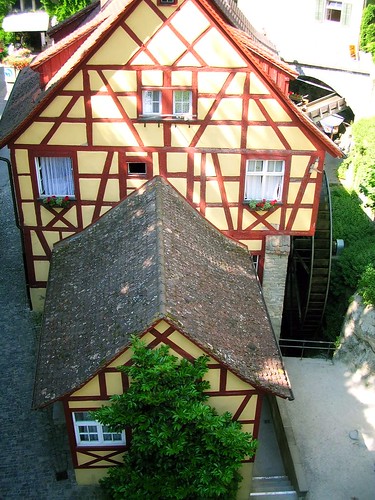
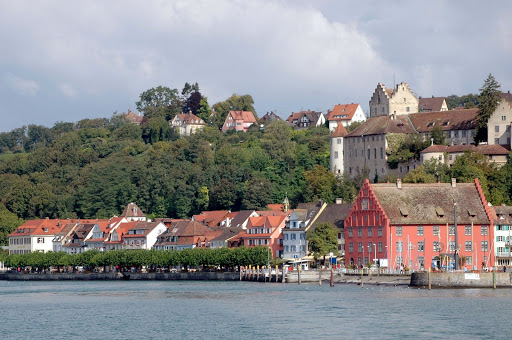
Meersburg is picturesquely situated on a steeply sloping hillside, with an upper town and a lower town. With its paint box colours and winding lanes Meersburg is a gem of medieval architecture.

While medieval in appearance, Meersburg has the air of a seaside town. An abundance of small hotels and restaurants line the Seepromenade, Meersburg's own little stretch of the Bodensee. Tethered yachts jostle in the waters known alternately as Lake Constance. Switzerland is clearly seen just 5km away.

Less than an hour earlier my husband George, my then 9-year-old Noah and I madly dashed to catch the bus departing hourly from the train station of nearby Friedrichshafen. Sitting cheek by jowl with a busload of gum-cracking German students I hadn't much hope for Meersburg.

The milk-run took a somewhat suburban route. But the 14th century lay just beyond the clock tower where the bus ambled to a halt. Despite the stinging rain and increasing wind, our spirits were buoyed by at the sight of the pretty town revealed within.

Resolving to shoehorn as much as we could into the allotted afternoon we headed across the drawbridge to the castle.

Schloss Meersburg known also as Burg Meersburg is Germany's oldest inhabited castle, founded in 628 by King Dagobert, the king of the Franks. With guide in hand we navigated chronologically through the thirty furnished rooms that gave us a taste of castle life from the 7th to the 19th century.

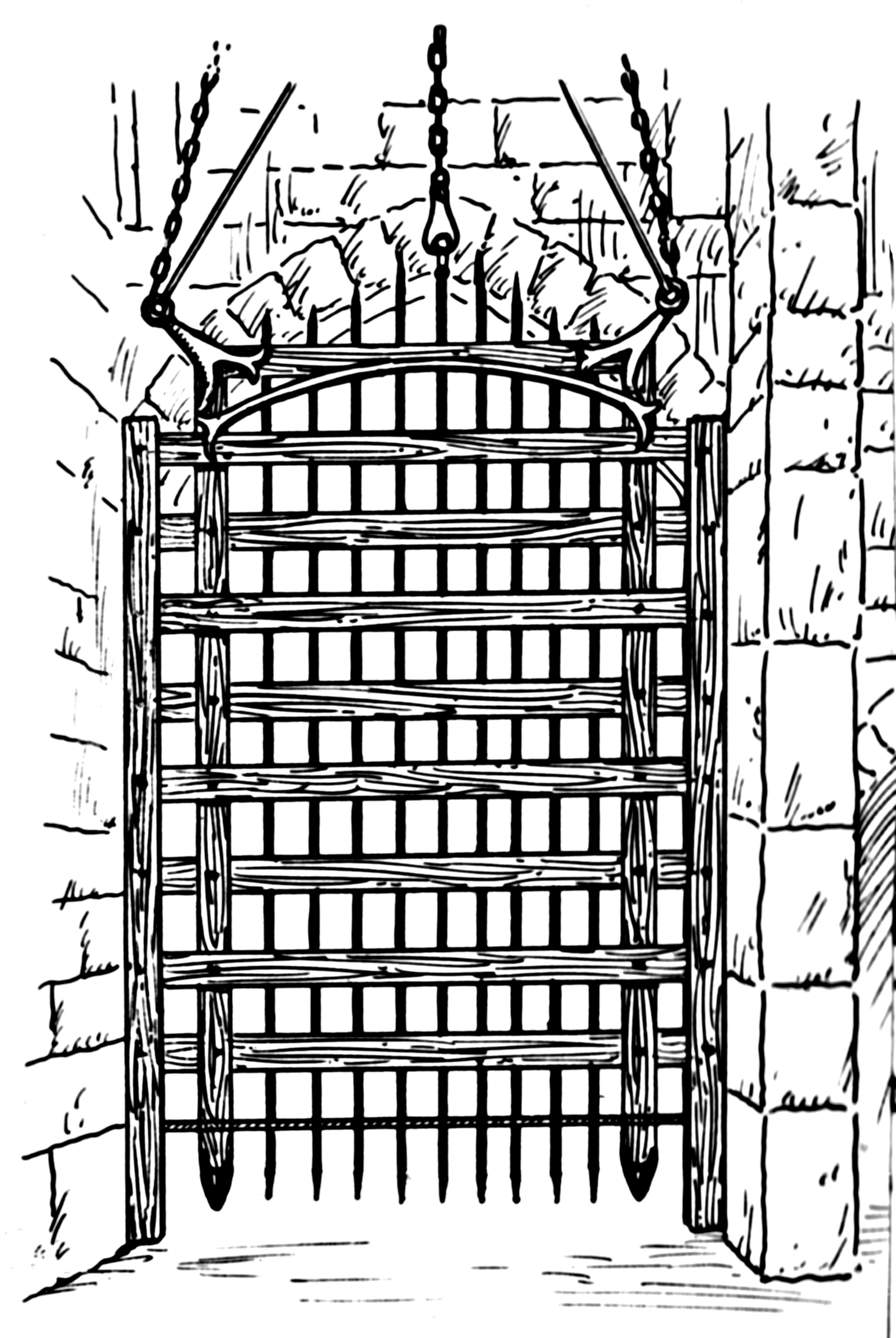
Once over the drawbridge and under the castle's yawning portcullis we weaved throughout the five towers of the ancient bastion like Dumas' Musketeers or Robin Hood's Merry Men. The spear-wielding sentinels are silent but the relics of a bloodier age are here, armour, helmets, axes and clubs. Piles of large stones are roughly stacked inside the windows, a reminder of when the enemy could have been brained by a well-aimed rock.

Moving cautiously amid the heavy timberwork we found the castle's kitchen with its fireplace big enough to sleep four. Of interest to Mum was the kitchen's stone sink that drained out a window about 25m above the ground.

The three of us peered down into the goose-bump inducing depths of well-like pit where prisoners were left to die. Noah surmised that there must have been a trapdoor for food. I don't think it was a consideration.

The more ancient of the castle's chambers were rudimentarily furnished with a smattering of rough-hewn benches and refectory tables. Deer pelts placed on the deep windowsills were the only attempt at providing warmth. More sumptuous were the rooms once occupied by the 17th century Prince Bishops and by the resident poet who lived and died here in the 19th century.

During her visits to Meersburg, revered German poet Annette von Droste-Hülshoff stayed in the Old Castle, which in the 1840's belonged to her brother-in-law. In the Altes Schloss Meersburg Droste-Hülshoff's study and the room she in which she died are open to visitors.

If you go:
The town of Meersburg has a website www.meersburg.de
Visitor Information: Meersburg Tourist Office is located at Kirchstrasse 4 (tel. 07532/440400) and is open Monday to Friday 9am to 12pm and 2pm to 4:30.

Zurich is the nearest international airport 80km (49 miles) away.

Meersburg is reached from Switzerland in the south by ferry that departs Konstanz every 15 minutes during the day. The trip takes 15 minutes.
www.sw.konstanz.de/verkehr/faehre/fahrplan_eng.htm

By Bus: Meersburg is not served by train. The nearest rail stations are in Überlingen 14km (9 miles) away, or in Friedrichshafen 17.5km (11 miles). From Friedrichshafen station, buses depart for Meersburg at 30-minute intervals. Buses display number 7395 on the front.

By Car -- Meersburg can be accessed by car via the E54 from Überlingen or Friedrichshafen or from the North via Highway 33.

Altes Schloss Meersburg is located at Schlossplatz 10. Tel.: 07532 / 80000
March to October its open 9.00 - 6:30, November to February 10.00 - 6.00. Admission is 8.50 Euros for adults, 5.50 Euros for children

Monday, January 5, 2009

The Mysterious Case of the Broom in the Night or The France and Belgium Adventure


Names have not been changed to protect the innocent.

After dashing from platform to platform following the much-anticipated clack-clack-clack of the Gare du Nord's electronic timetable, George and I found ourselves sitting in a first-class compartment facing the overnight trip to Holland with a couple named Fred and Lucy.

Fred and Lucy were from Australia. He was a hearty-looking retired fireman. She - waspish and somewhat sinister. He talked incessantly. She said nothing. They had just arrived on the continent from the Firefighter's Olympics in California. Why they were on the train headed from Paris to Amsterdam, I don't remember.

Just before the train departed we were joined by a plain, squat, 19-year old girl named France. Fred commented on the appropriateness of her name. We agreed.

Her father was there to settle her in. France shyly told us how she was starting a new job in Brussels and was moving into her first apartment. We cooed our congratulations and wished her all the best. For a flat-warming present, her dad had given her a new broom, which she placed on the rack above her seat. An odd and clumsy present to travel with, I thought. But as France had a new place to clean, suitable nonetheless.

After a few pleasantries and some peppermints that Fred supplied, George and I extended our seat bottoms, tucked our money pouches around our necks and slept with our feet around each other. Fred and Lucy did the same. France slept upright with her chin lolling on her chest.

Usually a light sleeper, my night's rest was punctuated only by the sound of France's departure as she slid out into the dark corridor and the dawn of her new Belgian life and by the occasional volley of farts coming from Fred's direction.

As the train moved slowly and steadily through the dismal lowlands, we woke to find the back half of the train was gone. So were 900 of Lucy's American dollars. After winning it in Vegas she had wrapped the cash in tissue (why?...)and placed it in her camera bag; the camera bag that was found lying violated in the empty compartment behind us.

After a futile search for Lucy's cash and much satisfied patting of our own secure money pouches, I turned my mind to solving the mystery. The crime baffled me. A dozen potboiler scenarios ran through my head. Sherlock Holmes was famous for asserting, "When we have eliminated everything else, whatever remains, no matter how incredible, must be the truth" I hadn't taken it. Neither had George. Lucy and Fred wouldn't steal from each other. Or would they....? Had someone else entered the compartment?

Lucy looked over at me and said peevishly "We'll never see that money again, WILL WE?"

"It doesn't look that way, does it?" I replied. And with that it occurred to me that Lucy thought we had stolen it. Now nervous, I tacitly feared that Fred and Lucy were trying to frame us for the job and wanted us to either 'fess up or ante up.

Although we had agreed to help Fred and Lucy place a report with the Dutch police upon arrival, I felt virtually dragged by the ear like a naughty child throughout the station's concourse.

The four of us hurried through Centraal Station as best we could with our unsuitable suitcases. George was the only sensible packer among us. Fred's solid-sided Samsonite couldn’t be raised more that an inch off the floor. In his rush,he dropped his murderously heavy case down the full length of the escalator. If it had popped open and a half a dozen bowling balls and nine hundred dollars had popped out I wouldn't have been surprised.

At the "politie bureau" the cops asked us why we were there as well. They gave us the once-over and much to Fred's chagrin they dismissed us. Upon our departure, Fred asked for our phone number and address. Swiftly, George offered his work address. Back in Sydney, Fred and Lucy think we live at the corner of Queen and Bay.

A few minutes later while breathing somewhat easier in the queue at the tourist office, an ironic and frequent announcement warned us to "keep our belongings near as pickpockets abound".

Back home it took me a while to solve the case; embarrassing for an avid Sherlock Holmes buff. Apple-cheeked France, young and full of promise was a crook, a phoney. A scheming, pre-meditative thief. When we were lulled by the rhythm of the rails, she had taken the tool of her trade, her broom, and used it to lever Lucy's camera bag down.

Quietly and quickly she identified the bag with the cash. Confident that none of us would wake, France had ransacked Lucy's camera bag, and disappeared along with the money, her broom and the back half of the train. She made a clean sweep.

Cherchez la femme with the broom.

Sunday, January 4, 2009

The Name Game

A while back I found online name analysis courtesy of a Kalabrian Philosophy website. http://www.kabalarians.com/cfm/menu-BriefAnalysis.cfm.

I found it to be so spot on for me and my friends and family that I thought I should share it.

Why don't you have a go?

Here's mine:

Your first name of Hazel has given you a rather quiet, reserved, serious, studious nature. You have sensitivity and appreciation for the finer and deeper things of life, the beauties of nature, music, art, and literature. The people who mean the most to you are those who can offer you intellectual companionship. It is only when you are among those who understand your deeper nature that you can really be yourself. The experience of having your remarks taken lightly or belittled, particularly during the early years of your life, has caused you to keep your thoughts and feelings to yourself. You do not express yourself spontaneously when conversing with others; hence other people may often regard you as being aloof, and even unfriendly. Your difficulty in putting your deeper thoughts and feelings into words can lead to problems in more intimate associations. This name has caused you to live much within yourself. You are rather easily hurt or offended. At such times you can withdraw into a mood, and may not even speak to others. Aside from these points, this name contains many fine qualities. You are a thoughtful, analytical person, and you know your own mind, even though you may not speak it. You are very conscientious and competent in all that you do. You take seriously any responsibilities that you have--in the home, in the community, or at the job. Worry and mental depression could be problems in your life. Physically, any weaknesses in your health would centre in the heart, lungs, or bronchial organs.


In other words - Crunchy on the outside, with a chewy centre.

The Boyd Gang: Toronto Outlaws - continued


Hours before Lennie Jackson and Steve Suchan were to be brought to court to answer for Detective Tong’s murder, the Boyd Gang staged a second dramatic escape that made them the most wanted men in the Canada.

Just before dawn on September 8, 1952, the four slipped out through the bars onto a wall. To their horror, there was a cop stationed at the base of the wall. They lay on the top of the wall for a few minutes watching the cop and wondering what to do next. Unexpectedly, the officer walked across the lane and entered the nearby Riverdale Hospital. It didn't take them long to drop to the ground and disappear down the hill into the wilds of the Don Valley.

Once again a huge manhunt ensued. The reward for information leading to the gang's capture hit $26,000 causing hundreds of phone calls and letters to the police. They were holed up in an old barn near Yonge and Sheppard Streets. They were spotted many times. Most people thought they were just hobo's seeking shelter, but some became suspicious and called police.

On September 16, 1952 police closed in on the barn and surprised the gang. They were arrested without incident and returned to the familiar Don Jail. They would never escape jail again.

Steve Suchan and Lennie Jackson were hanged in Dec. 1952, while Boyd and Willie Jackson were sent to Kingston Penitentiary. Boyd was sentenced to eight life terms, but he was paroled for good behavior in 1966. He lived quietly under an assumed name in British Columbia. Edwin Alonzo Boyd died quietly at age 88 on May 17, 2002.

Vocabulary:

Incriminating evidence: the objects or information, (clues) that make someone appear guilty.
Cell Block: a group of cells forming a unit in a prison
Parole: the early release of a prisoner, with conditions such as good behavior and regular reporting to the authorities applying for a stated period of time
Assumed Name: a false name, especially one used by somebody doing something illegal

Friday, January 2, 2009

The Boyd Gang: Toronto's Outlaws - part 1


Daring Edwin Alonzo Boyd and his gang burst onto the front pages of Toronto newspapers due to a series of well-executed bank robberies and two breakouts from Toronto's Don Jail.

Boyd's swashbuckling style of hopping bank counters and lightning fast hold-ups riveted Toronto residents. The Boyd Gang's reign as Canada's most notorious crooks was relatively short but their escapades nearly made them local heroes until two of the members ruthlessly shot down two detectives, killing one.

Boyd was the son of a police-officer. With his face plastered with make-up and cotton stuffed in his cheeks to disguise his appearance, he robbed his first bank in September 1949. He escaped with the loot even though the bank manager shot at him as he fled.

To see how well his disguise had worked, a few days later, he walked into the same bank and changed a twenty dollar bill with the teller he'd robbed. Since he wasn't recognized he decided to sharpen his skills and become a full time bank robber.

Boyd continued robbing banks, sometimes with his a partner, sometimes solo. At one robbery the bank manager grabbed a gun from a desk drawer and popped off a few shots at Boyd who returned fire. He had no choice but to turn and run without the money. Another time, Boyd was chased in his car by a bank employee, barely escaping.

Edwin Alonzo Boyd went on to hold up several more banks until his first capture in October 1951. His luck ran out on his last attempt. Everything went wrong. His partner was caught and squealed on him. He was soon behind the iron bars of the infamous Don Jail.

At the Don Jail, Boyd made friends with another bank robber, “Tough" Lennie” Jackson and a small-time crook, Willie “the clown” Jackson. The three hatched a sensational escape plan, added Steve Suchan to their ranks, and the legend of the Boyd Gang was born.

Lennie Jackson had a wooden foot. It came in handy to hide things, like hacksaw blades. The three of them used the concealed blades to saw through the bars on an outside window. On November 4, 1951, the three slid through the opening and dropped to the prisoner's exercise yard below. Lassoing the top of a surrounding wall with some tied bed sheets they climbed to freedom.

Steve Suchan had arranged a hide-out in Cabbagetown that they could reach quickly. Realizing they would need money to keep in-hiding for a while, they pulled off the biggest hold-up in Toronto's history.

After splitting the stolen money, Lennie Jackson and Steve Suchan left for Montreal and Edwin Boyd and Willie Jackson hid at Suchan's parents in the west end of Toronto.

After Suchan's father stole most of the loot out from under them, the rest of the gang headed to Montreal and there they lived until Willie Jackson was returned to the Toronto Jail after being arrested for possessing a gun. The rest of the gang then drifted back to Toronto.

On March 6, 1952, Police Detectives Edmund Tong and Roy Perry pulled over a black car containing Suchan and Lennie Jackson. As Police Officer Tong approached the vehicle, he was gunned down and fell to the ground in a heap. They then peppered the police car with bullets. Perry was wounded in the arm, but Tong was to die several days later, but not before naming his killer, "Suchan."

The relentless manhunt was on. Suchan and Jackson who had escaped to Montreal were captured after a lengthy shoot-out. Though he had nothing to do with the shooting, Boyd felt the pressure. Boyd was the only gang member left to be captured.
Detective Payne discovered that Edwin Boyd was to move into an apartment he had rented on Heath Street. Hidden in a neighbour's house, Detective Payne watched Boyd move into the flat. Wanting to avoid a shootout, he waited until he was sure everyone was asleep. At the crack of dawn the police crept inside the house and captured Boyd and his wife while they were still in bed.

Boyd was once again a resident of the Don Jail and, incredibly, was put back with the other three gang members. With some metal, a file and saw blades, they were able to make a workable copy of one of the guard's keys. They could now get out of their cells in order to saw through some bars leading to freedom.

Just hours before Lennie Jackson and Steve Suchan were to be brought to court to answer for Detective Tong’s murder, the Boyd Gang staged a second dramatic escape that made them the most wanted men in the Canada.


Find out what happens to Toronto's outlaws in an upcoming entry.

Thursday, January 1, 2009


I found Nemo!!!


"My friend drowned in a bowl of granola. He was pulled in by a strong currant."


Q: What do you call a fish with no eyes?

A: A fsh.